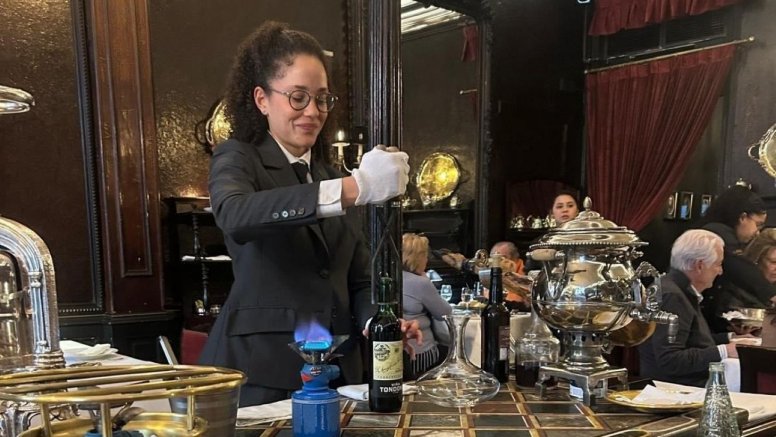
The experience in a restaurant not only depends on the quality and offering of its dishes, but also on the service they provide to customers, the treatment, and the drinks, a fundamental part. This is where the talent and experience of sommeliers come into play, those professionals whose objective is to enrich the customer experience through pairing, that is, the combination of drink and food. One of these sommeliers is Diana Luque (Arrecife, 1993), a woman from Lanzarote who works at Lhardy, one of the first haute cuisine restaurants founded in Madrid in 1839.
Luque decided to become a sommelier after meeting someone in the La Estación neighborhood who told her about this world. Therefore, she decided to move to Madrid and take the sommelier training at the Chamber of Commerce for a year. After finishing her studies, she began working in another high-level restaurant. As a result of that job, she began to delve into this world and meet more people, which led her to send her resume to Lhardy and be hired to work there.
To dedicate herself to this profession, the woman from Lanzarote acknowledges that all you need is "the desire to learn and to like hospitality," but above all, "the desire to keep learning and to like the world of wine because in the end, it is very entertaining, fun, and you always have something to study."
Her work focuses on attending to customers and advising them on the choice of drink in relation to the dishes they are going to taste. "When someone arrives at the restaurant, I try to guide them a little on the liquid part, from wine to non-alcoholic beverages," explains the sommelier. These non-alcoholic beverages can be coffee, tea, or kombucha, as "we should not normalize that everyone wants something with alcohol."
"Some people let themselves be advised, but there are other people who already have their tastes and preferences clear, so they prefer to choose the wine or any other drink themselves," she continues.
Interaction with the customer
As a sommelier, Luque's work focuses on attending to the customer as soon as they sit down at the table. "From the moment they sit down, you can go to the table in case the customer is going to want an aperitif or wants to start with a glass of champagne, a cocktail, or a Sherry wine," she points out.
However, this interaction "depends on how the lounge area is, but we try to go from the beginning so that the customer has our figure located and whether they want our help or not."
Regarding Lanzarote wines, the sommelier acknowledges that "it is more common to see wines from Gran Canaria or Tenerife." Although there are Canarian wines on her menu, the young woman indicates that the suggestions "depend on what the client wants because you can't recommend everything to everyone."
"You need to know what the client drinks, what they like, and so on, to start from that basis and know what to recommend because you can't recommend just anything to everyone," she continues.
Sharpening the sense of smell through experience
A sommelier sharpens their talent, palate, and sense of smell through experience, but also by "being in places with different references to continue learning and continue working with them."
"It is in practice where one learns the most; you can study all the paperwork, the regions, the producers, or varieties, but for me, it stays in my memory when I have already tasted that region or producer and know what profile of wine is made in that place," points out Diana Luque.
The world of wine is constantly evolving, whether due to the emergence of new grape varieties, wineries, or wines. "Even if you have tasted a lot of Rioja, there are new wineries emerging in La Rioja with different styles, and as I say, the more you study, the less you know," she indicates.
In the case of blind wine tastings, the expert acknowledges that "sometimes you can get it right and sometimes you can't." "You can get close because you rule things out, as you know what notes a Tempranillo has, for example," she assures.
Wine by the glass sales in decline in Lanzarote
Lanzarote wines stand out for their uniqueness, thanks, among other reasons, to the cultivation of vines in volcanic soil. In the case of volcanic malvasia, which is the predominant variety, Luque states that they are wines "with a lot of fruit, quite aromatic on the nose, very fresh, and with a lot of salinity."
Thus, she highlights that in the last ten years, Lanzarote wines "have changed their concept a lot." "When I lived in Lanzarote, wine from the island was often sold by the glass; now it's not," she assures.
Sales of wine by the glass, she says, "are being lost a lot," which is due to the increase in production costs and the raw material itself. "The price of the bottle is not in line with a wine that can be served by the glass, and people might not pay six euros for a glass of wine," she points out.
Regarding the reception of Lanzarote wines, Diana Luque points out that "for a wine to impress, it also has to be made with love and dedication, and it is not done that way in all areas."
And it is that good wine does not depend on the price, but rather that qualification should be given by each person individually. "Good wine is what you like, but something that really stuck with me that a communicator from Madrid said is that a good wine cannot cost less than five euros just for what a cork or a bottle can cost," she concludes.
Add La Voz de Lanzarote as a preferred Google source.
Stay informed with the latest current news.