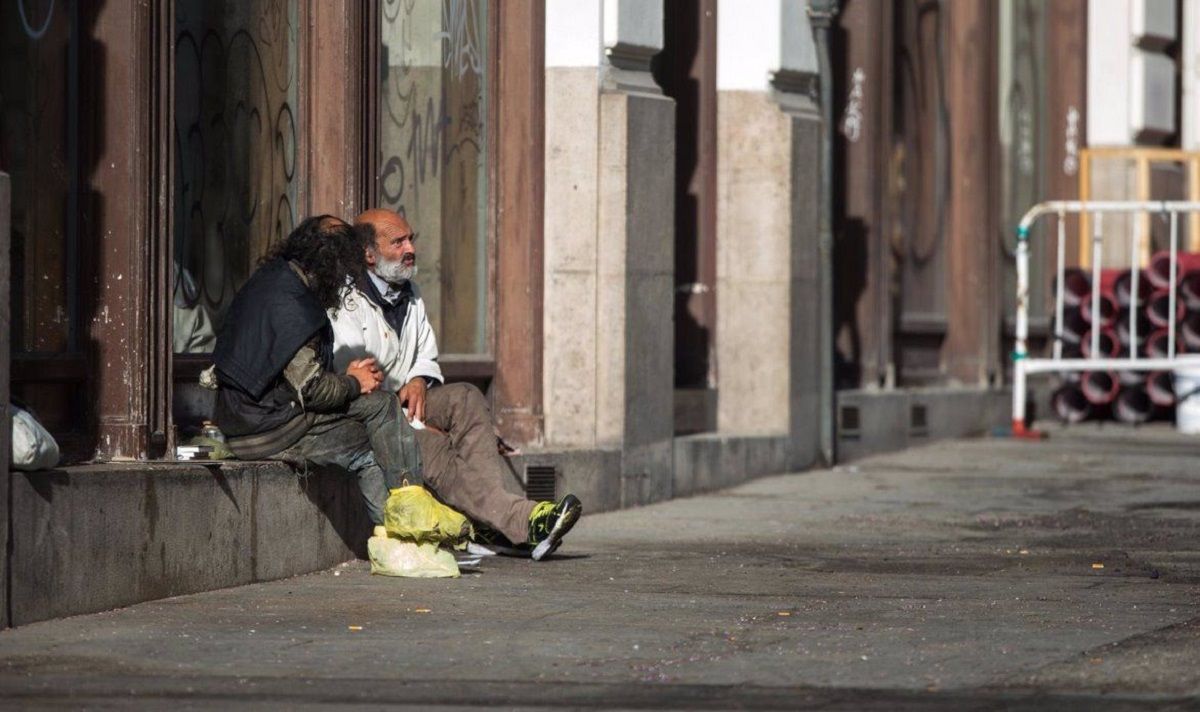
The Canary Islands leads the State in the figures for severe material deprivation - that is, "the poorest of the poor" - with 340,899 people, and is the third region with the highest number of inhabitants in poverty and exclusion, reaching 37.8% of the population, with 822,130 people.
Poverty and exclusion increased by 15,134 people in 2021 compared to 2015 (especially in women, children and adolescents) and 59.2% of Canarians have difficulties making ends meet, which, if it continues at this rate, will prevent achieving the goal of reducing poverty by half in the archipelago by 2030, and that the figure will be in a hypothetical 403,408 people.
These are part of the data from the XII Report "The state of poverty. Monitoring the European indicator (AROPE) of poverty and social exclusion in Spain 2008-2021", which was presented this Friday in the regional Parliament by representatives of the delegation in the Canary Islands of the European Network for the Fight against Poverty and Social Exclusion of the Canary Islands (EAPN).
Specifically, the report, which also monitors the indicators of the EU's 2030 Agenda between 2015-2021, has been presented by Juan Carlos Lorenzo, president of EAPN, and Fernando Rodríguez, vice president, who have stated that poverty has decreased by 1.3 points compared to last year, which translates into 29,329 fewer people in poverty and exclusion.
This decrease is due to the "social shield" measures and is "not something to be happy about", warned Fernando Rodríguez, because if decisions such as increasing the minimum wage and reinforcing the Canary Islands insertion benefit had not been made, poverty in the islands would have increased by 17.2 percent and 45 percent of the population would have been in a vulnerable situation.
According to EAPN, the measures adopted prevented 375,000 Canarians from falling into poverty after the pandemic.
Living on less than 454 euros per month
Fernando Rodríguez explained that for the AROPE report, the figures of people with an income of less than 681 euros per month are taken into account, for "severe" poverty, households with 454 euros per month and for the indicator of severe material and social deprivation, aspects such as the digital divide, not having healthy food, energy poverty, not being able to cope with unforeseen expenses or those derived from housing, such as rent and mortgage.
With 37.8 percent of the population in a situation of poverty and social exclusion, the Canary Islands is 10 points above the national average and in third position in this indicator, behind Andalusia and Extremadura.
The population sectors with the most poverty are women, who are affected by 39.2 percent, 2.7 points above men and "this year, as a curious fact, poverty among men has decreased by 5.2 points while female poverty has increased by 2.6 compared to the previous year", said Rodríguez.
Another relevant fact is that 49.1 percent of the population in a situation of poverty are under 18 years of age, that is, children and adolescents who live in poor households and who in the future, will probably end up being adults in the same situation. In the previous report, this indicator was 35.2 percent.
And poverty extends mainly in urban areas -39.4% of its population- compared to rural environments, which register a decrease in population.
"Salaries are really insufficient"
But where the Canary Islands leads the state figures is in relation to severe material and social deprivation, which affects 15.7% of the population and corresponds to those people who earn less than 454 euros per month, that is, "the poorest of the poor", stressed Fernando Rodríguez.
Also, 59.2% of the population has difficulties making ends meet due to precarious jobs, a situation of economic crisis and inflation that reveals that "salaries are really insufficient".
In addition, housing is beginning to be a condition of poverty because they are about to lose it or because they cannot access it, and again the Canary Islands is the first community in terms of delays in payments related to housing, which affects 26.2 percent of the population.
“There is a growth in the number of people who have fallen behind in the payment of expenses for their main home (from 23% to 26.2%), and among the group of people who cannot afford a meal of meat, chicken or fish every two days, which goes from 7.8% to 12.3%, an increase of more than 50% compared to last year”, said Fernando Rodríguez.
The Canary Islands also has the highest rate in the State with respect to the population with difficulties in accessing employment and which, with 21 percent, increased by six points compared to the previous report.
The islands are also the fourth community with the lowest income level and an average income per person of 10,161 euros, that is, 2,108 below the national average and a figure that, with respect to the Canary Islands, has only increased by 226 euros.
In summary, Fernando Rodríguez stated, if the Canary Islands were a member country of the EU, it would be the one with the highest poverty, above Romania, Bulgaria and Greece.
The president of the European Network for the Fight against Poverty and Social Exclusion of the Canary Islands, Juan Carlos Lorenzo, alluded to the "perverse" fact that people in vulnerable situations have to choose between their basic needs, whether to feed themselves adequately or live in a decent place, which affects their vital project.
There is an extreme polarization and the inequality gap is increasingly wide, so "we live in a fragmented society", lamented Lorenzo, to demand "a change of perspective" with European financing, the minimum living income and the future Canary Islands citizenship income, together with a new model of social services, so that there is a firm commitment in the islands to fight against poverty and social exclusion. EFE
Add La Voz de Lanzarote as a preferred Google source.
Stay informed with the latest current news.