Last September, the success of NASA's DART mission (double asteroid redirection test) was news around the world, the first "planetary defense" mission in the history of mankind, which managed to divert the trajectory of the asteroid "dimorphos", a small body 170 meters in diameter located about 11 million kilometers away from Earth.
The objective of the mission was twofold: on the one hand, to prove that existing technology is capable of sending a probe and crashing it into such a small object located so far away (equivalent to shooting a mosquito at 70 kilometers) and to prove that humanity has a defense system in case it is detected that an asteroid threatens to collide with our planet.
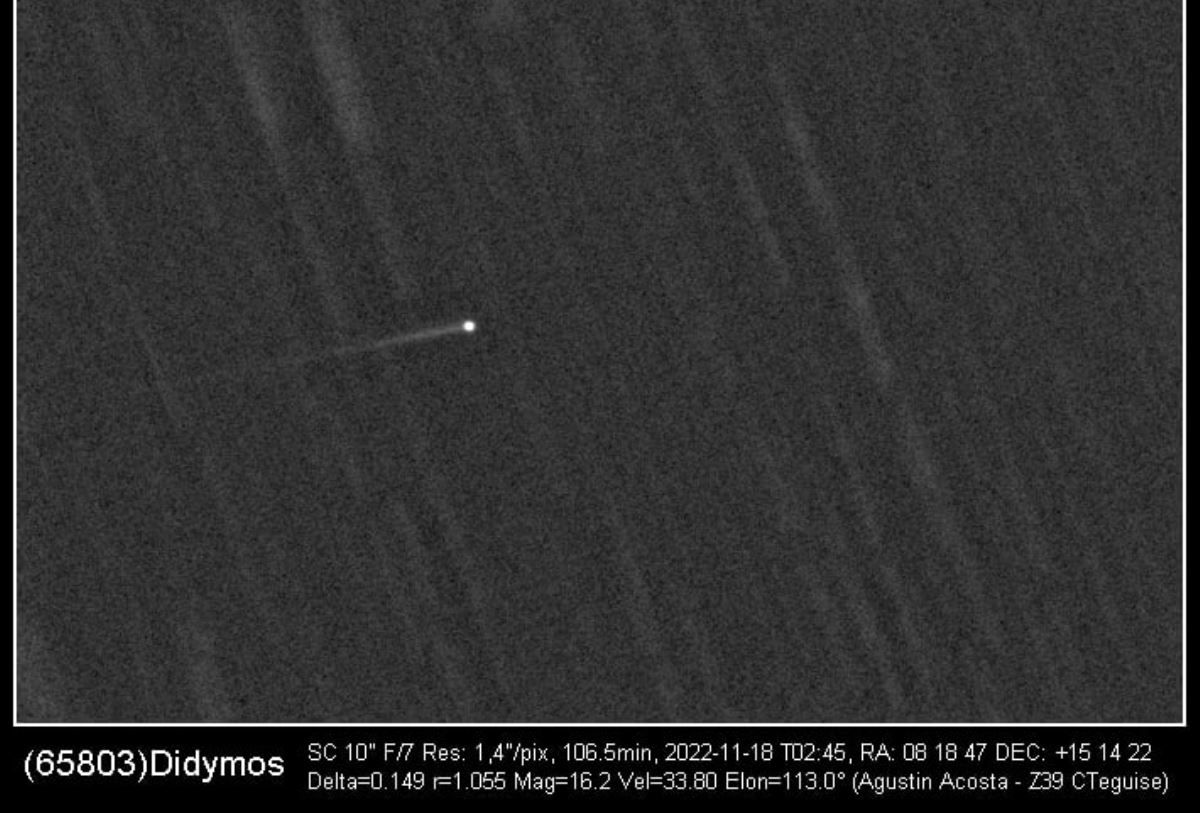
The impact of the DART probe against Dimorphos not only diverted the asteroid's orbit much more than had been estimated (25 times more than expected), which constitutes a resounding success of the mission, but also left a "debris cloud" more than 10,000 km long formed by the dust and rocks that were thrown off the surface of the asteroid after the impact.
Since then, the terrestrial observatories accredited by the Minor Planet Center (an organization dependent on the International Astronomical Union responsible for collecting observations and discoveries of asteroids and comets), formed by a thousand professional and amateur astronomers around the world, have been monitoring the asteroid to estimate its new orbit and the effects that the impact has generated on it.
Among the observatories accredited by the Minor Planet Center are two "amateur" observatories located on the island of Lanzarote: the "J47" observatory of Gustavo Muler (located in Nazaret) and the "Z39" observatory of Agustín Domingo Acosta (located in Costa Teguise), which have participated in monitoring the effects of the DART mission, taking multiple astrometric measurements and images of the object after the impact.
These are two observatories of amateur astronomers, but the precision of their astrometric and photometric measurements has allowed them to obtain official accreditation from the Minor Planet Center to participate in research, discovery and monitoring programs for asteroids and comets, as they achieve a precision equivalent to that of professional observatories.
The images that illustrate this information were taken on November 17 from Lanzarote by the Z39 observatory of Agustín Domingo Acosta, in which you can see the "debris tail" left by the impact of the DART probe on the asteroid Dimorphos, which extends more than ten thousand kilometers, as well as a detail of the core of the asteroid, the trajectory of the object and the cloud of debris that gives it an appearance similar to that of a comet.
Add La Voz de Lanzarote as a preferred Google source.
Stay informed with the latest current news.