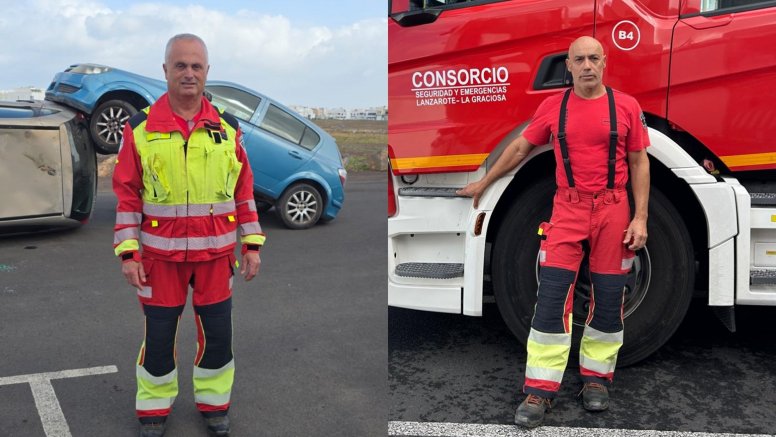
This year 2026, the Lanzarote firefighters Andrés Pérez (Haría, 1967) and Luis Perdomo (Tao, 1968) complete 35 years of service, the same number of years that the island's first Fire Station has. In these more than three decades, they have saved and aided thousands of people in traffic accidents, fires, or mountain rescues. Pérez and Perdomo belong to the first promotion of Lanzarote personnel, in which there were only twelve firefighters, unlike the fifty that the Emergency Consortium currently has.
Andrés Pérez looks forward to his retirement, which will arrive next September, after a life dedicated to being a firefighter. Although many workers eagerly welcome a well-deserved rest, in his case it is not so. "I'm not looking forward to it because I really like my job, I'm expectant because I'm used to having free time, so in principle I'm not afraid of not knowing what to do with my time, but I don't know to what extent I will miss my profession," he reflects in an interview with La Voz.
Pérez never considered being a firefighter, but being in compulsory military service he came on vacation to Lanzarote and saw that the deadline to apply for the firefighter opposition was open, so he decided to apply. "Finally I got in and I can say that I hit the lottery because I've been doing it for 35 years and I'm still comfortable," he emphasizes. And it is that on a personal level, the best thing the profession has given him is gratitude from the people he has helped. "They see you years later and recognize you, they tell you that I saved them in an accident or in a fire and that is priceless," he assures. In addition, the job offers him a great quality of life with the schedule, which allows him to spend a lot of time with his family.
In the case of Luis Perdomo, he will retire next year and he started as a firefighter at just 22 years old because he was passionate about sports and activities like climbing or diving. "I worked on trucks and found out they were going to incorporate firefighters in Lanzarote and as soon as I saw it I started studying until the tests," he recalls. Now, he looks back and after more than three decades, the profession has given him "gratification. "It's a privilege to like your job, it's a lottery and I've been very fortunate," although he confesses that "it gets very tiring."
As for Pérez, he began working as a firefighter in 1991, the year the Lanzarote Fire Station was created, at just 24 years old, after passing the opposition a year earlier. Until then he worked as a waiter in the San José Castle restaurant and submitted the application while on compulsory military service. Andrés is a corporal, meaning he performs the function of watch commander, which is why he is the one who directs the service in smaller stations like those on the island. The shifts performed are 24-hour shifts and the handover takes place at eight in the morning, giving the updates to the incoming corporal who organizes the rest of the firefighters.
Being a firefighter, much more than putting out fires
The work of a firefighter is more than putting out fires, since as Andrés Pérez says, "in the past we were only there to put out fires, nowadays it has nothing to do with that... everything that involves land rescues is the responsibility of firefighters and we are the wildcards, when someone doesn't know who to turn to, they turn to us". Thanks to the large number of resources in terms of material and vehicles, the services are carried out successfully.
The evolution of firefighters not only goes through the material and the curriculum, but also through the admission tests. "The tests now and those before have nothing to do with each other, it must be taken into account that when we entered, we inaugurated the park and entered as labor personnel, and the opposition we took we must recognize that was much simpler than they are now", says Pérez. And the thing is that currently, the tests are very tough physically and there are many people who want to be firefighters, but the professional assures that in his time "nobody wanted to be one". In fact, he recalls that it was a poorly paid job and that "he earned more working as a waiter at San José Castle than as a firefighter".
"Nowadays there are more means to train because there are academies and information, before there was nothing... I had to go to Gran Canaria to buy the books to study for the opposition," adds Luis Perdomo. In the case of training, it is a vital part of the personnel to stay in good physical shape and be able to move with agility and carry the weight of the equipment, the means and, even, people. "It's a very active environment," assures Perdomo.
In the beginning, in the nineties the guard shifts totaled about seventy hours a week and they earned 120,000 pesetas, which comes out to be about 721 euros a month. Now, the salary is much better, since firefighters are civil servants.
The evolution of rescue materials and resources has also been one of the most notable aspects in this profession on the island. Andrés remembers how the Park was inaugurated with only an all-terrain vehicle, a light urban pump with 2,000 liters of water, and an 8,000-liter tanker truck that was already almost twenty years old at that time. The Local Police also had a brigade for more serious emergencies in which extra help was required. "The Park was created with the concept of putting out fires and nothing else," he says.
So much so that the first high-altitude rescue equipment was bought by the officers themselves with money from their own pocket, a situation that has changed nowadays because "now they buy more than we need". "I remember that the first fire calls we did with plastic PPE, I have been in fires where the seams have melted on me", points out Perdomo between laughs. However, currently the equipment is much safer, with thermal cameras, gas control or more effective hoses.
Despite being a firefighter is a very vocational profession, Luis Perdomo believes that "it is less and less so because the job is increasingly difficult and being a civil servant attracts a lot of attention from people". In addition, he points out that the schedules are very attractive to people as they work shifts two days and have the rest of the week off, which "harms the profession". "You tell this to people and they don't understand it because they work five or six days, but these are many hours with many services and a lot of information", he continues.
Interventions that make a mark
There are interventions that particularly mark emergency services. In the case of Andrés Pérez, the event that most marked him was a traffic accident in Máguez in 1997. "They notified us to clean the road and told us that the injured were outside the vehicle, but when we arrived it had been a very serious accident where two girls were involved, one of them and her father died... the girl was my daughter's age at that time and that service cost me a lot, especially the next day because I wasn't mentally prepared for what I was going to find", he declares with sadness.
According to Pérez, during the interventions the most serious situations do not affect him psychologically because he experiences it "as if it were a movie," but hours later or on the following days is when that feeling really arrives that makes him unable to think about anything else.
For his part, Perdomo indicates that with the years the opposite happens to him, since "it seems that instead of making you stronger, you become more sensitive". "Over time you become more careful with everything and you are aware that your children do not walk on the edge of the road or leave the mobile charger plugged in... you see that many accidents happen due to carelessness," he explains.
For these cases, the Emergency Consortium has a psychological support service to attend to firefighters at any time they need it. However, Perdomo believes that the entire firefighting team should consult with a psychologist regularly on an obligatory basis.
Now, once he retires, Andrés Pérez will dedicate his free time to a farm he owns and to fishing, but he will not completely disassociate himself from the profession. "I also want to collaborate in something that has to do with training so that my experience serves a purpose," he points out. Now, his wife's son is following in his footsteps and is preparing for the civil service exam to become a firefighter and his four-year-old grandson "also wants to be one." The advice he gives to those who want to be part of this profession is "to mentally prepare because it's hard to get in, but it's worth it, so they have to live it and it's a very rewarding job," he concludes.
As far as Luis Perdomo is concerned, he assures that "I thought I wanted to retire due to tiredness and stress, but I feel strange... we train all together and deep down I don't believe the age I am".
The fire at the Gran Hotel in Arrecife in 1991
In its recent history, Lanzarote has suffered large fires that have left their mark on the memory of its inhabitants. Such is the case of the one that occurred at the Gran Hotel de Arrecife on November 21, 1994. The flames, which originated inside it despite having closed years earlier, completely incinerated the building.
During that time, the Fire Station only had twelve personnel and insufficient equipment to be able to extinguish a fire of such magnitude. "We were only two firefighters at the fire because they were shifts of three and one of them stayed at the station," recalls Jaime Guerra, another of the firefighters from the island's first promotion.
"Another colleague and I were the first to arrive with a car with 2,000 liters of water and we tried to put out the flames, but glass was falling and the water pressure only reached the third floor", he concludes.
Add La Voz de Lanzarote as a preferred Google source.
Stay informed with the latest current news.