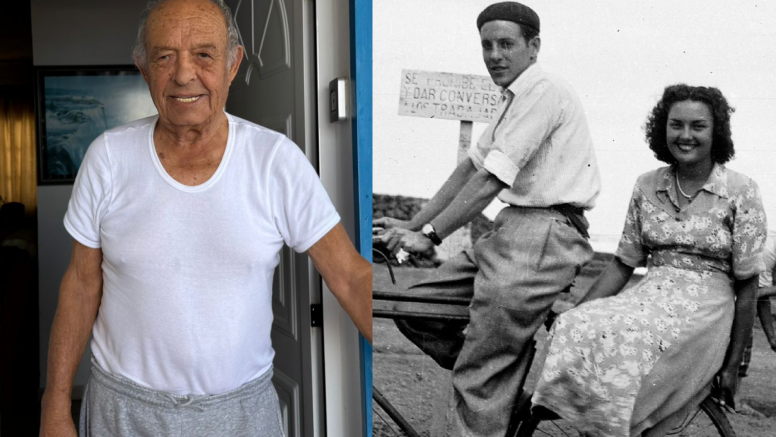
Anastasio Barreto Morín (Haría, 1936) was fifteen years old and had a duro in his pocket when he embarked for Argentina. As he was just a kid, he was starting to attend the cinema and the few dances that the Francoist regime allowed in Lanzarote. To pay for his boat trip, his family managed to gather thousands of pesetas, a fortune for the time, after selling a piece of land on the island. The man from Lanzarote departed from the Commercial Pier, next to the Puente de las Bolas in Arrecife, on December 13, 1951. Even today, at almost 90 years old, he has that date etched in his mind because that December, coinciding with Saint Lucia's Day, his life changed forever.
A sewing thread twisted the destiny of Anastasio. He was only ten years old when his father emigrated to Argentina and fifteen when his progenitor decided it was time for him to also embark for Latin America, following his steps to earn a living. "My father wrote to my mother, he asked her how I was and if I had already grown up," narrates Anastasio Barreto during an interview with La Voz.
During those years, his mother had stayed in Lanzarote in charge of Anastasio and his sister, who was younger than him. To be able to respond to the letters she received from her husband from time to time, she asked her son to write them because she could not read or write. That day, his mother decided to take a sewing thread, measure the child, and cut the thread to his height. "We put the sewing thread in the letter and wrote 'this is your son's measurement'", she recalls between laughs. When his father received that letter, he replied that the boy was already fit to work and could embark.
"In that era, when women had a child it was a joy because it was the sustenance of tomorrow," recalls the man from Lanzarote. Women were relegated to household chores and caregiving, without legal autonomy to be able to work or have their own bank account, a reality suffered by his mother and sister who stayed in Lanzarote.
The misery that was lived on the island and the lack of opportunities led him to leave for Gran Canaria for two weeks to process the necessary papers to leave the country. Then, being a teenager, he embarked alone and for fourteen long days on the ship Buenos Aires with more than a dozen compatriots and emigrants who had fled the peninsula.
"Migration was never cheap and was an exercise in collective effort," explains the doctor in American History from the University of La Laguna Ángel Dámaso Luis León during an interview with La Voz. Like him, the people from Lanzarote who crossed the Atlantic had to sell land, gather money among several families, and assume debts to be able to embark.
A journey across the Atlantic
"Sky and sea, sky and sea. What a trip that was! I remember I enjoyed on the journey mountains of waves, enormous. What despair!", narrates Anastasio Barreto in an accent that shows his migrant life, between the Canarian and the Argentinian. During the trip he was unable to sit down to eat the soup because he would fall to the floor pushed by the strong swell.
Upon arriving in Latin America, the first stop he made was in the state of Pernambuco, in Brazil. "I don't forget that trip," notes the man from Lanzarote, who was then struck by the number of churches the place had. After the stop in Brazil, the ship arrived at Río de Plata, in Argentina.
"We found that Health came to check us again, they opened my eyes to see if I was healthy and thank God nothing happened to me," he continues. With only that duro in his pocket, Anastasio "didn't have any bitch," and wondered how he was going to move from the place if they rejected him. After four years without knowing about his son and after several hours of waiting at customs, his father received him and took him to have a submarine, a typical Argentine drink that consists of a glass of milk with chocolate inside that is accompanied by vanilla.
After warming his guts, his father took Anastasio to the desert, where he worked as a contractor in a brick kiln. "He introduced me to the owner and gave me a shovel, a wheelbarrow, a small stool to make bricks, and a mold," he explains. The man from Lanzarote had never made a mud brick, but in nine months in that place he became an expert. "That was a total sacrifice," he recalls the loneliness he felt at the time due to the distance from the rest of his family and the lack of people to chat with.
Thanks to a countryman from the town of Haría who had also emigrated to Argentina, Anastasio Barreto managed to change jobs, where he met other Portuguese migrants who had also gone to make a living on the American continent. "We were all emigrants and there we only talked about working, about earning money," he adds. In those conversations among mud bricks, nine workers decided to set up a cooperative.
Despite the effort and work, the cooperative took some time to bear fruit, but the reward arrived. At 22 years old, Anastasio decided to venture out alone and start his own business. Then he allied with another Spaniard, a Basque man who gave him land to set up his brick business, in exchange for a 5% commission. "I started with little, I linked up with suppliers who sold coal and firewood and made friends with them," he adds.
At 23 years old, with the business set up, he married an Argentine woman with whom he had three children and began to build his first house. "In those years I began to think that it was not good to be a good worker, it was more important to be a good merchant," he advises, at that time he decided that he would sell the bricks at the price that suited him because he worked with a material that did not expire. At that moment, he built a second home.
Despite the economic boom, Argentina began to suffer the consequences of the military governments that succeeded each other in the country. Anastasio managed to send his three children to school and bought a chalet in the city of Ramos Mejía, on the outskirts of the Argentine capital of Buenos Aires.
His father, another Lanzarote native, died in a shootout in Argentina
An event dealt a setback to his life in Argentina. Anastasio was going to get into bed, when several knocks on the door put him on alert. "My wife was awake and I told her: "don't open, huh?", he recounts. There were some men at the door and upon looking out the window he saw that they were his father's neighbors, who had managed to leave the brick factory and ran a food business in Argentina.
"They told me he had been assaulted and that they didn't know if he would make it to the clinic," adds. When he arrived at the Emergency Room his father had already passed away. One of the assailants shot him three times in the heart from the bar's door. "He took his life, they didn't rob him or anything," adds.
Like many emigrated islanders, Anastasio became a migrant who was not completely from anywhere, but who was from both places at the same time. After the death of his father and due to the crisis that was hitting Argentina and increasingly devaluing its currency, Anastasio Fernández decided to buy an apartment in Fariones in 1970. First he did it as an investment, but he increasingly tipped his balance towards returning to the island where he was born and ended up returning with his wife and his three children until today.
Milagros Acuña, the luck and the second television of Haría
In 1963, the woman from Lanzarote, Milagros Acuña Brito, from the municipality of Haría, boarded a commercial ship with her son bound for Venezuela. Seven years earlier, her husband had set sail for that land in search of a better future than the one he had in Lanzarote. "When he was courting my aunt, he already said he wanted to go to Venezuela and that made my grandmother very nervous," recalls Orlando Acuña Betancort, Milagros's nephew during an interview with La Voz.
"My family never knew if my uncle traveled legally or if he was illegal," questions Orlando Acuña. For seven years, Milagros Acuña remained in charge of her son, with the help of her relatives. Between her grandfather's work, who was a truck driver and worked sanding his brother's land on the island, the harvests from the lands in Haría and the goat cheese, they managed to subsist on an island scourged by hunger and drought.
In the village they said that Milagros Acuña had been lucky because her husband "had claimed her" and had asked her to travel to reunite with him in Venezuela. Many other women in the municipality became white widows, had seen their husbands sail to Latin America, but were abandoned and never heard from them again, having to face poverty, social shame and being forced to get ahead with the support of their family, but without the ability to be independent.
In the Venezuelan city of Valencia the family got some land to work in the countryside and dedicated themselves to agriculture. With the arrival of their aunt in the country, their grandmother lived waiting for the mail to have news of her. "They went through a lot of uncertainty because the letters didn't arrive, they didn't know what it was like to start there," Acuña explains.
Ten years after emigrating to Venezuela, during a trip to Lanzarote in 1973, Milagros Acuña gave her mother a television. "It was the second TV in the village and that was a great revolution, my grandmother used to say 'how well this woman is doing!'", she recalls. That gift and the modern clothing with which she returned reassured her mother. The economic boom led the family to buy a plot of land in Punta Mujeres and several in Arrecife during that time.
However, her situation began to be cut short in the eighties, when the economic crisis in the country preceded the military Government of Hugo Chávez. These emigrated Lanzaroteans then needed back that money they had invested and sold the land in Lanzarote. Furthermore, although they did not ask for it, their family from the island sent them some money so they could subsist. Milagros Acuña died at almost 93 years old in December 1993 in Venezuela. Now, one of her grandchildren has been living for years in Lanzarote.
The ghost ships to Latin America
"Our culture is sifted by a process of migration and return," reflects historian Ángel Dámaso Luis León. Gastronomy, language, musical tastes, and architecture are a reflection of the constant flow of people between Latin America and the Canary Islands. "Canarian identity cannot be understood without America," he adds.
Emigration between the Canary Islands, Venezuela, Cuba and Uruguay (for the eastern islands) began in the 16th century, so the history of the archipelago cannot be understood without that of the Caribbean and the thousands of round trips. The Doctor of History from the University of La Laguna Ángel Dámaso Luis León, a member of the Atlantic-Caribbean Historical and Social Studies Group, explains that the population of the archipelago always migrated to Latin America for economic reasons.
To the scarcity in the islands, derived from their geographical situation and due to their dependence on the outside, was added the situation in the eastern islands, where it barely rained. The Lanzaroteans were climate emigrants who fled the drought on the island and during Francoism also political exiles or victims of the crisis in which post-war Spain was plunged.
Contrary to widespread belief, the Canarians who emigrated not only worked in the countryside of Latin American countries. For example, in Venezuela they "scattered throughout the country", where they performed "all kinds of trades", adds Ángel Dámaso Luis.
During Franco's regime, the Canarians who embarked began fleeing to Venezuela as stowaways on Italian ships. Then, illegally hidden in "ghost ships", creating their own boats, stealing them or buying them. Full beyond their capacity, they departed from any island of the archipelago. The Canarians, as clandestine emigrants, were taken to prisons and their crews repatriated or confined in El Dorado. They were even sent to Gusina, an island that did not meet basic hygiene conditions.
The chronicler of Haría, Gregorio Barreto, narrated a few years ago that in 1949 several residents of Haría embarked on a small vessel bound for the country, which took three months to arrive, so they ran out of water and food. "A number was assigned to each one to be sacrificed because there was nothing to eat", he narrated. However, they did not have to do so because a large ship picked them up. Finally, they were arrested upon arriving in the country. That same year, 106 Canarians aboard El Elvira arrived in Venezuela, where they were detained for "illegals".
"There is a certain understanding of the phenomenon on the part of the authorities who are in the Canary Islands," adds Luis León, who also added to the lack of resources on the islands to prevent maritime departures. It is estimated that between 1948 and 1951 around 12,000 Canarians reached the coasts of Venezuela in irregular vessels.
After the legalization of migration in 1951, the islanders arrived in the country on large ships, but they were not always treated as political and economic refugees.
"In the island identity there has been much insistence on tricontinentality", in its location between Africa, Europe and America, explains Ángel Dámaso, which is why "it grates a lot if it is then accompanied by a discourse of hate"
"Today we are a land of immigrants, but we have been throughout history a land of emigrants", adds Orlando Acuña, "if you scratch a little, every family has someone who emigrated because there wasn't enough food for everyone." "Many places, among them Africa, hunger killed the Canarians and that is forgotten", he concludes.
With the support of:
Add La Voz de Lanzarote as a preferred Google source.
Stay informed with the latest current news.