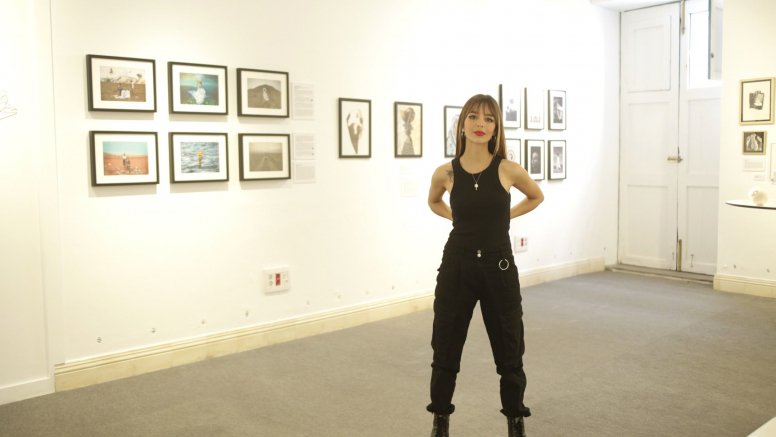
The artist, journalist, photographer and researcher from Majorca, Nadia Martín, is the curator of the exhibition Your silence will not protect you, which has been available since this past Thursday, March 7 in Arrecife on the occasion of International Women's Day at the Casa de la Cultura Agustín de la Hoz.
The exhibition is made up of different young women from the Canary Islands who, through various artistic disciplines, have shown their concerns and struggles to achieve a more egalitarian world and archipelago.
Several of the artists participating in the exhibition are from Lanzarote, while others come from other islands such as Gran Canaria, Fuerteventura, Tenerife and La Palma. In addition, it includes everything from conceptual photography to painting, illustration, children's literature and even crafts. This gallery brings together different forms of artistic expression and the dialogues with feminism of the Canary Island creators Ángela Glezal, Asiria Álvarez, Cristina Mahelo, Ellah García, Liz Lindo, Elvira Piedra, Gema Hernández, Moñoño, Laura Balde, Lana Corujo, Sara Gutimeli, Rosa Vera and Patricia Jiménez and Nadia Martín herself coexist.
In addition to curating the exhibition, Nadia Martín exhibits part of her conceptual photographs, within a discourse that combines feminism with other movements that are transversal such as anti-speciesism, economic inequality or the right to abortion for women.
From conceptual photography, this artist seeks a "prior claim" that she then translates into the creation of the work. "At the moment of taking the photo, at least in my case, almost a performance is created in the space," she tells La Voz. For example, one of the photographs in the exhibition shows the right to abortion in the Canary Islands, "recovering the historical memory of what our grandmothers experienced and how progress has been made to this day in that fundamental right," she explains.
In the image, taken in Villaverde in the north of Fuerteventura, Nadia Martín is surrounded by hangers and a green cloth is entangled between her body. "It symbolizes the feminist green tide that dyes the streets when it goes out to claim the right to abortion in different places," she adds. "I would define conceptual photographs as those in which you try to transmit a concept," she says.
This exhibition seeks to represent that "there are inequalities that cross us in relation to gender, but there are many others that intersect and cross us as well. So that diversity is also present in the exhibition," she reflects.
For Martín, the struggle of different movements must coexist with other demands. As an example, feminism is not understood without the fight against aesthetic violence or against misogynoir, the term that refers to misogyny against black women, where machismo is combined with racism.
"The type of machismo is not the same depending on your skin color, because you add that discrimination," the creator emphasizes, "but they cannot be seen as separate discriminations or separate struggles that have nothing to do with each other, because they do have to do with each other."
When claiming the role of a transversal feminism during the interview, Nadia Martín and the artists bring to the present the poet critical of white feminism Audre Lorde, who pronounced the phrase: "I am not free while any woman is not free, even when her shackles are very different from mine."
For the Canary Islander, "it is super important that we have space and voice for the maximum number of artists possible and that we see the diversity that exists in the Canary Islands, that it is not only white cishetero artists, that there are also bisexuals, there are also racialized women, there are also trans women."
The importance of achieving true social transformation comes from transferring the struggles and demands of the streets to the classrooms, culture and art. On this path, attending schools in the Canary Islands has found "a beautiful and super powerful advance in the new generations."
Among her works, the conceptual artist, activist, journalist and communicator highlights a didactic guide on aesthetic violence and body shaming. "Art can be a way to co-educate," she tells La Voz, with this guide she tries to democratize knowledge and bring tools to the classrooms to fight against bullying.
She is currently also working on a project of fanzines, countercultural publications that have had great cultural value in social activism, where she tries to train on disinformation and combat hate speech. "It is very interesting what is generated in the classrooms. How to create educational projects through culture, photography, collage," reflects the artist. At this point, she refers to the use of fanzines during the feminist movements of the 70s.
"I think the right to housing is one of the biggest lies in history," Nadia Martín
The right to housing
So transversal is her work, that in her latest works she has also investigated the right to housing and the scarcity of this fundamental right that is now suffered in the Canary Islands. As a majorera, and after eleven years living in Madrid, Martín tried to return to her native island but the lack of rentals became a puzzle.
In that way, Nadia Martín began to see how the stress of not finding housing interfered with her mental health. At that moment, she decided to photograph the housing situation in the Archipelago and in the tourist spaces, even more affected by real estate speculation.
"I wrote a text about uprooting, about how I felt and what we Canary Islanders were going through about all this. Being away and wanting to return to the roots and you find real estate speculation and it generates that tic in the eye of stress. I wondered if even the movement of my eye no longer belonged to me and it belonged to real estate speculation and the violation of the right to housing," she laments.
Add La Voz de Lanzarote as a preferred Google source.
Stay informed with the latest current news.