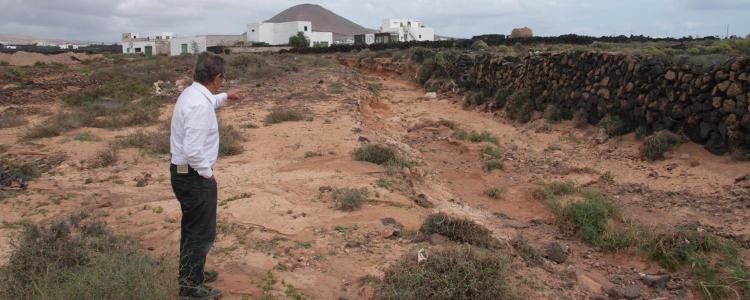
PHOTOS: Sergio Betancort.
A resident has submitted a "damage report" to Canal Gestión in which he claims 38,000 euros in "damages" from the company. These damages, according to this man, are a consequence of the "torrent of water" left in its wake by the rupture of the Maneje reservoir on January 9. According to the Consortium at the time, some 16,000 tons of water were spilled as a result of the rupture, causing "a major flood."
The firefighters of the Security and Emergency Consortium went there when the rupture occurred, to search the area and check if any person or animal had been dragged by the waters. Fortunately, there were no personal injuries, but there was material damage. In fact, the breakdown affected the two water impulsion lines of the municipalities of Teguise and Haría, and left a good part of the localities of those two municipalities without drinking water for more than a day.
Very close to where the reservoir was is the farm of Juan Corchero, in which there are three buildings and a land where this man had his crops. Corchero has worked for decades as an agricultural technician and, although he does not live there, he had been planting vegetables, fruit trees, and olive trees on that farm. "I have realized that I have grown old in three days and I said 'I who could have an extraordinary farm, producing and time has passed me by...' So, I was doing something agricultural on that farm," he explains.
In addition to planting trees and vegetables, he had also built a covered "garden" protected with stone walls and had a cistern in which he accumulated rainwater for irrigation. "I had some little plants and watered them with good water. Well, now that's over for me." However, after the rupture of the reservoir, much of that was "razed" or "destroyed." "What bad luck I've had, the water ruined everything for me," Juan laments.
A "totally destroyed" orchard and "razed" crops
The letter that this resident presented on January 21 at the offices of Canal Gestión, recounts the damage caused by that "torrent of water" and attaches 24 photographs to illustrate the damage allegedly caused by that flood on this farm on Diseminado Volcán de Tahíche street.
Thus, the claim states that the orchard that was in the garden of that house has been "totally destroyed." That orchard, he relates, had walls of volcanic stone and a covering of white sand, but the water "carried them away." It also dragged in its wake the roof of the cistern which, according to that claim, was made of "joists and prefabricated concrete vaults" and was about "50 years old."
"The oldest trees have resisted, observing in their trunks the height to which the volume of water reached," Corchero states in his text. He adds, however, that that area of the farm was "razed", "clean of the layer of white sand (jable) that had been incorporated and of the crops that it had". He also points out that the "passage to the house" was "destroyed", as well as "five banana trees". After the flood, the soil was "without protective sand and without plants, the white sand, 25 rooted native olive trees" having disappeared, among other crops.
It could have been "a real catastrophe"
At the "shelter" of another of the walls, this resident explains, "there was a strip of soil covered with jable sand, with horticultural plants and vegetables, which has disappeared due to the current of water." Juan Corchero also had there a pile of 14 cubic meters of black sand for construction, of which a part was dragged by the water and another has been "rendered unusable", he concludes.
Despite this, Juan states that he has no intention of reporting the company and that he has only filed the claim to recover what he estimates he has lost. "They are damages, losses, from the civil point of view, not criminal, because they have not had bad intentions either," he explains. For Juan Corchero, it has been "bad luck" and a "misfortune" also for the company, although he believes that the consequences could have been much worse. "It has been the minimum misfortune, because the reservoir that broke is in a fairly flat area. If it had been on a mountain and there were houses below, it would have been a real catastrophe."
Add La Voz de Lanzarote as a preferred Google source.
Stay informed with the latest current news.