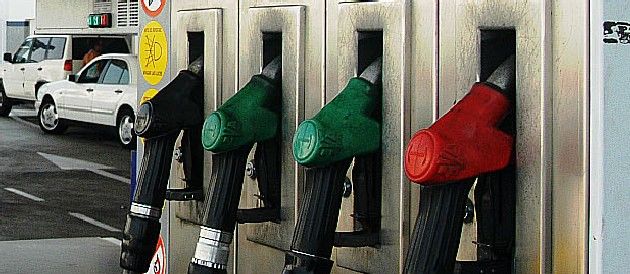
"I filled the car's tank, about 70 liters, started it and drove about 100 meters. It stopped and wouldn't go anymore." This is how Leocadio, a taxi driver from Tías, explains how his car broke down after refueling at the Pcan gas station in this municipality. His car was 5 days old, "50,000 euros, gone to hell", the taxi driver laments. According to him, the vehicles of "at least three taxi drivers and some individuals" would be affected by this new case of fuel in poor condition in Tías.
Both this affected party and the gas station chain itself point to Disa, which is the fuel distributor on the island, but the company denies it. In fact, they claim that neither the gas station nor anyone from Pcan had contacted them and that the first news they had of this episode was when they received the call from La Voz de Lanzarote asking about what happened.
However, the Pcan press office maintains that they did file a complaint with Disa. In any case, they acknowledge that so far they have not been able to determine who was responsible for the fuel being in poor condition, as they are awaiting the results of the analyses. "Until the analyses are done, we don't want to comment on anything", the owner of the establishment told this newspaper.
For its part, when asked again by La Voz about that complaint that Pcan claims to have sent them, Disa has been blunt. "We can confirm that there has been no direct official communication from PCAN about this incident, as PCAN is not currently a client of the company. For this reason, the problems mentioned are in no way attributable to DISA", they state in a letter addressed to this medium.
The company refers in this way to the existence of an intermediary between Disa and the gas station, as confirmed by Pcan itself, which explains that its supplier is Cepsa, although the fuel that it supplies does belong to Disa. "It will be very difficult to elucidate because Disa denies anything", say from Pcan, who insists that they complained both to Cepsa, their supplier, and to Disa. "They said no, no, that their product was fine," they say.
"Contaminated with water"
What has already been confirmed from the Pcan headquarters in Tenerife is that the fuel "was contaminated with water" and that, as soon as they had "knowledge of the problem", they removed "the 18,000-liter tank". Although they do not yet have the results of the official analyses, which will be carried out "in the Cepsa laboratory in Tenerife" and could be ready by the end of this week or the beginning of next week, they have carried out preliminary tests on site that determine that the contact of the fuel with water would be the cause of the problem. "There are very easy tests to detect water. There is a detector paste that is put in the rod and you know if there is water or not", they explain.
However, from the Pcan distributor they insist that they do not believe that the problem comes from their station. "The tanks do not create water", they affirm, indicating that the problem could come from the transport by boat of the fuel by Disa. In addition, they emphasize that their company has taken prevention measures "that no other service station has". "At Pcan stations, filters have been installed, the dispensers come with a filter like the oil filters of cars, the gun has another filter...", they point out.
Despite this, they admit that they discovered several problems at the Pcan station in Tías that, they point out, could be due to the passage of that fuel in poor condition through the dispensers and filters. "We have detected things at the service station to which a remedy has been put on the spot: the filters became clogged as a result of all this, the filters were removed, they were cleaned, the filters of the dispensers were changed, the pipe of the dispensers was disconnected and pressure was applied, removing 5,000 liters to clean the lines. We have done a lot of things and we have spent a lot of money to solve the problem", they assert.
A repeated story
This is not the first time that an incident with fuel has been recorded on the island. In 2011 there were several similar cases. "Three years ago I fell, who was then the president of the Taxi Association and they ruined a Peugeot that I had. The colleague who was then the vice president also fell, (taxi) 68 from Tías fell, 102, 54 fell... A lot of cars fell in Tías", recalls taxi driver Leocadio Martín.
On that occasion, the problem affected vehicles that had refueled at various gas stations and the Industry Council of the Cabildo of Lanzarote took action on the matter and urged Disa to carry out controls and analyses before distributing the fuel on the island. From the Pcan headquarters they also refer to that incident three years ago and assure that, then, Disa hid "what they felt like" from them.
On this occasion, however, the problem seems to have been limited to a single gas station, which gives Disa arguments to ensure that the problem does not stem from the fuel it distributes. In addition, neither the Industry and Consumer Affairs Council of the Cabildo of Lanzarote nor the Industry Council of the Government of the Canary Islands have received "so far" complaints about this new episode, although the Tías station itself that sold the contaminated fuel claims that it does intend to forward a complaint to the regional Executive.
For his part, one of the affected taxi drivers regrets that he has not only suffered the breakdown of the car, but also the consequences of having his vehicle in the workshop, which has prevented him from working. Thus, although he explains that the gas station's insurance has taken care of the repair of the car, he will also request compensation "for the days it has been broken down".
In addition, although he insists on pointing to the fuel distributor as responsible and not the gas station, he warns that if he does not receive that money for the damages he has suffered, he will file a lawsuit and will do so against the person responsible for that service station. "I know that she is not the one who manufactures the diesel, but I don't manufacture it either, I buy it and I buy it from that gas station. So, I will denounce the owner even if I get along with her", he says.
Add La Voz de Lanzarote as a preferred Google source.
Stay informed with the latest current news.