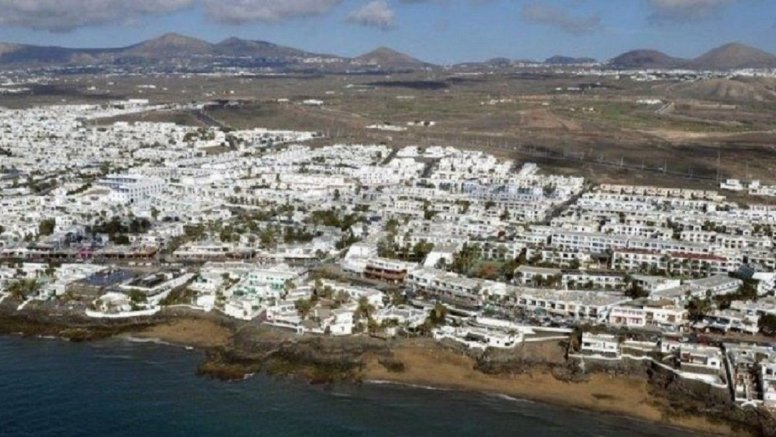
10% of the population registered in the Canary Islands is concentrated in the tourist areas of the coast, which occupy 1.8% of the territory and where 45.8% of the holiday rental places are concentrated. In Fuerteventura and Lanzarote, the percentage of the population registered in the tourist areas of the coast exceeds 20%.
In addition, these areas are home to 89.4% of the travelers staying, 85% of the overnight stays, 83% of the tourist establishments and 85% of the hotel and non-hotel accommodation places, said the professor of the Department of Geography and History of the University of La Laguna, Moisés Ramón Simancas.
Moisés Simancas, in his intervention in the parliamentary commission of the demographic challenge and the population balance in the Canary Islands, has affirmed that there is a process of concentration of the population in a specific area of the territory, so he has pointed out that the challenge is to address the coexistence between locals and foreigners.
The expert has argued that the tourist areas have become residential areas, so it is necessary to provide them with more public educational and health services, among others.
In the municipalities of Adeje, Tías, Pájara, Antigua, Yaiza, Teguise and Mogán the registered population reaches 50%, Simancas added.
He also detailed that in 40% of the 19 tourist areas of the coast in the Canary Islands, the main residence exceeds the non-main residence, a percentage that, in his opinion, reflects that there are people who live in the tourist areas and consider it their home.
As for the population living in these areas, those of foreign origin predominate and 71% are of working age, while 18% are over 65 years old and live in the islands to enjoy their retirement.
He warned that the tourist areas of the coast were not conceived as cities, although there are residents in them, and stressed the importance of starting to plan processes of coexistence between the tourist and the resident for work and leisure reasons.
The resident who lives there for work reasons does so attracted by their expectations and job opportunities, said the expert, who explained that by offering 30 square meter apartments for 700 euros per month, the population that arrives goes to the outskirts of the tourist municipalities.
The professor has put on the table some proposals, such as limiting holiday rentals to 51%, in the tourist areas of the coast of those non-hotel establishments that no longer comply with the unit of exploitation.
Thus, the rest, 49%, would be allocated to residential housing, with which he said that it can contribute to solving the housing problem, in addition to the declaration of a stressed area to regulate the price of rent.
In this way, he indicated that 21,058 homes could be obtained, which are now used for holiday rentals, for residents immediately in Arona, Las Palmas de Gran Canaria, Adeje, La Oliva and San Bartolomé de Tirajana.
Regarding holiday rentals, he added that it is necessary to propose a moratorium "yes or yes" to this accommodation regime, because it has "blurred" tourists throughout the territory, which has generated environmental problems.
However, in the green islands, holiday rentals are generating a "very important" benefit and is a dynamizing element of rural areas, he asserted.
In short, he concluded, it would be necessary to assume that the tourist areas of the coast have become residential areas that need public facilities and infrastructures.
Therefore, it is also necessary to draft urban planning that makes residential uses compatible with tourist uses and the strengthening of the technical tourist and building inspection, he added.
In his opinion, in the Canary Islands there is no tourismophobia, as the data he handles does not reveal that there is rejection towards the tourist. "The objective of tourism is to improve the quality of life of the hosts, of the residents," said Simancas, who believes that the Canary Islands is a model of coexistence "with those from outside."
In the same commission, the honorary professor of Human Geography of the University of La Laguna, José León García, asked the administrations to build public housing in the Canary Islands, and not leave everything in the hands of private initiative and the approval of laws.
In this sense, he recalled that the Canary Islands is one of the communities with the greatest problems of poverty and lack of accessibility to housing due to lack of sufficient salaries.
He has also reflected on the tourist model of the islands, which needs the population to work "for low wages" in order to compete with other destinations, which means that immigrants who live in the islands for work reasons have to "assume" low payrolls.
However, "tourism does not impoverish, the system we have impoverishes," said the professor, who insisted that the administrations have to act to make it attractive from an economic point of view that it is possible to live in the non-capital islands and also in the midlands.
The expert, who has asked for consensus so that people can live better in the archipelago, commented that it is paradoxical that there is more and more unemployment and more need for immigrants to arrive to fill jobs that residents do not want because of their low wages and "certain harshness", such as those related to hotel cleaning, hospitality and construction.
Add La Voz de Lanzarote as a preferred Google source.
Stay informed with the latest current news.