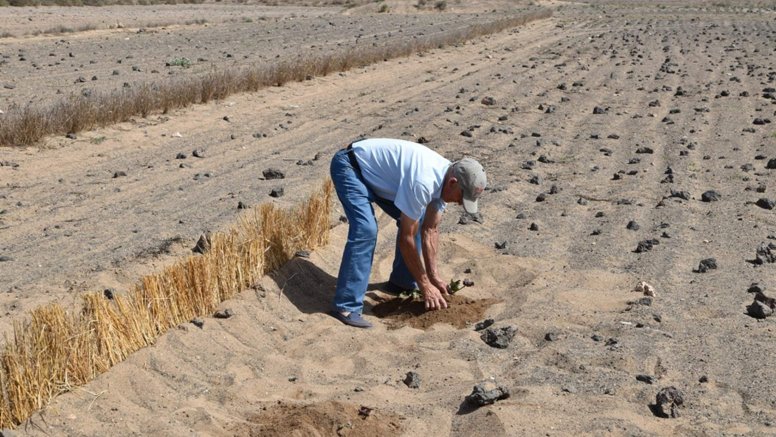
If something stands out in Lanzarote, it is the quality of the products that emanate from its land. The sweet potato and the watermelon are two great examples of how a dry farming can offer the maximum flavor, all thanks to the sand and the volcanic gravel, which act as an insulator by conserving the humidity of the scarce rains that fall on the island.
In the case of the sand, it is a type of organogenic sand of marine origin that has been formed over time by the crushing of shells and calcareous algae. Its presence in Lanzarote is very abundant. So much so that there is the area known as El Jable, a place with a high ecological value that crosses the entire island from Famara to Playa Honda.
The traditional agriculture that has been practiced in Lanzarote has always been dry farming, since the island receives an annual average of 115 liters per square meter.
In this sense, Ascensión Robayna, farmer and collaborator in the Agrarian Transformation Society (SAT) 'El Jable', explains that "today, in dry land and obeying the traditional cultivation systems, the agriculture that is being done is not very significant because it has not rained".
"The resources to be able to cultivate the famous sweet potatoes and watermelons require a little rain and, apart from that, to provide them with some water, so we must question whether these products are really produced one hundred percent in dry land. It is not about doing irrigated agriculture, but about accompaniment to simulate a nature that we had so that we continue to conserve the soils", continues Robayna.
A unique soil
The fields of Lanzarote are covered with volcanic gravel or sand, but throughout its orography, the type of soil that is found underneath is the bermeja. That is, fertile and cultivable land. In this way, "the soils are sheltered, that is the secret of Lanzarote", says Robayna. This causes the little existing humidity to be maintained and the fertility remains.
In fact, as the farmer says, "when we talk about climate change, we do so thinking about covering the soils and we have that quality in agriculture because it is possible thanks to that protection that the soils have".
As she explains, "with Lanzarote's proximity to Africa, the little rain and the winds, no one in their right mind could affirm that we can produce anything, not even the vine, but the island's farmers soon realized that productivity increased in the lands that had been naturally sanded".
For his part, the agricultural technical engineer Teno Osorio, explains that the soil of Lanzarote "is like a cake, the upper layer is formed by the sand and the lower one by the clay, the more layer of sand it has, the more capacity it has to store water". Formerly, he continues, "farmers made tastings of the land and when they saw that it had enough humidity, they planted". In addition, to guarantee the rest of the soil and that the rains of several years accumulated, fallow lands were left.
At SAT El Jable they focus on promoting organic farming, something vital for the soils of Lanzarote. "In the case of an island as dry as this there is a problem, and that is that when chemical products are used, they stay in the land and are not washed away. In rainy areas the soils are washed, but not here, so this leads us to think that the path to follow is in organic farming", he declares.
A unique flavor thanks to dry farming
The extraordinary flavor of the so-called 'Soo watermelons', melons, sweet potatoes or grapes is due to this dry farming, which makes the flavors of vegetables or fruits much more concentrated. "A watered grape or sweet potato has a lot of water, they have less quality, and if everything is concentrated because it hardly rains, that translates into flavor", he explains.
However, to increase the quality of the products a quality water is needed that does not go against the soil and a rational use of it. "Very little is needed, only that it emulates the amount of water that rained in Lanzarote and that in recent years has not been reached", details Ascensión Robayna.
Such is the importance and uniqueness of the cultivation systems of Lanzarote that the island received in May of this year the recognition as a Globally Important Agricultural Heritage System, which values the three ancestral agricultural systems of the island: the natural sanding of La Geria, the artificial sanding of the north and the cultivation on organogenic sands of El Jable. All of them fruit of local knowledge and the adaptation of the human being to an environment with extreme climatic conditions, marked by the scarcity of water and the trade winds.
The Soo watermelon, the most coveted
In the case of watermelon, the variety that is currently planted, especially in the Soo area, is the Pata Negra, although formerly a variety known as 'muscatel watermelon' was cultivated. It is a fruit shaped like a cucumber, very large black seeds and inside it has air gaps. Although it has a very sweet taste, "commercially it is not the most popular because people when they go to the supermarket go in search of the roundest possible watermelon and visually it is not the most appetizing", says the engineer.
Decades ago, watermelon cultivation was done in dry land, but climate change has meant that today rainfall has decreased in Lanzarote. Regarding the sweet potato, it requires less water than the watermelon. "If you don't have irrigation, its cultivation is impossible because there are farmers who plant watermelons and have had water cuts for two or three weeks and have lost the entire harvest", says Osorio.
The success of this fruit has meant that new plantations are beginning to emerge in other parts of the island apart from Soo. "There is a farmer in Guatiza who is obtaining watermelons that are becoming a very big rivalry to those of Soo, although there are also farmers from Tinajo who are planting them in sanded areas in an ecological way and they are spectacular", he reveals.
Likewise, one of the qualities that Teno Osorio highlights most of Lanzarote is the amount of hours of sunshine, since it allows plants to do a lot of photosynthesis. "This makes the plant transform the nutrients it absorbs into sugars, so that characteristic and distinct flavor is achieved", he concludes.
Add La Voz de Lanzarote as a preferred Google source.
Stay informed with the latest current news.