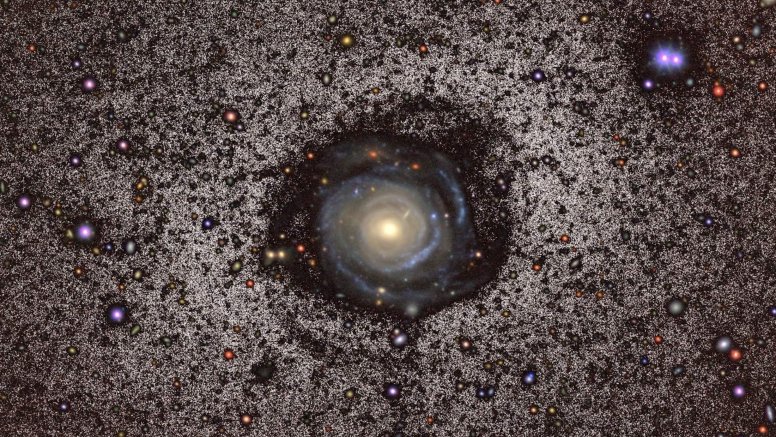
A research team from the Instituto de Astrofísica de Canarias (IAC) has obtained the deepest visible light images taken of Malin 2, one of the largest and faintest spiral galaxies in the Universe, revealing structures never seen before.
Thus, according to an IAC statement, several diffuse stellar emissions and a striking elongated spiral-shaped structure have been revealed, pointing to past interactions with other galaxies.
In addition, a possible ultra-diffuse dwarf galaxy (UDG) has been identified about 400,000 light-years from Malin 2, which could be its first known UDG satellite.
The discovery of such faint structures around this galaxy has only been possible thanks to the exceptional depth and quality of the new images from the Two-meter Twin Telescope (TTT) robotic telescope, located at the Teide Observatory, in Tenerife. of the TTT, says Junais, an IAC researcher linked to the European project ExGal-Twin and lead author of the study.
It's like discovering a "hidden story written in the faint light of the galaxy's outskirts," the researcher adds.
The results suggest that interactions between galaxies and tidal processes, that is, the mutual gravitational influence between galaxies, may play a much more important role than previously thought in the formation of giant low surface brightness galaxies such as Malin 2.
The faint spiral arm and diffuse stellar features align with the structures of the galaxy's gas distribution, further suggesting its complex dynamic past, and these findings demonstrate that even the most seemingly quiet and isolated galaxies can have turbulent histories, the IAC adds.
Based on these results, the researchers plan to conduct deep follow-up observations of the gas content and its kinematics to confirm the origin of the stellar structures revealed in Malin 2.
They also intend to observe more giant low surface brightness galaxies using ultra-deep imaging to determine whether these faint features are common in this type of galaxy or whether Malin 2 is an exceptional case.
By pushing the boundaries of what "we can see, we are opening a new window into the processes that shape the formation of such enormous galaxies over billions of years," Junais concludes.
The Two-meter Twin Telescope (TTT) is a robotic facility operated by the Canary Islands company Light Bridges, consisting of four telescopes in total: two 2.0-meter twin telescopes and two complementary 0.8-meter telescopes, all designed to operate in a coordinated and fully robotic manner.
Add La Voz de Lanzarote as a preferred Google source.
Stay informed with the latest current news.