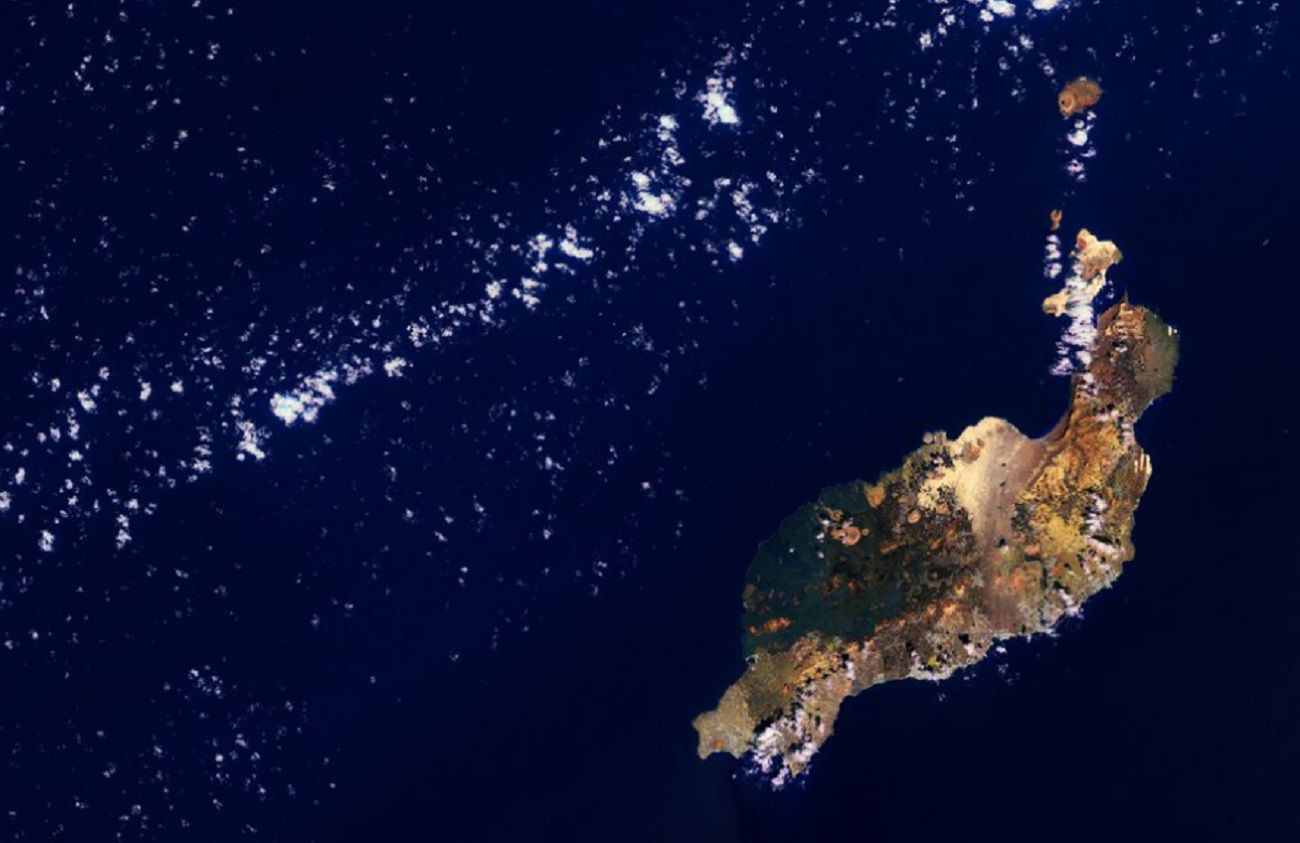
The geographical position, the trade winds and the cold currents of the Atlantic Ocean make the Canary Islands privileged against the effects of climate change, however, there is a "distant" danger that the Archipelago will become tropical.
This tropicalization process means that extreme phenomena are becoming more intense and frequent, so that the Canary Islands could resemble the islands of the Caribbean and have a "more extreme" climate.
The physicist Manuel Vázquez reviews in an interview with EFE the main challenges facing the Archipelago with climate change and, although he trusts in the resistance of the trade winds and in the mitigation of the decrease in cold currents, he warns that a good urban organization of the islands is necessary.
In this sense, the disseminator explains that it is necessary to prioritize the existence of free spaces, as well as clear the ravines and not allow construction near the beaches when it is a fact that sea levels are rising.
"The Canary Islands may not be the worst place to live in the future," says Vázquez, who says that this "privilege" may disappear depending on how we act today.
Reconstructing history to face the future
Knowing the history of climate and meteorology in the Canary Islands is vital for this researcher, who stresses that in order to face the future we have to know "what happened and may return" and recalls, with special significance, the storm of 1826 in Tenerife, in which 400 people died.
And following this example, he has just published Stories about climate and meteorology in the Canary Islands (1500-1960), together with the publisher Le Canarien, a book in which he materializes an intellectual journey that includes the first settlers of the islands and culminates just before the "official" development of climate change.
The work has an inevitable quantitative background on the subject in question, but also includes stories and unpublished documents about the Canary Islands that reflect social and scientific behaviors in the face of different phenomena.
In fact, the author, honoring his profession as a solar physicist, delves into part of the observational history of the archipelago and, in his research, dates the appearance of the first instruments that recorded changes in the atmosphere from the islands to 200 years ago.
Volcanic eruptions affect meteorology
As Vázquez delves into his stories, volcanic eruptions have had an immediate and temporary effect on meteorology, which is not the same as climate, and details how this influence can be exerted on the environment or on a global scale depending on the size of the volcano.
"Large volcanoes, such as the Pinatubo in the Philippines, have influenced the average temperature of the Earth, which in the case of the Philippine volcano caused it to drop for three years and which contrasts with the case of La Palma, which affected the meteorology of the western part of the island," he explains.
Thus, for days, and even months, the atmospheric composition of the area changes, with the presence of CO2 and other types of gases, and affect agriculture immediately, as happened after the eruption in Timanfaya, south of Lanzarote, where there were more towns and an agriculture very different from what exists today.
The sun, a laboratory with an expiration date
After his retirement, Manuel Vázquez boasts of having time to delve into everything he wants, and despite dedicating his latest book to meteorology, much of his work has been linked to solar physics.
The sun is, in his opinion, a "laboratory star" where we can study phenomena that we know on Earth, but on a large scale and with very different properties.
An example of the danger that the Sun can have for Earth is in its solar flares, an event that occurs in its outer layers and launches clouds of electrically charged particles.
The Earth's magnetic field "screens" them, but if these are significantly strong, they affect the atmosphere and can affect the satellite network.
In a less technological and more human condition, the researcher comments that he does not believe that the species is going to be threatened by the sun at least for hundreds of millions of years.
However, the scientist qualifies, "everything that has a beginning has an end" and, consequently, humanity lives on a planet that, for the moment, allows us to preserve the conditions of habitability, something that will not last forever.
Add La Voz de Lanzarote as a preferred Google source.
Stay informed with the latest current news.