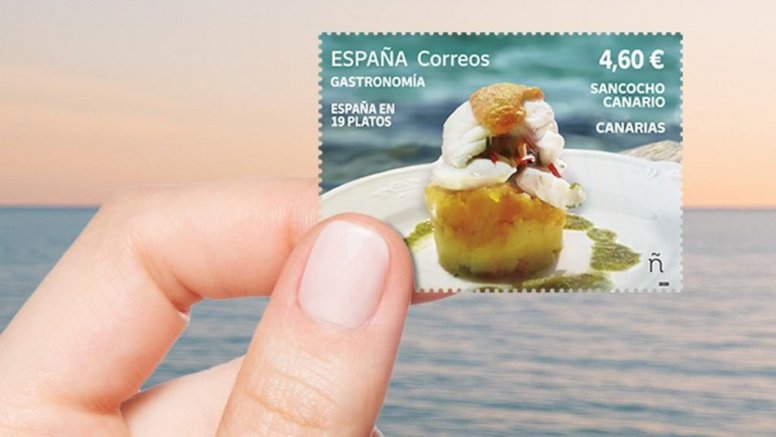
Correos celebrates the identity of the Canary Islands with a new philatelic issue, within the series ‘Gastronomy’, dedicated to sancocho, the stew that defines the palate of the islands. Unlike the popular versions in Latin America and the Caribbean -where sancocho is a soup of meat, cassava, and plantain-, the Canarian recipe is a unique ritual composed of desalted fish, potato, sweet potato, and the inseparable mojo picón.
Although its aroma of sea and land floods kitchens throughout the year, sancocho reaches its maximum splendor on Good Friday. In addition to complying with the religious tradition of avoiding meat, this dish has become the heart of family gatherings, uniting Canarian generations around a shared table.
The history of sancocho is the history of the Canary Islander's adaptation to their environment. Its origin dates back to the 19th century, a time when fresh fish was only accessible in coastal towns. It was the salting technique that allowed this product to reach the interior of the islands and be preserved for months, laying the foundations in the early 20th century for what we know today as sancocho.
Curiously, although the term "sancocho" is used in various Latin American countries to describe stews or broths, in the Canary Islands the word acquired its own nuance that has even been recently recognized by the Royal Spanish Academy (RAE). In the islands, "sancochar" is synonymous with boiling and the resulting dish is a dry and balanced combination of primary flavors.
The pillars of flavor: Wreckfish, potatoes and gofio
Not just any fish is suitable for making an authentic sancocho. Salted wreckfish is the undisputed king, valued for its firm and white flesh, although other varieties such as corvina or cod are also used. The process begins days before with the desalting, a ritual that requires patience and several changes of water.
The dish is composed of four fundamental elements that must coexist in harmony on the platter: the desalted fish, boiled to its exact point so that it does not lose its texture; the potatoes and sweet potatoes, which cooked together provide the contrast between the saltiness of the fish and the characteristic sweetness of the sweet potato; the gofio pella, which is a dough of gofio (toasted cereal flour) kneaded with water, a little sugar and, sometimes, oil or pieces of cheese, which serves to accompany each bite; and, finally, the mojo: both the red (spicy) and the green (of cilantro or parsley) are responsible for giving the final touch of intensity to the whole.
Despite its status as a Canarian national dish, sancocho faces modern challenges as most of the ingredients that make up the Good Friday recipe -from fish to legumes or cereal- are increasingly imported from abroad, putting at risk the purely local "DNA" of the raw material.
However, the fervor for sancocho does not wane. On social media, Canarians boast about their cauldrons as a symbol of pride, and local restaurants continue to elevate this humble recipe to the category of delicacy. Eating a sancocho is not just feeding oneself; it is biting into a piece of the history of the Canary Islands, a tradition that resists being forgotten as long as there is a good piece of cherne and a pella de gofio on the table.
This stamp can be acquired at Post Offices, through Correos Market, or by contacting the Philatelic Service at the e-mail atcliente.filatelia@correos.com or by calling 915 197 197.
Add La Voz de Lanzarote as a preferred Google source.
Stay informed with the latest current news.