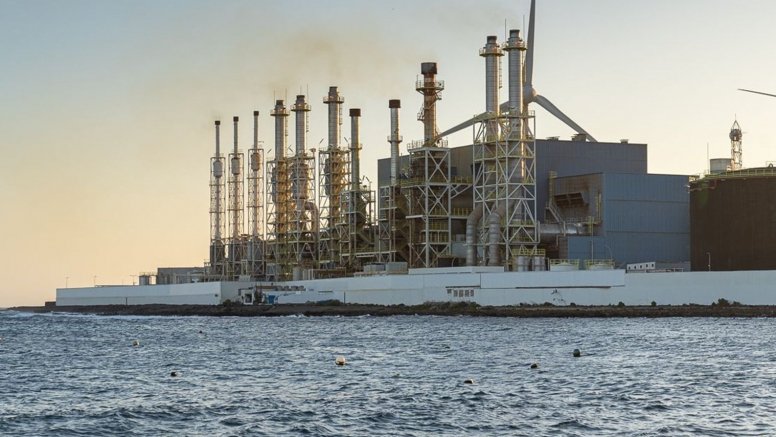
The air quality in Lanzarote due to atmospheric pollution has been for several days ranking between the parameters of "fair" and "unfavorable" in relation to tropospheric ozone, known as bad ozone, a greenhouse gas and one of the main atmospheric pollutants in Europe.
All stations of the Air Quality Control and Surveillance Network in the Canary Islands that measure the Canary Islands Air Quality Indices on the island show regular air quality on Thursday morning due to tropospheric ozone. Among them, several meters in Arrecife, the Las Caletas station and the Costa Teguise station. Added to this situation is the unfavorable air quality generated by the calima in one of the Arrecife stations.
But, what is tropospheric ozone? Also called "bad" ozone, this gas has negative effects when it presents high concentrations. According to the Ministry for Ecological Transition, it is produced by combining pollution from vehicles, ships and airplanes and power plants with solar radiation.
This gas causes negative effects on the health of the population, on vegetation, on biodiversity and also on the functioning of systems and is one of the gases that contributes to the warming of the planet and to climate change. In the health of citizens it generates respiratory problems and can indirectly affect food crops.
Thus, the pollution derived from traffic and the power plant adds to the fact that the Canary Islands is the Spanish autonomous community with the highest ultraviolet radiation. This very weekend a "very high" radiation level is expected.
The Las Caletas plant, several days above WHO recommendations
The report on the air quality in the Spanish State during 2024, published last summer by Ecologistas en Acción, reported that the Endesa station in Las Caletas exceeded for several days the tropospheric ozone levels recommended by the World Health Organization.
The highest concentration of tropospheric ozone occurred in Las Caletas, the town bordering Endesa's thermal power plant in Lanzarote. In total, this coastal town experienced 26 days for more than eight consecutive hours with values above one hundred micrograms per cubic meter of this greenhouse gas. Despite this, the WHO only advises that it be exceeded for a maximum of three days a year.
Another air measurement point located in Arrecife that measures the impact of the Endesa power plant exceeded for five days and more than eight consecutive hours one hundred micrograms per cubic meter of this pollutant. Meanwhile, the Costa Teguise meter showed that one day this value was exceeded.
In Lanzarote, there is the aggravating factor that due to its proximity to the African continent, tropospheric ozone pollution is added to that of African dust. The numerous episodes of high pollution were aggravated by the intrusion of particles less than ten microns, which exceeded 500 micrograms per cubic meter in Lanzarote.
To which is added the presence of nitrogen dioxide, a polluting gas coming from vehicle smoke and industry. The same report by Ecologists in Action highlighted that Arrecife's pollution meter, located near the power plant, also added eleven days with more than eight consecutive hours of values above 25 micrograms per cubic meter, when the WHO only advises a maximum of three days.
Add La Voz de Lanzarote as a preferred Google source.
Stay informed with the latest current news.