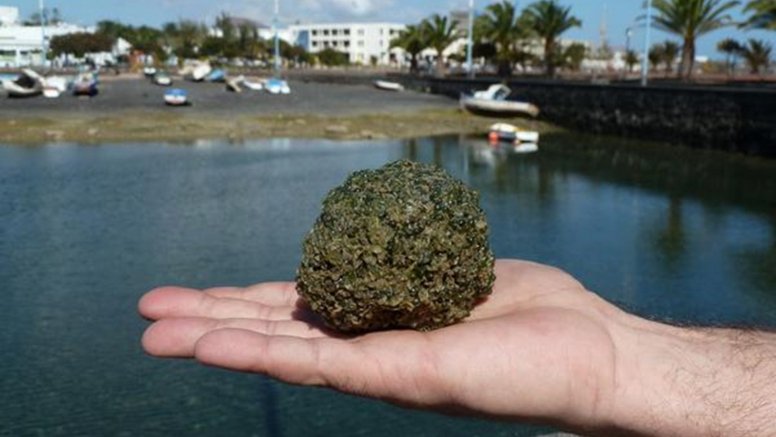
As we already know, terrestrial vegetation is responsible for purifying the air by absorbing carbon dioxide and generating oxygen. However, this does not only happen on land, but also under the sea. This is the case of the species Valonia aegagropila, an alga present in the Charco de San Ginés and which represents the greatest ally for the purification of its waters.
Tenerife and Lanzarote, as well as in Italy, is where we can see this singular species of algae due to specific characteristics. El Charco de San Ginés is a lagoon system, so "it has a restriction of water flow because it only has water intake in one area," explains marine biologist Giacomo Palavicini. Furthermore, this area was very important decades ago for the fishing industry, and "much of the organic waste we generate in the city ends up in the Charco de San Ginés area, so there is a lot of organic matter."
This organic matter, according to the expert, "is a favorite food for many algae". And it is that "algae can be bioindicators, that is, they reflect that there is a very important ecological contribution that serves to know if the conditions are good or bad", indicates Palavicini.
In the case of Wallonia, they are bioindicators of "healthy regeneration of an ecosystem", since the function of this type of algae is very important "by serving as shelter and food for many species". This algae is found all year round in this area, but there is a greater abundance in the months when solar radiation is higher, that is, in spring and summer.
Characteristics of Wallonia
Although we see this species floating in the water, Valonia actually lives attached to the seabed, but ends up coming to the surface. This happens, according to the biologist, because "by performing excess photosynthesis, it forms gases".
At the beginning of its life, it acquires a suction cup shape that makes it attached to the bottom of the Charco de San Ginés which, in this case, is formed by a kind of clay and sand. One of its most unique characteristics is its ball shape.
Regarding its life expectancy, it can live several years although everything depends on the climatic conditions. "It depends a lot on the warming of the water," he indicates. "When talking about a lagoon area like this and dependent on the tides that cause a faster exchange, the water can heat up much more," he assures.
Despite the fact that the algae can withstand high temperatures in the summer months, if it increases too much due to heat waves and haze, this "can affect the water temperature and kill it".
Regarding its size, it is variable. It can reach the size of a fist although its growth is closely linked to the sun it receives and the organic material it absorbs.
Its positive impact on the Charco ecosystem
The biologist emphasizes that its survival is also linked to the tides and they depend on them throughout the year. "It is a very important alga to protect the biomass and biodiversity of species within the Charco de San Ginés because those same species that Valonia protects help regenerate the ecosystem," he details.
On many occasions, if we walk next to the Charco we can notice a bad smell, like decomposition, something that we often relate to this alga. However, this smell actually comes from the decomposition of the stagnant water itself in some areas of this space in the capital. "It is these algae that are responsible for cleaning this decomposition of the water, for providing nutrients like phosphates that serve other algae or fish," he highlights.
These species include different types of crustaceans, invertebrates or mollusks that "have a very important function, in addition to the contribution the alga makes in oxygen and in cleaning the system".
As Giacomo Palavicini explains, the value of this type of species "is not in itself, but in the value it provides in a more complex ecosystem where each one has a specific function." And the Charco de San Ginés acts as "a refuge for fish larvae and fry that are vital for fishing, diving or the ecosystem itself."
Other species that have a positive impact on the Lanzarotean ecosystems are, for example, sea sponges, which have a great filtration capacity and serve as a refuge for many fish. Also sea cucumbers, which are responsible for cleaning sediments, and mollusks, which filter the water.
Sargassum, a threat to Valonia aegagropila
Sargassum is an alga that in many areas of the world causes serious economic and biodiversity problems when it reaches the coast. It is a brown-colored species that in Lanzarote we can sometimes see piled up on the shore.
They cause a bad smell when they begin to decompose and it also becomes difficult to bathe when the amount of this algae is large. Furthermore, its increase is related to climate change and water pollution, which causes the nutrients in the oceans to increase and, with them, a greater presence of sargassum.
"The problem arises when there is a large input of organic material or waste, which can benefit an alga that is not as important as Valonia," points out the expert, who notes the absence of studies on this spherical alga. "There is a lack of studies to establish the fragility of the Charco de San Ginés lagoon system because it is small and surrounded by the entire city of Arrecife," he continues.
However, Palavicini sees it as positive that more sustainable activities such as kayaking or canoeing are increasingly promoted in this area of Arrecife, as it "encourages greater care of the area because the city's own people make use of this resource and benefit the fauna and flora that inhabit the Charco de San Ginés".
Add La Voz de Lanzarote as a preferred Google source.
Stay informed with the latest current news.