What do we do with the waste we generate in this limited territory? What options are there for a pallet, a plastic bottle, or a tin can, other than ending up in the landfill or abandoned in some corner of the island's landscape? Or where does the plastic end up that, pushed by the wind, travels lost and aimlessly across this small stretch of land?
CACT, Waste and Reintegration attempts to answer these and many other similar questions. It is a circular economy project launched by the Art, Culture and Tourism Centers, with the support of the Chacón business group, the Papacría association, and Derecho y Justicia, which provides a second life to the waste generated by daily activity in the Tourist Centers, such as pallets, glass bottles, cardboard, or plastics, through recycling.
Methodology of a project that is "much more" than a brilliant idea
José Goñi, a professional with extensive experience in artistic recycling and the person in charge of the project, has taught a training program at the Ángel Guerra Social Insertion Center. Over several sessions, a group of sixty inmates from the Tahíche Penitentiary Center acquired theoretical knowledge and began to transform the waste generated in the Tourist Centers into works with a strong social and environmental component.
Among the most striking transformations, the reuse of cardboard stands out, which, in some cases, gives life to filing cabinets and folders for internal use, and in others replaces bubble wrap in product packaging. This closes a circuit that reduces waste, eliminates single-use plastics, and offers a new opportunity for resources within the organization itself.
In Tourist Center stores starting this Wednesday
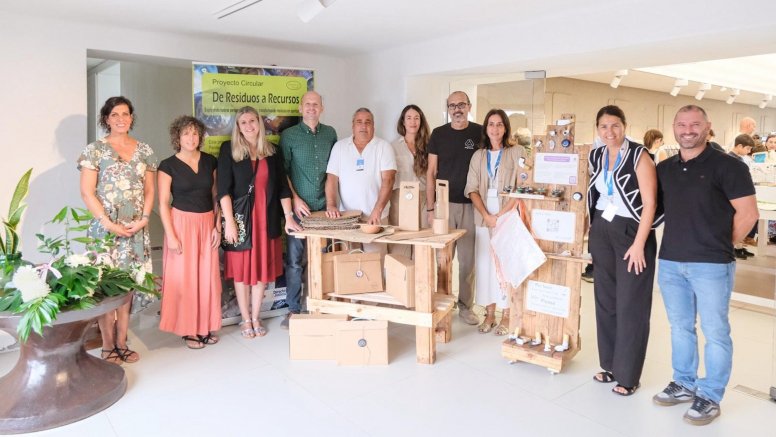
After months of learning, work, and production, the result of an initiative that "is much more than a brilliant idea" was presented today in Jameos del Agua, according to the Entity's counselor, Ángel Vázquez. "It is an opportunity for the reintegration of people in vulnerable situations that awakens sensitivities around the sustainability of ecosystems and contributes to the protection of our landscapes."
Exhibitors, bags, all kinds of souvenirs, bottle packaging, jewelry, and handcrafted items are just some of the products that can be purchased starting today in the Tourist Centers' network of stores. The profits obtained from the sales will be allocated to the project.
Accompanied by Carlos Armas, representing the Chacón group, Tharais Armas, from Derecho y Justicia, and José Goñi, from Papacría, the *alma mater* of the project, Vázquez was able to enjoy the "work, expertise, and good work of those who have participated in a social initiative that aims to make life more pleasant for people and offer an opportunity to the planet." Also present during the visit were the Deputy Director of Security, the Social Educator, and the Jurist from the Tahíche Penitentiary Center.
CACT, Waste and Reintegration also aims to prevent recidivism; contribute to reducing socio-family vulnerability faced by the population that completes their sentence and their families; and promote the reduction of addiction consumption during the serving of sentences, enabling healthy leisure and free time spaces.
### ### “The workshop is a moment of freedom”
For many participants, the workshop has been a space for change and expression. "Motivation," says one. "Incredibly ingenious," comments another. Others define it as "creativity and imagination," or simply "a way to enrich what no one wants and to make the most of time." Some link it to "its contribution to the island's sustainability," and others define it as "Self-recovery." For some, it was "a moment of freedom."
In light of the result, the Director of Tourist Centers pledged this Wednesday to continue with a second edition.
Add La Voz de Lanzarote as a preferred Google source.
Stay informed with the latest current news.