A study carried out by the Finnish universities of Helsinki and Jyväskylä, the German University of Kassel, and the Canarian University of Las Palmas de Gran Canaria, and published in the British Ecological Society (Sociedad Británica de Ecología in Spanish) states that nature "plays an important role" for tourism traveling to the archipelago. Meanwhile, it warns that if the number of visitors continues to grow, pressure on natural areas will also intensify, driving mass tourism in these spaces and putting their conservation at risk.
The research delves into the geolocation of more than 723,000 publications that tourists have made on the social network Flickr, an image and video server, about the Canary Islands over eighteen years.
The work, published last March by five researchers, states that travelers do not only come to the archipelago to enjoy the sun and the beach, but also travel to its natural spaces. Thus, they highlight the role social networks play in expectations about the destination and the growing pressure on natural areas.
The geographic analysis of publications disseminated between 2004 and 2022 shows that a quarter of the photos published on the platform and georeferenced in the archipelago showed content related to nature. Of these, the majority (75%) correspond to protected areas of the islands. These images have also received ratings from users from other countries.
Seven protected areas in Lanzarote, among the most in-demand
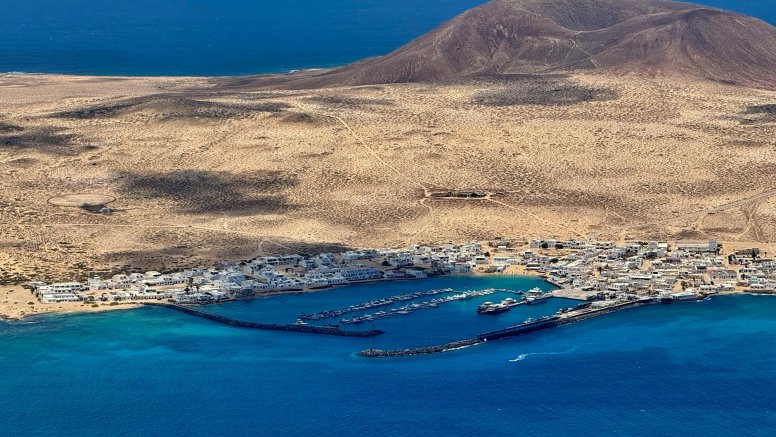
Of the twenty most visited protected areas in the Canary Islands, according to content published on Flickr, seven are from Lanzarote. The third natural space in the Canary Islands with the most visitors is the Chinijo Archipelago Natural Park, a protected area of 460 square kilometers, which has accumulated 1,720 photographs on this platform. In fourth place is the Los Volcanes Natural Park, with 1,591 photographs and an area of 100 square kilometers.
The special protection area for birds of the Bocayna strait, between Lanzarote and Fuerteventura, also accumulates 971 photographs on this network, in eleventh place; followed by La Geria, in twelfth place, with 905 photographs; Timanfaya National Park, with 784, in fourteenth place; followed by the scientific interest site of the east and south of Lanzarote, protected by the European directive, with 764 photographs; as well as the Natural Monument of Los Ajaches, with 615.
Nationality influences how people interact with nature
The research also includes the popularity of each environment, depending on the tourist's country of origin. Thus, it indicates that of the 17,213 users analyzed, Spaniards, Germans, and tourists from other Central European countries had published at least one photograph of nature, but this figure decreases among the British and those from Nordic countries.
Meanwhile, of the publications about nature, among the British there are more publications about the coast, as is the case with the Nordic, Spanish, and other Europeans. While Germans prefer the lush forests of islands such as La Gomera, Tenerife, Gran Canaria, or La Palma, the British have arid landscapes as a second option.
The research explains that reconciling recreational activities in nature and its conservation "will be increasingly difficult" if tourism growth continues. Thus, the study points out that natural spaces and, in particular, protected areas, risk becoming increasingly tourist attractions, following the wake of the tourist "commodification" that other spaces on the islands have already experienced.
The study published in the British Ecological Society highlights that restrictions on access to natural spaces, such as charging a fee or requesting a permit, serve to "mitigate the ecological impacts of large visitor flows," but can "undermine" the role that protected areas have as social spaces.
Finally, the research urges the search for "flexible, participatory, and multilevel approaches" that combine conservation with the recreational use of spaces.
Add La Voz de Lanzarote as a preferred Google source.
Stay informed with the latest current news.