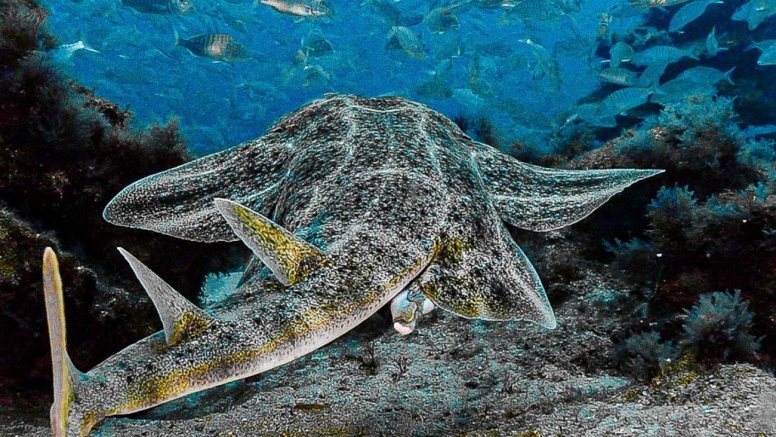
The Canary Islands harbor a species of shark threatened throughout the world. Among all the oceans of the Earth, the angel shark has found a space for hope on the coasts of this small archipelago, neighboring the African continent. Thus, the Islands have become the last bastion for one of the angel shark species, Squatina Squatina. In this role, Lanzarote is extremely important.
"If the word angel shark is mentioned, everyone thinks of the Canary Islands," confesses the co-founder and co-director of the Angel Shark Project: Canary Island project, Eva Meyers, to La Voz. The angel shark or angelshark is a species of shark from the Squatinidae family. They have a flat body and pectoral fins similar to those of a ray or stingray, but they actually belong to the shark family. They are not as large as whale sharks, the largest fish in the ocean, but they can reach two meters in adulthood.
Its presence on highly visited beaches such as Jablillo in Costa Teguise or in different areas of Puerto del Carmen makes it another resident of the island. "The genetics of the specimens that reside in the Canary Islands is unique in the world and they only move within the Archipelago itself," explains Meyers. In particular, "the population of Lanzarote, La Graciosa and Fuerteventura seems to be connected. They could be a single population, a huge habitat," she explains.
This European project, financed by a collaboration between institutions, was born in 2013 while Eva Meyers was developing her Master's Thesis with the University of Las Palmas de Gran Canaria (ULPGC). At that time, it started with a collaboration between the Canarian institution and the Zoological Society of London. Currently, a third partner, the Alexander Koenig Zoological Museum (ZFMK), has joined.
Currently, this initiative is "a network of collaborators, including researchers, government, divers, fishermen and photographers." The monitoring on several islands, including Lanzarote and La Graciosa, has turned the Autonomous Community into a "natural laboratory." In the world, there are not as many breeding areas as can be found on the eight islands of the Archipelago. In addition, those of the eastern islands and Tenerife stand out. This learning is then used to apply it to other parts of the world, where about twenty species of angel shark live.
The ideal environment for angel sharks are shallow areas and within the coast, a space away from fishing and tourism. "We give priority to conserving critical areas. In the Canary Islands there are ideal conditions, but you have to give it space and tranquility."
Knowing to protect
The aforementioned project arrived in the Canary Islands with the aim of collecting data on the ecology of the angel shark, as well as reducing mortality and disturbances that it suffered in its habitat. All to ensure the future of the species. After that, the angel shark entered the Spanish Catalog of Protected Species only four years ago, exactly in 2019, thanks to the awareness-raising work of this project. It was in that period when it was given the maximum protection contemplated by law and it was declared an endangered species. Since then, it is forbidden to attack the integrity of this animal, damage its environment or market it.
In the Angel Shark Project: Canary Island team, a dozen experts, including researchers and geneticists, ensure that the angel shark is preserved in its Canarian habitat. Despite this, field work has not yet allowed us to estimate what the real size of the angel shark population in the Archipelago is. However, they estimate it to be above 500 individuals.
Each female can have between seven and 14 pups, but Eva Meyers reveals that not many of them survive. These neonates are monitored in breeding spaces. At that time they measure between 22 to 24 centimeters and grow in the breeding area until they reach 50. After that, they leave these spaces and return when they exceed 80 centimeters, reaching up to one meter long. At the moment, these researchers do not know where they go during that period of time. Although there is no fixed data, the perception of this team of experts is that the mortality rate "is quite high."
To know data like these, they not only feed on their own samples, but citizen science plays an important role. "We have agreements with diving centers or fishermen who inform us of sightings and thus we can learn about the progress of these animals and their movements," Meyers explained.
These follow-ups are done "very close to the coast." Thus, to avoid disturbing the animal as little as possible, monitoring is carried out visually. Initially, the pups are marked with tags, each one has a color and a unique code, which is also different on each Island. In the case of Lanzarote they are identified with a green tag. Meanwhile, in La Graciosa they are monitored with acoustic signals. In this way, they can know if they move or relate between islands. The sightings and reports make it possible to get an idea of the animal's routine.
These traces allow us to know the age of each animal, what the life expectancy is, but it has also served to discover that, once they grow and after going out to deep sea, the angel sharks "return to the same sites after years."
Canary Islands, "a unique place"
The angel shark family "is the second most threatened family of sharks and rays in the world," explains Eva Meyers. The Archipelago is "a unique place" for the preservation of this species of angel shark. "It was thought that the Canary Islands was the last population for that species. Now it is known that it is not, but the Islands are the only place where it is seen frequently," she adds. Regarding these sightings and in the particular case of Lanzarote, a study carried out by this project between 2014 and 2015 shows that Puerto del Carmen (Tías) is one of the four points in the Canary Islands where angel sharks can be observed the most.
The value of the La Graciosa Marine Reserve
To conclude, the continuity of this species is also supported by well-cared for seabeds, with variety and quantity of food. An example of this is the La Graciosa Marine Reserve, which has great value in the preservation of this species.
The angel shark, as a predator, enjoys a feast of food on the eighth island. "In La Graciosa there is more surveillance, more protection and control measures," concludes the co-founder of Angel Shark Project: Canary Island.
Add La Voz de Lanzarote as a preferred Google source.
Stay informed with the latest current news.