A scientific study published in the journal Fossil Studies reveals that the eggs discovered in Lanzarote in the mid-20th century are not ratite, a type of ostrich, despite what was previously believed. Specifically, the remains were found in the northern area, near Órzola. The scientists conclude that they are elephant bird eggs, a type of extinct non-flying animal native to Madagascar that reached a height of three meters and a weight that could reach up to 650 kilos.
The scientists point out that these birds "lived during the Lower Pliocene on a smaller island, one-third the size of present-day Lanzarote, which today constitutes the northern area of the island." The analysis of the eggshell indicates that only one species of this bird inhabited the island, since the reduced size of the island meant that it "could not provide food and water resources to two populations of the same species of large, herbivorous or omnivorous birds."
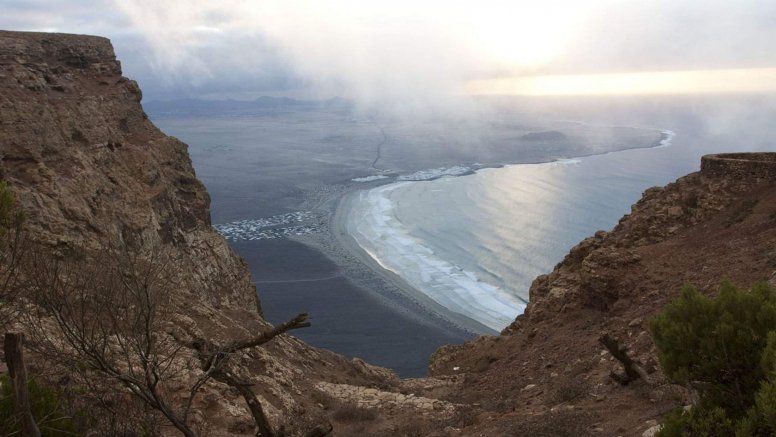
According to the study, it is believed that these animals probably crossed to the island from Africa around four million years ago. In total, several thousand fragments of ratite eggshells have been collected, mainly in three locations in the Famara massif: in Valle Grande, Valle Chico, and Fuente de Gusa. Additionally, seven complete eggs, two external molds, and half a shell have been found.
The analysis of the eggs reflects that the females that laid three of the four eggs indicate that they "reached quite large sizes compared to current wild ostriches." The small dimensions of the nests found in Lanzarote would be due to the laying of only one or two females.
After analyzing the eggshells, the scientists have discovered that neither the pore pattern nor the corresponding figures of the fossil pieces coincide with the characteristic pore pattern of S. c. camelus eggs, the most well-known ostrich species.
As the researchers explain, "during incubation, the surface of the ratite egg is subjected to intense friction against the ground, which can totally or partially erase the pore pattern. Sometimes, only a few very scattered individual pores remain. Eggshell fragments with this appearance are very numerous in the Lanzarote record, indicating that they come from incubated eggs. However, the appearance they acquire after rubbing against the ground does not resemble the pore pattern of Struthio eggs or any other ratite."
"It is also possible that the various degrees of erosion have led some researchers to believe that the pore pattern varied along the surface of the egg. This has not been observed in any complete ratite egg, either modern or fossil," they continue.
Regarding how these birds arrived in Lanzarote, the study considers several theories. One of them suggests that the animals could have reached the island through a kind of "land bridge" from the African continent, due to the proximity of the Canary Islands to it. Another idea indicated is the possibility that heavy rains in Africa washed the eggs into the sea and that, due to the current, they reached Lanzarote. However, the scientists rule out this last option because no marine elements have been found next to them.
Add La Voz de Lanzarote as a preferred Google source.
Stay informed with the latest current news.