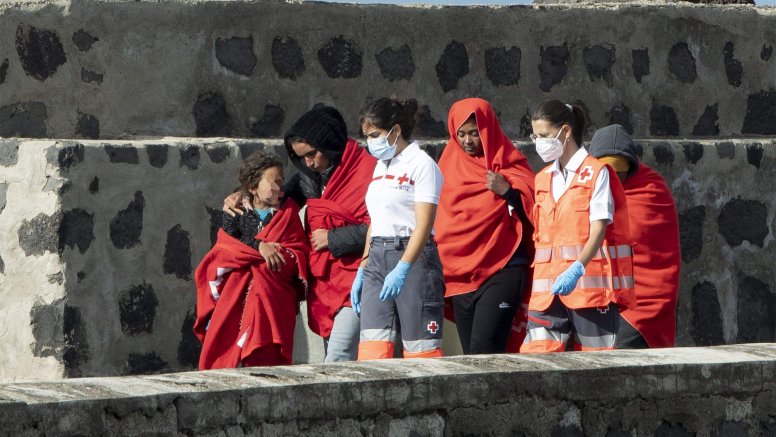
Lanzarote has become the Canary Island where the most migrants receive their first care upon arrival in Europe. A total of 41 precarious boats have arrived at the island between January 1, 2023 and this past Thursday, May 4. According to data provided by the Red Cross, which may vary from the official data handled by the Ministry of the Interior, 1,816 migrants have been assisted in this period.
In total, according to the biweekly figures published by the Ministry of the Interior of the Government of Spain, until last April 30, 3,211 people had arrived in the Canary Islands in inflatable boats or pateras from the African continent, 56.5% of them had arrived through Lanzarote.
However, the fact that they arrive on the island, due to its proximity to the points from which the inflatable boats depart, does not imply that they stay there. The central government's transfer system works more agilely than in the year after confinement, when the islands became a kind of prison and the mobility of people was restricted.
Specifically, between January 1 and April 15, 2,376 people had arrived on the islands, so 59% of the migrants had been relocated to other autonomous communities. The data provided by the Government Delegation in the Canary Islands to La Voz, placed only 977 of the migrants still in the Archipelago in the past week from April 17 to 23. Which means that the rest had been relocated to other autonomous communities.
"The majority of people who arrive in Lanzarote are transferred," they assure from the Red Cross, although they do not provide the exact figures. Neither does the Government Delegation in the Canary Islands to avoid disclosing the logistics of the transits.
Children, almost 27%
Of the people who arrived in this period, 26.9% are minors. A total of 489 children have arrived so far on the island of Lanzarote. Of these, almost half, 226 children arrived alone. The rest, 53.8% did so accompanied by one of their relatives. This distinction is given because unaccompanied minors enter directly into the reception system for protected minors.
Of the 1,816 migrants cared for by the Red Cross, the organization present at all disembarkations, in Lanzarote 10.3% have been women. Thus, the Canary Route and in particular the arrivals to Lanzarote continue to be led by men. Mostly, the people who have arrived on the island in the last quarter are mostly of Maghreb or sub-Saharan origin. At the moment, no people of Asian origin have been located in the Red Cross data, as happened at specific times with arrivals from Bangladesh, for example.
In the case of women, eleven of them were pregnant and eight were breastfeeding. According to data provided by the NGO, of the people cared for on the island of Conejera, 11.8% required health care, five had disabilities and one person died.