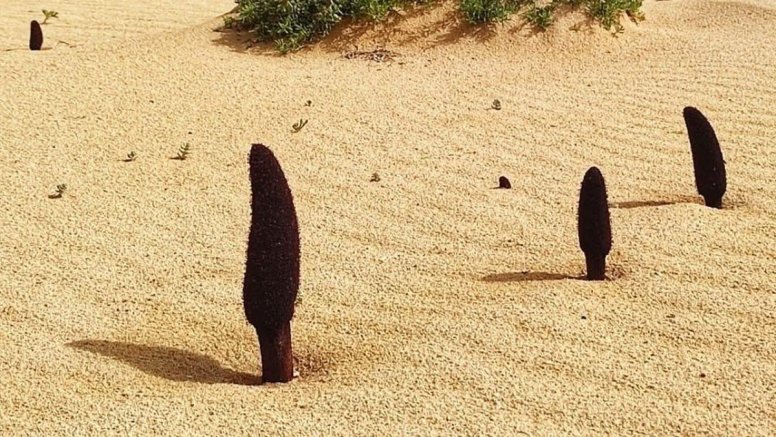
The abundant rains that fell in Lanzarote and La Graciosa between December and January have caused various plant species, some endemic, to germinate from land that has changed its usual black mantle for a green one. Species such as verode, vinagrera, yerba múa, or poppies are well-known, but there are others so curious that among their characteristics are the absence of photosynthesis or medicinal use.
Matías Hernández, an environmental scientist and coordinator for the Arrecife Natura Environmental Association, travels the island in search of many of these species to photograph and appreciate them. He shares many of these images on the Instagram profile of Chaboco Natura, where he disseminates information about the flora of Lanzarote and La Graciosa. Additionally, through Arrecife Natura, he leads tours around the island to observe these plants.
In an interview with La Voz, Hernández explains the characteristics of different plant species with the support of two books that detail the ancient uses of species through information **gathered from the testimonies of shepherds and farmers** on the island. These are Flora Vascular de Lanzarote, by Jaime Gil and Marta Peña, and Usos culturales de las yerbas de los campos de Lanzarote, also by Jaime Gil, Marta Peña, and Raquel Niz, which serve as a guide to better understand the island's vegetation
One of the species that emerges from the sandy soil of Lanzarote and La Graciosa after the rains is the broomrape (Cistanche phelipaea), a parasitic plant that does not photosynthesize, as it lacks chlorophyll. "To live, it absolutely needs to parasitize the roots of other plants, which are normally coastal scrub plants on the island and Fuerteventura," explains the environmentalist. In this way, "when the seed germinates, it has a limited time to form structures to obtain nutrients from the plant it parasitizes."
Despite being native to Macaronesia, it is also distributed in other parts of the world such as the Mediterranean basin and the Sahara. "It likes sandy soil because it develops a very thick underground part and can grow well in this type of soil," he points out. Likewise, the batatera, so named because its tuber resembles the sweet potato, is consumed in other parts of the world, although there is no record of it being consumed in Lanzarote. "That it was called that in Lanzarote may indicate that it was consumed in the past," he continues.
The ajillo gato (Colchicum psammophilum) is also a species that grows with the moisture in the soil from winter rainfall. It is a bulb that germinates with the rains in the sandy soil and can live for more than two years. It is a plant with ephemeral beauty, as its flowering "lasts very little".
The sea star or buck's-horn plantain (Plantago coronopus), as it is known in Lanzarote, is a type of flora that also covers some areas of the island at this time of year. "It is an annual species and grows in both sandy soil and other types of soil," explains the environmentalist.
Without a doubt, one of the most unique and strange plants we can find in La Graciosa is the pingatierra (Cynomorium coccineum), which only inhabits the eighth island, the only place in the Canary Islands where we can enjoy it. Until 1842, at the very least, there are records indicating that this species existed in Lanzarote at that time. Currently, it also extends to other parts of the world.
Furthermore, the ancient inhabitants of Lanzarote fed on it and "it may be one of the reasons why it disappeared." It is parasitic and one of the difficulties it has regarding reproduction is that the seed must find the roots of other plants to germinate and adhere to them. Otherwise, they die. "If they fed on it in Lanzarote, it means that they collected it before it dispersed its seeds, which caused its population to be reduced until it disappeared," the expert points out.
Cynomorium coccineum has been known for hundreds of years in all cultures of Europe, Africa, and Asia. It is in the latter continent where it is most used and produced as an agricultural crop, both for its gastronomic use and for its **healing medicinal properties**, something supported by popular culture and scientific studies.
Another of the bulbs that are part of Lanzarote's biodiversity is Autonoe latifolia, which has broad leaves and its showy flowers appear in a spike formation. "It has great ornamental value but its flowering period is very short; within a week, the flowers are practically dry," he explains.
Year after year, with the rains this bulb germinates, which **remains dormant during the dry season** that lasts most of the year on the island
On the other hand, one of the species most expert at camouflaging its flowers is Arisarum simorrhinum, whose inflorescences are hidden beneath large, bright green leaves
It germinates from a tuber found underground, which **was formerly used in Lanzarote to feed pigs**. However, **Lanzaroteños themselves also consumed them** during times of scarcity
Along the roadsides, we can find some species that use them as the perfect place to germinate. This is the case of Ononis hesperia, a legume that grows in a shrub form and whose flowers are yellow with fine red stripes on their reverse side.
It was used as animal feed and in Lanzarote it is known as codeso, among many other names.
Finally, we cannot forget a species of flora that is very common in the western islands and Gran Canaria due to the great humidity that always exists in certain areas, but which is not usually seen in Lanzarote. This is the fern, of which we find **two types** in Lanzarote.
The **doradilla** is usually seen in the crevices of the malpaís where there is shade and humidity. **Its rhizome sprouts with the first rains** of winter until it dries up again after a few months.
In this case, in Lanzarote, this plant was used to combat fever, treat respiratory ailments, and as a remedy for the flu. Currently, it is still harvested for medicinal purposes, especially in the south of the island.
Add La Voz de Lanzarote as a preferred Google source.
Stay informed with the latest current news.