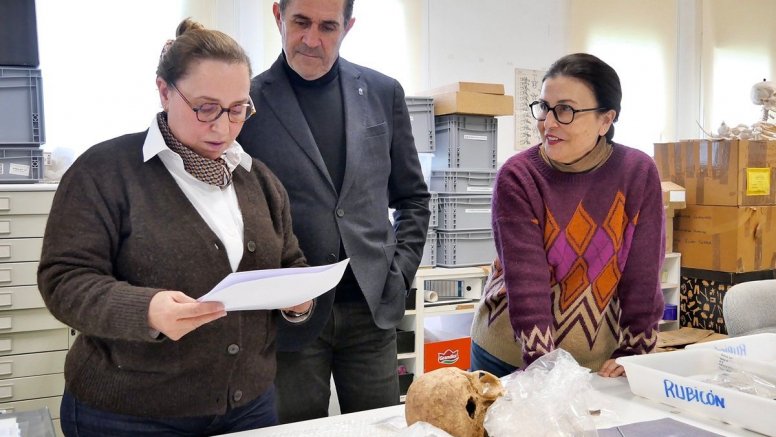
The latest campaign of archaeological excavations in San Marcial de Rubicón in Lanzarote has brought to light a multitude of bone, faunal, metallic and ceramic materials, among others, which evidence those first contacts between the indigenous culture and the European culture. After the field work, the research continues within the collaboration agreement between the Government of the Canary Islands, the Yaiza City Council, the University of La Laguna (ULL) and the University of Las Palmas de Gran Canaria (ULPGC) with the study of the materials in the Prehistory and Archeology laboratory of the ULL.
The co-directors of the 'Rubicón Project', doctors María del Cristo González and Esther Chávez, together with the company Baraka Arqueólogos and specialists in different areas, are carrying out the laboratory work that mainly consists of inventorying the elements recovered in this first European settlement in the Canary archipelago. In addition, the project has a strong teaching vocation, so students also participate voluntarily in the research.
The general director of Culture and Cultural Heritage, Miguel Ángel Clavijo, visited the ULL facilities to learn about the preliminary results of the laboratory work, "which is generally not seen, but from here all the historical information that these archaeological sites provide us is extracted," Clavijo assured.
During the meeting with the research staff, the general director stressed "the importance of the Canary universities in the study and knowledge of the history of the islands" as "absolutely fundamental" institutions to provide "a lot of information about the first cities of the archipelago", in this case.
It should be remembered that this site has a "high scientific and heritage level since the process of exploration and conquest of the Canary archipelago begins here in the 15th century." This is clearly reflected in the ceramics imported from Europe that "appear in the same contexts sharing space with indigenous ceramics, but not only indigenous ceramics from Lanzarote," González anticipates.
First results
The first results indicate that apart from the ceramic remains of Lanzarote, as usual, there are also some from Fuerteventura and Gran Canaria, something "unprecedented in this archaeological site." However, for González "it was to be expected because these findings are the materiality of what that written source that is Le Canarien tells us", where the expeditions to other islands by the Norman-Castilian company, led by Jean de Bethencourt and Gadifer de la Salle, are recorded.
As already announced during the field work, the research team located a necropolis with a dozen burials, among which the bone remains of three babies and an infant stand out. Some of them presented a "worse state of conservation", so "they were consolidated and transferred in block", following the instructions of the restorer Patricia Prieto, "so that they could be exhumed in a controlled place such as the laboratory and that their preservation was guaranteed in this way", explains González.
It is important to emphasize that the discovery of these infant individuals raises the possibility that this is the first mixed-race population of the Canary Islands. For this reason, all the bones "are undergoing a DNA analysis to determine their origin and radiocarbon tests to determine their chronology", González clarifies.
The archaeological research project at the San Marcial del Rubicón site will have continuity and greater stability thanks to the extension of the collaboration agreement between the Ministry of Universities, Science and Innovation and Culture, the Yaiza City Council, the ULL and the ULPGC, which has gone from two to four years in duration (2024-2027) with an increase in budget and resources.
Add La Voz de Lanzarote as a preferred Google source.
Stay informed with the latest current news.