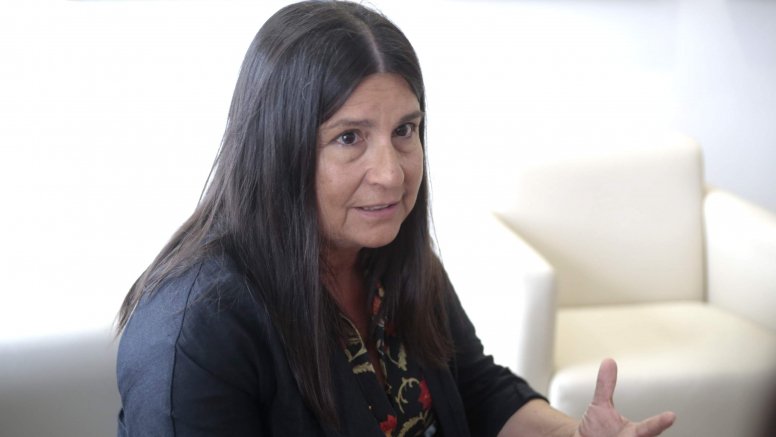
"Many minors start consuming porn without having had a sexual relationship with their peers before, so we can say that there are porn natives", reveals Dr. Esther Torrado, Doctor of Sociology and expert in sexual violence, pornography and prostitution, during an interview with La Voz. "Pornography is the pedagogy of sexual violence," she continues.
"The problem is that pornography is now being watched by young minors at very early ages. In our study, which we conducted in 2022, we saw how most consumers are minors who start consuming at eight years old and by 12 they are regular consumers," she emphasizes.
The problem with growing up normalizing pornography is that it makes young people "unable to separate the sexual violence they see in porn" and end up eroticizing said violence. She also assures that this consumption "is having an impact on the increase in sexual violence" in Spain and the Canary Islands.
Thus, the first times a minor comes across pornography is not voluntary. "Many times pornography finds them through networks," she points out.
Torrado highlights the importance of fining companies that allow underage children access to porn. In addition, she emphasizes the need to "educate, raise awareness and work hard" so that "group rapes or bukkakes" are not seen as a "normal" practice among young people.
The culture of rape and media cases
"Isn't it a big deal? Yes, it is a big deal." That is the question-answer with which Esther Torrado began her speech at a presentation she gave this past Thursday at the conference Keys for the prevention and intervention in sexual violence: identification and management of critical knots, organized by the Mararía association.
In this sense, she highlights that in media cases, such as the rape of Dani Álves on a young woman, "it is a big deal when the victim is questioned more than the aggressor." Torrado adds that "when the victim is questioned publicly, violence is being normalized and a culture of rape is being generated." Living through this type of situation, "victims are going to feel shame and fear when they understand that their experience is going to be questioned and not believed. That is one of the issues that causes the most terror to an assaulted woman."
The doctor from the University of La Laguna indicates that "what we have to ask ourselves is what makes a group of children rape a girl, what is happening? People who consume porn or prostitution are generally not sick, we must not pathologize."
In this sense, she attributes this type of behavior to "a patriarchal and macho education where women are objectified and hypersexualized." The only way to end it is to bet on "a feminist affective sexual education, based on human rights" and educate families from childhood about what sexuality, sex and violence are and not just "how to put a condom on a banana or prevent sexually transmitted diseases."
"We have to train so that when pornography reaches a young person, they are able to say this is not sex, I cannot get excited about this," she emphasizes. Torrado insists that if this change of mentality is achieved through education and by persecuting the dissemination of porn, "men will stop hypersexualizing women."
This reality affects relationships and the perception that men have of women. "Since we are born women, we are already objects of desire, we see how there is pedophilia, rape of minors, of babies and that is combated with a lot of prevention work and, above all, with laws that protect us," she continues.
Prostitution and the objectification of women
The expert in sexual violence, pornography and prostitution, Esther Torrado, indicates that "when we defend the abolitionist model [of prostitution], we are defending the pro-rights model for women and girls," explains the researcher.
The specialist defends the abolition of prostitution as the best alternative to prevent consumption, avoid the increase in trafficking and trafficking in human beings and offer other avenues to women who have been captured "by the force of necessity or by coercion."
Torrado, who is a founding member of the International Academic Network for the Study of Prostitution and Pornography, denies that "the women who are in the system are there of their own free will" and states that "that voluntariness or that consent is flawed."
As director of the Viosex research group, Torrado assures that the women she has met in this network are not there by "their own desire" and if they had alternatives, or society offered them, "most of them would not be in prostitution."
Thus, she reasons that "if it were a profession like any other, it would be mostly occupied by men. However, it is occupied by women and the demanders are men, which makes it an absolutely patriarchal institution."
Young and vulnerable women
Esther Torrado explains that women with resources and other alternatives are not in prostitution networks. "A fundamental element of recruitment is being in a situation of economic, family or psychological vulnerability. Poor women, undocumented women, women in a situation of vulnerability are the ones being recruited," she explains.
"We are seeing now in Spain how they are recruiting women who are in juvenile centers," she indicates. Thus, belonging to a unstructured environment, with few resources is a risk factor. To this is added the role of social networks, which are serving as a focus to "recruit these minors."
To tackle this situation, she reveals that the best way would be to prosecute pimping. However, the Congress of Deputies rejected last May a proposal to modify the Penal Code and prosecute pimps. "The political parties did not measure up, which means that above human rights and above women are partisan interests," she emphasizes.
Regarding the impact that the Spanish Immigration Law has on foreign women being part of the face of forced prostitution, Torrado, who is also part of the Chair of Globalization, Migration and New Citizenships of the ULL, explains that although she defends "that people have the right to migrate," women and the Immigration Law cannot be used to refuse to approve a law that prosecutes pimping."
The expert supports the idea of creating a Comprehensive Law through a State Pact that "establishes prevention measures" to prevent the continued generation of "future consumers of prostitution, consumers of pornography and future sexual aggressors."
Add La Voz de Lanzarote as a preferred Google source.
Stay informed with the latest current news.