Fishing has fed the population of Lanzarote for centuries. First it was a means of obtaining food and then it became a business that fed entire families. Throughout the last century, the island's fishing tradition led to several canning factories being erected on the island's horizon, where the island's women prepared fish for storage and sale; while the fishermen embarked for days at sea to catch it.
In 1995, the Government of Spain established the marine reserve of fishing interest in the surroundings of La Graciosa and the islets north of Lanzarote, in those years it became the largest in Europe, with more than 70,000 hectares, although it was later surpassed and is still the largest in the country today. Despite its protection on paper, this protected area suffers from poaching, insufficient surveillance, but also from the setbacks of the climate crisis.
An investigation published in Science direct warns that the reduction in fish catch in this marine reserve is not caused by sharks stealing fish while fishing, but by the climate crisis and "inadequate" fisheries management.
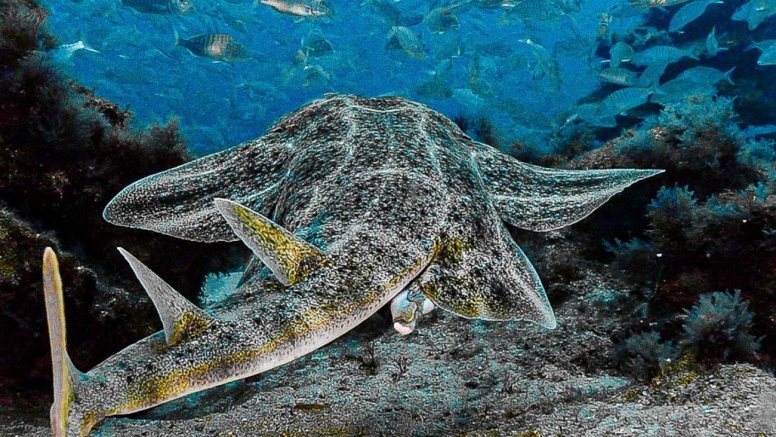
The study surveyed 26 fishermen from the artisanal fishing fleet of the port of Caleta de Sebo, in La Graciosa, and that of Órzola, in Lanzarote, who operate in both depths. These sailors assured that there were frequent encounters between fishermen and majarro sharks (Isirus oxyrinchus), thresher sharks (Alopias spp.), and hammerhead sharks (Sphyrna spp.), among others, and attributed 30% of the catch losses to shark predation. However, through more than 300 direct monitoring sessions, the researchers observed that only 0.7% of fish loss is related to sharks and revealed that the cause is more complex.
The oscillation between the Iceland low and the Azores high
These researchers explain that there are "strong correlations" between the oscillation of the North Atlantic, known as NAO, and the variation in catches that fluctuates each year. The NAO is a climatic phenomenon that measures the changes in the pressure difference between the Iceland low and the Azores high. "Depending on how those low and high-pressure nuclei move, the speed and intensity of the winds change, the upwellings are more or less intense, the water temperature rises or falls," explains broadly the graduate in Marine Sciences José Juan Castro Hernández, one of the seven researchers who were part of this study.
The Canary archipelago is on the edge of the NAO, which implies that when the Azores anticyclone moves, there are changes in the wind of the Canary Islands, from the north, more humid, or from the south, drier. Furthermore, the oscillation of the anticyclone of the Portuguese islands generates that the trade winds are more or less intense, promoting a greater or lesser production of fish in the waters of the islands.
Castro points out that if the NAO is in a negative phase, the water temperature is higher, while if it is positive, the temperature drops. This temperature is fundamental because it affects fish larvae and their probability of survival. It depends on this oscillation whether there is "more or less quantity of fish of some species, depending on the mortality caused by the temperature in the larvae," while if the sea conditions in the archipelago are not adequate, other species will migrate looking for better conditions.
It is common for the North Atlantic atmospheric circulation to alternate between negative and positive cycles. In fact, between 2014 and 2017 there was a period of negative NAO in which an "exceptional recruitment of deep-water species" was recorded and which led to record catches between 2018 and 2020. However, since 2021 "sharp decreases" have been recorded.
"Some can last more years than others or not be as intense depending on the general climatic conditions of the planet," adds the Bachelor of Marine Sciences, who explains that although the alternation "has happened and will always happen," the role of climate change influences its intensity and frequency.
Castro states that the artisanal fishermen of La Graciosa and northern Lanzarote attributed to sharks the theft of catches, because when from 2019 fishing began to decrease due to climatic reasons, sharks continued in the vicinity of the islands because there was an abundance of trumpetfish. "They are migratory species, but if they find food they stay longer," states the graduate, "fishermen, by fishing less and less, saw those interactions with sharks, which are normal, in a more negative way," he indicates. "I fish little and on top of that the shark takes part of my catch," he exemplifies.
Illegal practices and lack of oversight
To climate change, another factor is added, and that is that, despite this area being part of a maritime fishing reserve, illegal practices occur, such as fishing with pots, but also insufficient supervision by the Ministry of Fisheries and the Government of the Canary Islands. At the same time, Castro proposes that the minimum sizes of fish be increased, since most fish in the archipelago do not have this protection that allows them to grow more before being caught.
To which he has added that fish and sharks not only live in the marine reserve, but also move outside its limits, so it is not only important to take care of what happens in this space. "The sea has no borders, we are conditioned by what happens in other places," he adds, while explaining that the archipelago's marine reserves do not cover even 5% of its waters and those where nothing can be fished, barely 0.002%.
"In the reserves there is no catch limit for professional fishermen, they can fish what they want and when they want. There is a limit on fishermen, but not on kilos, so there is no exhaustive control," he warns.