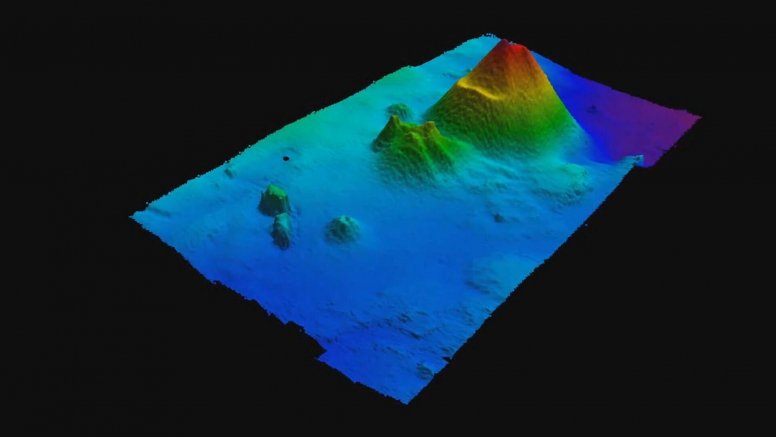
Outside of the Canary Islands, it is largely unknown, and among residents of the islands, it is not very common to find someone who knows of its existence, but between Gran Canaria and Tenerife there is an active submarine volcano, which regularly demands attention in the form of notable seismic movements.
With all eyes on Teide for a month due to the thousands of earthquakes being registered in its vicinity, all imperceptible except to scientific instruments, a slight tremor was felt this Thursday in a dozen municipalities in Gran Canaria and Tenerife, which even caused some objects to sway.
It had a magnitude of 4.1 and intensity III. In Tenerife, it was clearly felt around 12:26 p.m. in Santa Cruz, Güímar, La Orotava, Los Realejos, Santa Úrsula, Arafo, Arico, and Los Silos and, in Gran Canaria, in Las Palmas, Agate, Santa María de Guía, and Gáldar.
But, in principle, it has little to do with what happens under Las Cañadas del Teide: Its epicenter has been located in the sea, halfway between Porís de Abona (Tenerife) and La Aldea (Gran Canaria), and scientists associate it with the activity of the Enmedio volcano.
It is a volcano identified and mapped for the first time relatively recently, in 1994, which receives its name for obvious geographical reasons: it is right between Tenerife and Gran Canaria.
The journal 'Bulletin of Vulcanology' publishes this month research from the Spanish Institute of Oceanography (IEO), the Institute of Marine Sciences of Barcelona, and the Universities of La Laguna (Tenerife) and Salamanca that describes it for the first time in detail and provides evidence that it generates hydrothermal activity.
The Enmedio volcano has a conical shape, with a base diameter of 3.5 kilometers, which is located at a depth of between 2,140 and 2,350 meters (the greater depth corresponds to its northeast half).
It is, in fact, a mountain of considerable altitude (between 560 and 730 meters, depending on the slope from which it is measured), but whose summit is 1,625 meters below the sea surface.
It began to form in the Middle Pleistocene, about 240,000 years ago, in already "human" time, if that concept includes the moment when the first homo sapiens inhabited the Earth, along with other older species, such as homo heidelbergensis or Neanderthal.
In any case, it is much younger than any of the current Canary Islands, whose age ranges between 1.1 million years for El Hierro and 22 million years for Fuerteventura.
The Enmedio volcano presents a significant fracture that crosses it in a northwest-southeast direction and favors the circulation of hydrothermal fluids. And, around it, there are at least 20 other smaller volcanic cones, some of them with craters.
The work now published by the team led by the IEO details the changes that its hydrothermal activity causes in the sea, such as the fact that the water column located directly above its summit is half a degree warmer than the surrounding ocean.
Its hydrothermal flows generate another anomaly in the form of dissolved nutrients in the water: in its vicinity, and especially in the fracture zone, ammonium levels in the water exceed the normal for that area of the Atlantic by 400%, and those of silicates, nitrates, nitrites, and phosphates are between 3% and 8% higher.
Furthermore, the volcano and its surroundings habitually generate earthquakes. The 4.1 magnitude earthquake registered this February 26 in its area is neither the first nor by any means the largest: on May 19, 1989, Enmedio caused a 5.2 magnitude earthquake, with nearly 230 aftershocks.
Add La Voz de Lanzarote as a preferred Google source.
Stay informed with the latest current news.