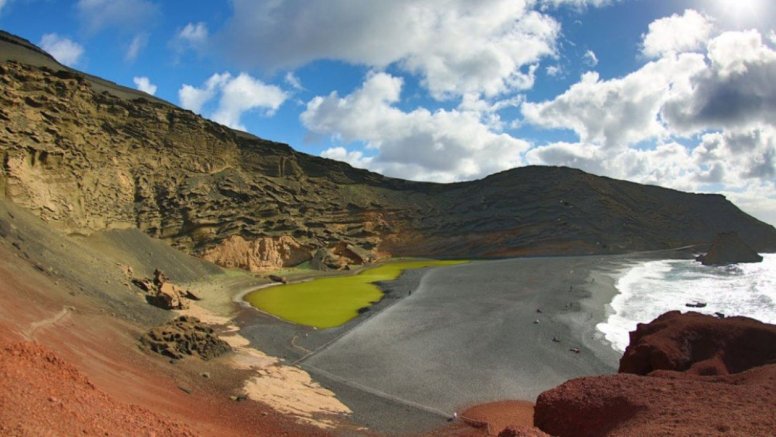
The end of the coronavirus pandemic came hand in hand with the current tourist overcrowding of Lanzarote and many of its natural spaces. The possibility of making short trips, with minors and accessible from the general roads, add to the "call effect" generated by audiovisual productions and the impulse of social networks.
This excessive growth of some spaces, such as El Volcán del Cuervo and Charco de los Clicos, is posing a puzzle for the preservation of the environment, while visitor records continue to be reached.
According to Volume II of the Study of the reception capacity in areas of high intensity of use in the Natural Park of Los Volcanes, prepared by Gesplan and the Cabildo of Lanzarote with European funds, Volcán del Cuervo and Charco de los Clicos double their visitors in summer.
In figures, El Charco de los Clicos received 2,494 people daily last August and had 1,106 daily visits in May. In contrast, the second most visited natural space in the area, Volcán del Cuervo, received 466 in August and 226 in May.
El Charco de los Clicos, located in El Golfo, accounted for 79% of the visitors who come to the Natural Park of Los Volcanes last summer. While "in low season" it receives 67%. "El Charco de Los Clicos is reaching a situation of extreme saturation, which is detrimental to the quality of the experience," highlights the document accessed by La Voz.
The aforementioned study is based on analyzing the influx of visitors in low season (May 2023) and high season (August 2023) of the main tourist attractions of the Natural Park of Los Volcanes. Among them, the Volcán del Cuervo, Caldera Blanca, the Charco de los Clicos, Caldera la Rilla and Montaña Colorada.
This influx of people generates "the loss of psychological comfort" among the tourists themselves. For example, the research reveals that 68% of tourists felt that this space was overcrowded during their visit in summer. Meanwhile, in El Volcán del Cuervo, 47% also felt this overcrowding last August.
Half of the representatives surveyed revealed that people were too close to each other, and four out of ten testified that there were more people in the space than the place can hold. Some even went further, three out of ten advocated for visits to be restricted.
On routes where the trails are longer, such as Caldera Blanca, Los Rodeos - Caldera la Rilla and Montaña Colorada, visitors behave differently. Even these spaces see a decline in tourist arrivals during the summer months.
The saturation of natural spaces
According to the conclusions of the document, one of the main problems of the natural spaces in this area of the island is the saturation of visitors in high season. For example, in the Charco de los Clicos (or Charco Verde), the greatest influx in the parking lots occurs when different tour buses coincide.
The vehicles that transport the most people are organized tour buses, with an average of 60 passengers. These are more frequent in areas such as the Charco de los Clicos, while in Los Rodeos-Caldera La Rilla more visitors come in tourist vans, with an average of six passengers.
This leads to tourists parking outside the permitted areas, not respecting the areas reserved for parking buses, and vehicles and pedestrians transiting in the parking lot "without any control" with the risk that entails.
The massive influx of visitors also produces "an increase in behaviors that negatively impact the conservation of the natural space." Proof of this are the numerous attacks on the environment that the island has suffered in recent months, from athletes skipping the trails of the Volcan de La Corona, others sliding down the slope of the Volcán del Cuervo or bathing in the pool of the Jameos del Agua.
This study collects that in moments of saturation, "the most common" is that in these protected spaces visitors leave the trails enabled for walking and running, taking photos, sliding down the slopes of the mountains, bathing in the case of the Charco de los Clicos, dumping waste or "collecting stones, rofe, jable or plant elements."
Information as a tool to fight against environmental attacks
The report cites "the lack of information and environmental awareness" as the origin of inappropriate behaviors. Thus, it highlights that natural spaces do not have "enough" environmental agents, nor with informative signs that indicate what is allowed to do or not, in addition some trails are not well signposted.
The lack of information adds to the fact that there is no figure in the park that explains the importance of respecting the rules for environmental conservation nor the true natural value of the spaces or the island.
The aforementioned investigation explains to the Cabildo that more information panels should be offered, the trails should be better signposted, face-to-face information points should be enabled, the number of agents should be reinforced and tourists should be informed of good and bad habits upon arrival on the island.
In addition, it highlights that the tourist workers consulted indicated that visitors who come with guides to these spaces are more respectful because before the visit they "carry out awareness work."
Social media
According to Volume II of the aforementioned study, three out of ten people access these places driven by recommendations, four out of ten are informed through a website, a travel blog or social networks. However, the tourism websites of the Canary Islands and Lanzarote only reach 8% of the visitors to these spaces.
Add La Voz de Lanzarote as a preferred Google source.
Stay informed with the latest current news.