The World Biological Corridor has announced the adhesion of Lanzarote to the project present in the five continents. On the occasion of International Oceans Day, the adhesion comes after several meetings between the Cabildo of Lanzarote, in which the Ministry of Environment, the Ministry of Waste and the World Biological Corridor itself participated.
In these meetings, the high ecological value of the different natural areas and species of fauna and flora of Lanzarote was exposed, making Lanzarote one of the most important points of the project worldwide.
Also declaring two world zero kilometers in the Chinijo Archipelago Marine Reserve, thanks to the research coordinated by Dr. Óscar Ocaña Vicente, scientific director of the FMMC and the Ceuta Sea Museum and recognized expert in morphotaxonomy and descriptive ecology of corals, study of submerged landscapes and habitats and their ecological interpretation in relation to natural history and biological adaptation, member of the World Biological Corridor.
These investigations were developed by the group of researchers that carry out this project, have been working uninterruptedly for several years in the mesophotic habitats of the Canary Islands and is constituted by scientists from the University of La Laguna, the Government of the Canary Islands, the University of Granada, the University of Alicante and the FMMC; It also has the support of the companies CIMA and Aquawork for all the complex logistics of diving and measurement of oceanographic variables.
The World Zero Kilometer of mesophotic habitats (of penumbra) in the Canary Islands.
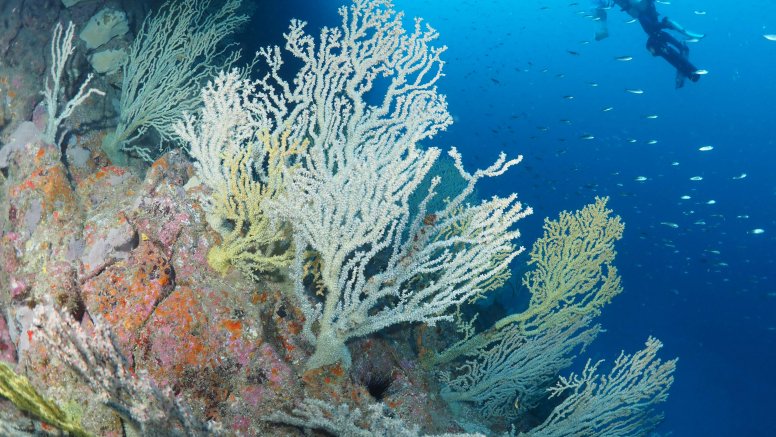
The Chinijo Archipelago Marine Reserve and its circalittoral funds are established as the zero kilometer of the mesophotic habitats of the Canary Islands.
Due to the exceptional concentration of environments dominated by corals, the main bioconstructors of these marine funds of attenuated light, together with red algae and other invertebrates, this unique enclave contains the four large submerged landscapes highly representative of the circalittoral of the Archipelago:
- Belts of Antipathella wollastoni mainly between 50 and 70 m.
- Belts of several species of black corals (Antipathes furcata; Stichopathes spp.; Antipathella wollastoni) between 70 and 100 m.
- Belts of Stichopathes spp., and Antipathella sp., (a species to be described for science currently in the process of study) that develop from 90-100 meters deep in the detrital funds.
- Systems of submerged mountains that develop banks of zoantideos with organic skeletons between 40 and 70 meters.
In the rest of the Archipelago only the first two landscapes have been registered while in the proposed space it is just double. In addition, 15 mesophotic habitats of the Canary Islands have been explored and described in its seabed, several of them being novel for the Spanish Inventory of Marine Habitats.
This declaration is based on the projects:
- Descriptive ecological study of mesophotic corals in the circalittoral environment (habitat 1170): establishment of environmental monitoring stations in relation to Global Change; 2021.
- Characterization of the deep communities of zoantídeos (Savalia savaglia and Antipathozoanthus macaronesicus) in the environment of the Chinijo Archipelago”, 2020.
- Description of the state of conservation and restoration of the effects of fishing of Bajo de las Gerardias, Islote de Montaña Clara, of the Chinijo Archipelago”, 2021.
As well as in several scientific publications focused on the field of corals (Ocaña et al., 2015a; Ocaña et al., 2015b; Ocaña et al., 2018; Ocaña et al., 2019a; Ocaña et al., 2019b; Ocaña et al., 2020; Ocaña et al., in press, 2022; Rosales et al., in press, 2023).
Mesophotic habitats of the Canary Islands
The group of researchers that carry out this project has been working uninterruptedly for several years in the mesophotic habitats of the Canary Islands and is constituted by scientists from the University of La Laguna, the Government of the Canary Islands, the University of Granada, the University of Alicante and the FMMC; It also has the support of the companies CIMA and Aquawork for all the complex logistics of diving and measurement of oceanographic variables.
These works on submerged landscapes, their habitats, the associated biodiversity and the studies on corals are also coordinated by Dr. Ocaña Vicente and recognized expert in morphotaxonomy and descriptive ecology of corals, study of submerged landscapes and habitats and their ecological interpretation in relation to natural history and biological adaptation.
Due to the impacts detected in these environments, it is necessary to establish conservation plans for this unique space and authentic park of submerged landscapes and environments of attenuated light that constitutes a unique heritage of the biodiversity of the planet that needs to be preserved.
Montaña Clara as World Zero Kilometer of Relict Coral Banks
Under the Montaña Clara volcano, "spectacular and exceptional" concentrations of a rare coral species with unique characteristics develop, as it combines an impressive horny skeleton similar to that of black corals and the anatomical structure of zoantídeos.
It is a "peculiar" product of biological evolution that may have evolved thanks to the processes of capture of genomes throughout the convulsive geological history of the Atlantic Ocean since its inception in the Jurassic period (see Ocaña & Brito, 2018). The presence of thousands of colonies of this species distributed between two systems of submerged mountains formed around the islet of Montaña Clara, together with its beauty, rarity and scientific consideration as a relic, makes this enclave something extremely valuable and constitutes the biological monument associated with the most important submerged seabed of the Canary Islands.
The group of researchers in charge of these investigations and the project has been working uninterruptedly for several years in the mesophotic habitats of the Canary Islands and is constituted by scientists from the University of La Laguna, the Government of the Canary Islands, the University of Granada, the University of Alicante and the FMMC; It also has the support of the companies CIMA and Aquawork for all the complex logistics of diving and measurement of oceanographic variables. These works on corals are coordinated by Dr. Ocaña Vicente.
This enclave is suffering dramatic impacts due to fishing that takes place on this unique enclave. Therefore, we strongly advise that urgent preservation plans be established to conserve this place and help its regeneration as soon as possible.
Add La Voz de Lanzarote as a preferred Google source.
Stay informed with the latest current news.