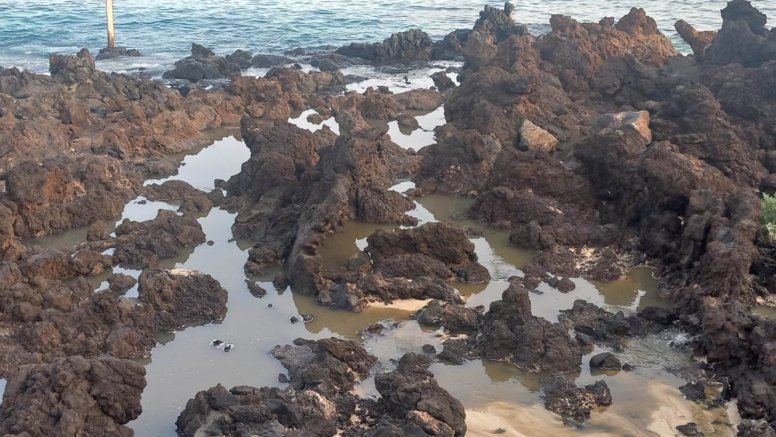
There are dozens of images of closed beaches on the island of Lanzarote for days throughout the last year due to wastewater discharges into the sea. Punta Mujeres, Playa Chica, or Playa Blanca have been some of the coastal points that have seen the red flag waving or banners placed to prohibit swimming until laboratory results are obtained that would authorize swimming again. In the midst of the climate crisis, the Canary Islands continue to dump most of the wastewater produced by its 2.2 million residents and more than 16 million annual tourists into the sea. Back in 2006, the United Nations warned that 80% of marine pollution came from land to sea and that if nothing was done to prevent it, the figure could increase, affecting ecosystems and the health of the population.
Spanish legislation requires a census of authorized discharges by the autonomous communities. According to the Natural Census of Discharges, updated in 2023, in Lanzarote alone, there are 77 authorized discharge points. Of these, most are urban and underground industrial. In addition, there are fecal waters from residential and tourist areas that are discharged into the sea through pipes and some submarine outfalls without authorization and, in many cases, without giving it the corresponding treatment.
Despite this, European directives on the treatment of urban wastewater strongly establish the obligation to treat all urban fecal waters of the member countries. In the Canary Islands legislation, the census of discharges has gone a step further and since 1998, authorized spills have been updated, but also unauthorized ones and those that are in the process of being processed. Through this census and with data from 2021, the Grafcan system shows that only between Costa Teguise, Arrecife, Puerto del Carmen, and Playa Blanca, several discharges into the sea that are not legalized are carried out.
"Is the law being complied with or not? Regardless of whether it is complied with or not, water is being put into the sea, with a lot of organic compounds, persistent pesticides, antibiotics, and parabens," adds industrial engineer José Luis Peraza in an interview with La Voz. The expert in wastewater management and natural treatment anticipates that "the Hydrological Plan puts dumping into the sea as a last option, but they have taken the last option as the first."
Among the unauthorized points, there are more than a dozen Wastewater Pumping Stations (EBAR), all of them dependent on Canal Gestión. For example, those of Jablillo and Playa Bastián until the record of three years ago discharged wastewater into the sea in situations of saturation, taking advantage of their rocky areas, without authorization and harming the bathing areas of the area. In 2021, their authorization was in process, but even now it does not appear in the National Census of authorized Discharges. The same happens with the Pretreatment EBAR, located in Las Caletas, which serves to treat the wastewater of Costa Teguise, but which is also not authorized. A more serious case is that of the EBAR of Las Caletas, which, even being active, did not have any type of authorization to discharge fecal water and was not processing it either.
Likewise, in the capital of Lanzarote, the Agramar EBAR in Arrecife is also not authorized. This pipeline was originally used for the discharge of cooling water from the company Agramar, but currently serves as an emergency overflow of the EBAR and reaches the sea very close to Las Arenas Beach in Arrecife.
"These discharges modify the habitat, the fish eat these wastes. To which we must add that these wastes generate a lot of algae, which end up being eaten by other fish and that produce diseases that are not harmful to fish, but are to humans," says wastewater treatment expert José Luis Peraza during an interview with La Voz. Among these pathologies are diseases such as ciguatera, a food poisoning caused by eating fish contaminated with ciguatoxins and that can produce gastroenteritis, but also cardiovascular and neuronal conditions.
"The situation on each island is completely different because they depend on the policies carried out by the Water Consortium in each of them, the amount of population, and the inhabitants it receives," continues industrial engineer José Luis Peraza. In the case of Lanzarote, it depends on the entity Canal Gestión Lanzarote, because the integral water cycle is privatized. In addition, Peraza indicates that "there are islands in which the superficial wastewater does not manage to take off, it stays spinning on the coast and does not manage to go badly inside. This is serious for bathers," he says, even for those who bathe with neoprene because "then they must disinfect it."
The coast of Arrecife, the point of the island with the most discharges
The Charco de San Ginés has three wastewater pumping stations that discharge without authorization into that body of water 500 meters long and 250 wide. The Ebar Alcorde and the Ebar Barquillo have pipes through which the wastewater comes out to the pond through the stone wall that delimits it. The Ebar Puntilla is also located in this area.
The coast of Arrecife is the point of the island that has the most registered wastewater discharge pipes into the sea. Specifically, three of them occur near El Reducto beach. The Ebar Casino, located in the Arrecife Yacht Club and managed by Canal Gestión, discharges the water through a retaining wall located next to the club's landing ramp; the Ebar Portugal and Las Buganvillas discharge the water on the promenade of Avenida Fred Olsen near the headquarters of the Cabildo, and the Cabildo's overflow also discharges through this area.
Likewise, the discharges from the El Cable Wastewater Pumping Station, which is not carried out directly into the sea, nor any of the three stations that operate in the neighboring town of Playa Honda, already in the municipality of San Bartolomé, are not authorized. In the case of Playa Honda, the discharges are made from the avenue and "a metal basket" has been installed.
The environmental and health effects do not only occur from unauthorized points, but also from those that are legalized. For example, Puerto del Carmen does have its submarine outfall authorized, from which untreated, semi-treated, and treated sewage is discharged, according to the census itself. This outfall is far from the coast, but it affects a bathing area. In the tourist town of Tías, the Ebar Kontiki, pending authorization, discharges wastewater at the same point as the rainwater network and flows into Los Fariones beach. Both are located in the Cagafrecho Special Conservation Zone.
Meanwhile, the Ebar El Muellito and Varadero flow near Playa Chica and are two unauthorized discharge points. In the case of El Muellito, it is a recreational underwater maritime fishing area and Canal Gestión reported in 2021 that discharges do not usually occur in this Ebar.
To conclude, Yaiza has an unauthorized submarine outfall on the Costa de Papagayo, from which the wastewater from two treatment plants and a pumping station flows. In 2015, it discharged an annual average of 68.5 cubic meters per hour of wastewater. However, Canal Gestión did not know at that time at what exact point it flowed.
Authorized discharges, as of 2023
In the case of La Graciosa, the National Census of Discharges does not contemplate any authorized discharge of fecal water into the sea, with updated figures from 2023. While in Lanzarote, authorized discharges are classified as: industrial or urban; and underground or surface.
On the island, there are several points of authorized underground urban discharges distributed by towns such as Órzola, Caleta de Famara, Arrieta, Guatiza, or Charco del Palo, but also spaces of social interest such as the Psychosocial Rehabilitation Unit or the military base of Peñas del Chache and also cultural, such as the Mirador del Río or the Cueva de Los Verdes. Likewise, the National Census of Discharges includes the authorization of a point in the Montañas del Fuego Natural Monument, corresponding to the Art, Culture, and Tourism Center located in the area, as well as two other nearby points. To this are added eight authorized points in the Protected Landscape of La Geria.
Spaces such as the Farmer's Monument have two authorized discharge points, one of surface industrial water and another of underground urban water.
The discharges from hotels and industrial areas
In Costa Teguise, there are six authorized underground industrial discharge points, all of them linked to hotels and tourist apartments. The same happens with Puerto del Carmen, where there are a dozen points of industrial discharges of underground water from the hotel and hospitality activity, as well as five authorized points in a zoo. In Costa Calero, there are four more spaces in which discharges into the sea are authorized.
In the case of Playa Blanca, there are three authorized points near Puerto de Marina Rubicón, as well as other authorized underground urban discharges related to two hotels in the area and a surface industrial discharge.
To this is added that in the industrial area of Arrecife and the Las Caletas power plant (Teguise), there are three authorized surface discharge spaces. Specifically, two of them come from the Punta Grande Thermal Power Plant and a third from the industrial area of the capital of Lanzarote. Also, other discharge points related to health services such as Hospiten Lanzarote.
"This is a problem that the authorities of our government have to solve and at least avoid any discharge into the sea, by law it should be prohibited. Peraza proposes the option of betting on the reuse of wastewater, but also on the creation of natural treatment plants suitable for each place. "We can do it because we are going to zero consumption and depending on the climate and the area, one option or another can be chosen," he continues, "natural treatment plants do not depend on external technologies that are very expensive, we do not pollute the sea and they are CO2 consumption holes, in addition to a source of oxygen. It couldn't be painted more beautifully," he adds.
Although there are currently no natural treatment plants in La Graciosa or Lanzarote, the engineer explains that the eighth island should have a natural desalination plant. "It is an emblematic place and natural treatment plants are made in the spaces with the maximum protections that exist and they have no discharge into the sea."
Add La Voz de Lanzarote as a preferred Google source.
Stay informed with the latest current news.