The IES Agustín Espinosa de Arrecife has become the first innovative center in Lanzarote to implement a new Baccalaureate model that is taught in the afternoons, with the option of semi-attendance classes and aimed at employed adults or those with personal difficulties.
The classes develop a training focused on students being able to self-organize during the course and establish their schedules according to their needs. "People who want to take exams for the Army or who want to go to University come," said the director of the center, Antonio Alonso, during an interview with La Voz. A model that offers the possibility of saving the two Baccalaureate courses for "life" and extending the training for a few years depending on the personal situation of each student. "One year I can choose three subjects and the next, another three," he revealed.
"We recently had a 50-year-old woman who finished with very good grades"
The system has paid off and works satisfactorily on the island, giving opportunities to people who have some complicated circumstance to combine their life with secondary education. "We recently had a 50-year-old woman who finished with very good grades and completed the course," revealed the head of the center.
It also has room for minors under 18 who have exceptional circumstances and cannot take the Baccalaureate in the morning. "For young people of 17 years old, it requires special authorization, but we continue to adapt to their needs," Alonso said about this possibility.
The director highlighted to La Voz that the population in Arrecife "is not fully aware" of the model that is implemented in the center. "Most citizens are unaware of the modality that we offer," he added. The most important thing for the model to succeed among students is the maintenance of "regularity", with which students comply despite having to continue working. "They know that the effort opens many doors for them at the labor level, something they appreciate," Alonso added.
"They know that the effort opens many doors for them at the labor level"
New figures in teaching centers
Over the years, the figures of professionals within educational centers have been changing, with new positions being incorporated such as the Equality and Welfare Coordinator and a Coexistence Management Team.
The Equality Coordinator, "has a hourly dedication and a commitment to the regulations themselves and our educational project." From his figure within the school, the coordinator proposes activities for specific days such as International Women's Day. "He has proposed a corner of feminism and equality in the center's library," he exemplified.
In addition, in a case of gender inequality in the classroom, the center takes the pertinent measures to stop these actions and above all sanctions with the aim of raising awareness and educating. "When someone does not act correctly or puts another person in a vulnerable situation, it is necessary to resolve it," he added.
"We try to intervene from training and cut off harassment at the root"
The coexistence management group also plays a fundamental role in the IES Agustín Espinosa. A team that consists of seven people, very prepared and committed, who deal with the problems that arise in the center, Alonso specified. They are aware of the problems that are created and once or twice a week, they are the ones who help solve them. "That leads to an improvement in the coexistence of the center, as well as with cases of harassment," he said. The moment a case of bullying is suspected or detected within the center, our action is rapid. "The philosophy we have consists of detecting it and preventing it as soon as possible," he added.
When it is decided to activate the Official Protocol of action against harassment, it means that the problem has gone too far. "When things get more complicated and there really is a very serious situation of vulnerability," he stressed. "We try to intervene from training and cut off harassment at the root," said the director of the Arrecife school.
The Welfare Coordinator also intervenes in the difficulties that arise among the students of the institute. "It is a very important particular figure," he stressed, that has been in the schools of the Canary Islands since 2010, always collaborating with the Coexistence Management Team.
Exhibitions in English for all citizens
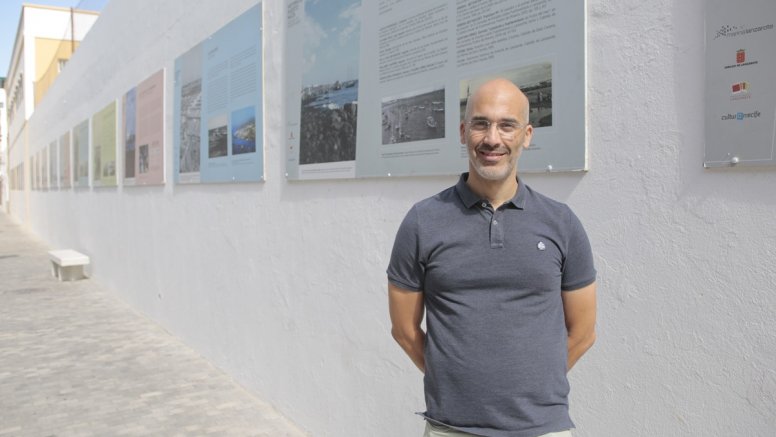
The Arrecife institute has also launched to promote public communication and social skills through guided tours of its students with the exhibition Knowing La Marina de Arrecife, which has been donated by Calero Marinas. Mario Ferrer is the teacher of the center, responsible for Heritage in the center and promoter of the cultural initiative. "We have hit the nail on the head with the initiative, both for the students and for the tourists" who visit the capital of Lanzarote.
An exhibition with twelve panels with photographs and information of some events and places that have marked the economy, history and culture of Arrecife. "They are completed with aspects of fishing or nature," Ferrer pointed out. For them it has been their "small grain of sand" for the city and its inhabitants. A work that speaks of social aspects, such as the migration of Canarians outside the archipelago or of well-known artists such as César Manrique.
The students of second and third year of ESO and Baccalaureate have had to expose the content of these panels to their classmates from other courses of the center. A project also aimed at the families of the students themselves and students from other centers such as CEIP Nieves Toledo. "We invite families to participate, with the importance of students developing the content and being able to defend themselves in public," Ferrer showed.
From the center there was a proposal to hold the exhibition in two languages, in Spanish and English. "The exhibition that was made in English had volunteer students who wanted to take their effort further," concluded the teacher.
Add La Voz de Lanzarote as a preferred Google source.
Stay informed with the latest current news.