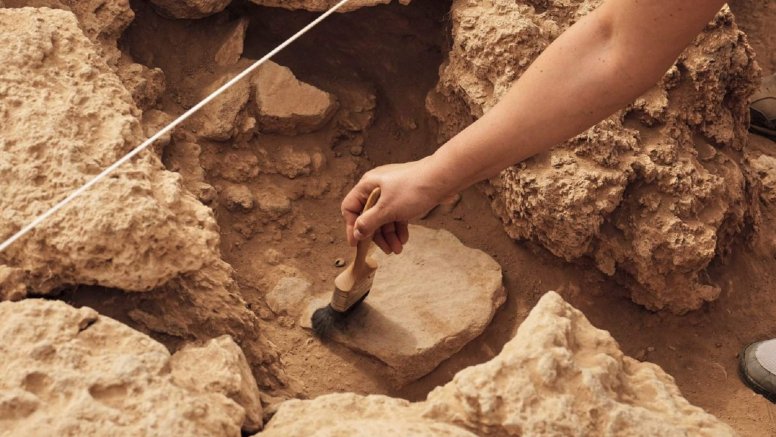
Forty years after its first excavation, the El Bebedero site, in Lanzarote, continues to offer surprises. In the first days of this year's campaign, what could be the oldest cistern, cistern or water tank on the island found to date has appeared.
The remains of the cistern, circular in shape and about a meter and a half in diameter, have appeared in the southern area of the aboriginal settlement, between strata III and V, dated from the 1st century BC. El Bebedero, together with Buenavista, both in Lanzarote, would be among the oldest sites in the Canary Islands.
The north wall of the cistern is semicircular and closes, "which suggests that it would have a vaulted roof," Pablo Atoche, professor of Prehistory at the University of Las Palmas de Gran Canaria and one of those responsible for the research at the site, along with archaeologist Ángeles Ramírez, tells EFE.
Both work on the ground every summer with the financial support of the Teguise City Council through a subsidy granted to the Canaria Universitaria de Las Palmas Foundation. Pedro Méndez and Elena Hernández, historians and archaeologists, are also investigating the site.
You can also see a stone slab, which would serve as an alcove, on one side "with the stone blocks locked with mud to try to cover the cracks," says Ramírez.
The floor is hardened earth, without slabs. Atoche points out that it is the first time that a cistern associated with an indigenous settlement has been identified.
Inside, a large number of remains of land snails have been found, which indicates that it was a space with a lot of humidity. The settlement's rooms are located higher up.
A trapezoidal basalt stele with an altarpiece engraving has also appeared.
The geographer Antonio Bueno, who is scanning the settlement, points out that the structure of the deposit and its south-facing orientation, which guarantees the greatest number of hours of shade, suggest that it was water for human consumption, so as not to drink from the same place as the animals.
El Bebedero is an aboriginal settlement that would host several families, with rooms for sleeping and cooking, which resemble what has been called the deep houses.
It would be an original settlement, sought after for its location: in a protected area, with vegetation and water, as well as great visibility over El Río, the arm of the sea that separates Lanzarote and La Graciosa.
The settlement was also the scene of various exchanges between the aborigines and the Roman or Romanized population that sailed through that area between the 1st century BC and the 4th century.
The remains found and the dating confirm, according to the researchers, this relationship for at least five centuries.
The sailors needed water, food, such as cereals or meat and skins, and could provide wine, oil or salted products, which they transported in amphorae whose remains have appeared at the site.
Regarding the skins, Atoche considers that there is a room that could be used to work the skin or to store it, due to the discovery in it of different polished stone tools used to cut and tan it.
Goat skin was important both for shelter and for making tools and even weapons.
Throughout these 40 years, numerous Roman objects have been found, such as iron, copper or bronze metal tools, vitreous elements such as necklace beads and amphorae, which allow for a more exact dating since each type of these objects responds to a specific era.
There are also remains of aboriginal pottery modeled by hand with traces of charcoal and all kinds of animals: from the Canarian clam (now disappeared), limpets, fish vertebrae, terrestrial mollusks, some birds, dogs, and especially goats, sheep and pigs.
"The dating of the Roman elements coincides with the carbon 14 dates," says Atoche. "It is not a matter of one or two dates, we have a series of 40 different dates," he adds.
The dates of the amphorae coincide with the dates obtained from samples of different nature, such as bones, sediments, coprolites or charcoals and have been carried out in three different laboratories "providing all very similar dates, consistent with each other and located between the 1st century BC and the 4th century," he assures.
Add La Voz de Lanzarote as a preferred Google source.
Stay informed with the latest current news.