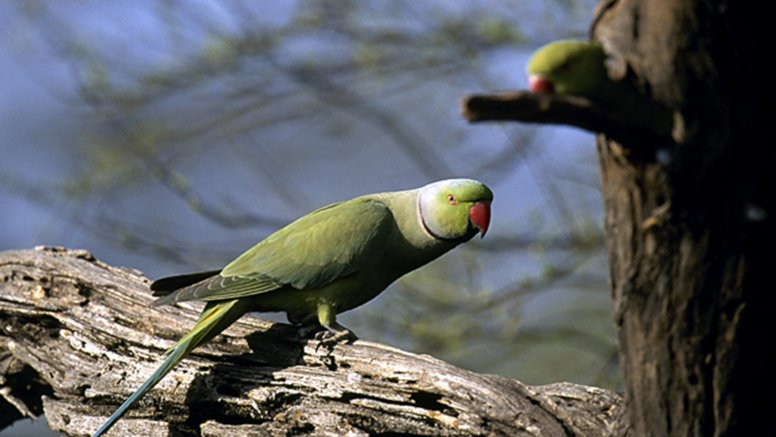
The good climate, their keeping as pets and the availability of food are some of the factors that have caused the Rose-ringed Parakeet (Psittacula kramerise) to have reproduced at the speed of light in Lanzarote and the rest of the Canary Islands, which has turned this species into an invasive bird in a very sensitive archipelago with wide endemic biodiversity.
The Kramer's parrot is an exotic species, that is, one that is in a place after having arrived directly or indirectly, whether intentionally or by chance," explains biologist Adrián Flores. "Invasive species are those exotic ones that establish themselves in a place and cause economic or environmental problems," he continues.
It was in the seventies when the first specimens were introduced in Spain, rapidly expanding through areas such as the Canary Islands, the peninsular interior, Andalusia, and the Mediterranean coast. It should be remembered that it is a species originating from Africa and Asia.
It is a bird of the parrot family that lives in trees and for this reason in Lanzarote and the rest of the islands it is very common to see them in parks, gardens or golf courses forming small groups of less than twenty individuals. However, hundreds of individuals can gather to look for food, even though it is a sedentary bird that settles in an area. Its size reaches 40 centimeters and its plumage is green and yellowish tones.
According to the expert, "the good climatic conditions, the availability of food, and not having a predator that threatens it, despite some hawk that hunts some specimens", has made the Canary Islands the perfect habitat for the proliferation of the Rose-ringed Parakeet.
Concentrated in tourist areas
In Lanzarote, we can observe these birds in the gardens and parks of tourist areas such as Puerto del Carmen due to the presence of trees and palm trees. "It does not usually venture into natural environments because there is not as much food available, so it usually stays in urban areas where there are more palm trees to feed on and make cavities for nests," points out Adrián Flores.
This represents, within the problem of being an invasive species, "good news", since it prevents the endemic fauna of the islands from being affected. And it is that the Rose-ringed Parakeet feeds on fruits from different palm trees and trees and, despite being a granivorous species, it can also feed on almost anything it finds. "We try to corset what they feed on or not, but then, for example, we see videos of seagulls eating rats or rabbits," he indicates.
Furthermore, the increase in the population of this bird has also been accompanied by its closeness and lesser fear of humans. The reason has been feeding by residents and visitors to the parrots, which has further aggravated the problem.
Problems that cause their nesting and squawking
As an arboreal species, its nesting occurs in trees such as Canary Island date palms, a species endemic to the Canary Islands that is greatly affected. The reason is the location of its nests, as it "makes cavities in the trunks".
"In some areas it is being a problem because it makes these cavities in palm trees and competes with other species of birds like blackbirds, which already have their nests, and displaces the nests to keep the cavity," asserts the biologist.
On the other hand, the squawks they emit are high-pitched and strident, which is a major inconvenience in urban areas where a large number of specimens are concentrated.
Lack of measures to prevent its expansion
Despite the serious problem facing the islands, no effective or significant measure has been taken to solve it or curb the expansion of the rose-ringed parakeet, with the exception of the capture of some specimens in places like La Palma or Tenerife to relocate them to animal protection centers.
However, Flores warns that action has been taken "late", as its population has increased considerably since its introduction. In the case of San Cristóbal de La Laguna, he explains that the city council did not want to capture these birds, but rather to use contraceptive feed, something that is unfeasible because "it is not selective, as you do not know if only the parrot will eat it".
"The main solution, not only for parrots, but for all invasive species, is to try to prevent them from entering," he assures. Here comes into play the catalog of invasive species, which does not include certain species and which, if they are not included, "technically you cannot prohibit someone from introducing that species."
In the event that the problem is serious, as is the case, the solution involves taking measures to control the situation and prevent it from worsening.
Other invasive species in Lanzarote
Kramer's parrot is not the only invasive exotic species that exists in Lanzarote and that has unfortunately settled on the island. In the case of flora, there are two species that the expert indicates that "we have identified as ours due to their history and use, but which cause a big problem".
These species are the prickly pears and the agaves, since their origin is Mexican and they are classified as invasive in the Canary Islands. "Many people do not know that, unless you have a farm with certain requirements and controls, you cannot have a prickly pear at home," he says.
Add La Voz de Lanzarote as a preferred Google source.
Stay informed with the latest current news.