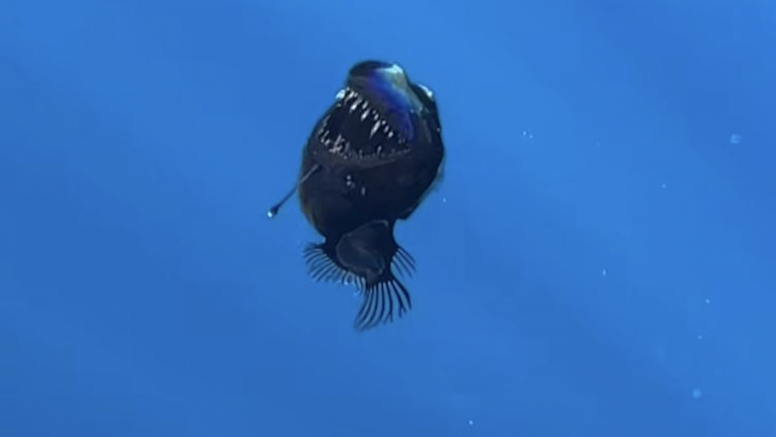
An international study led by the Institute of Environmental Science and Technology of the Autonomous University of Barcelona (ICTA-UAB) indicates that the decrease in oxygen in the oceans threatens the survival of deep-sea fish and the health of the oceans themselves.
The conclusions of this study have been published in the journal Communications Earth & Environment, and point out that "the progressive decrease in oxygen levels in the oceans is intensifying due to climate change".
This significantly affects marine ecosystems, including mesopelagic fish populations, and can also alter marine food webs, fishing, ocean health and the ability of these to store carbon.
This phenomenon can have serious repercussions on marine food chains, on fisheries globally, and on the balance of ocean ecosystems.
Lantern fish
The study analyzes how marine ecosystems reacted to deoxygenation episodes that occurred in the past and, to carry it out, the researchers studied fossils of lantern fish, one of the most abundant and important species in the deep ocean.
These fossils are more than 10,000 years old and were preserved in marine sediments of the eastern Mediterranean.
Lantern fish are very small deep-sea fish of the family Myctophidae, named for their ability to produce light through bioluminescent organs.
Despite their small size, lantern fish are extremely abundant in the global ocean, with an estimated biomass of 600 million tons, which possibly makes them the most abundant vertebrates on the planet if weight is taken as a measure.
During the day, lantern fish live in the dark mesopelagic zone (between 200 and 1,000 meters deep) to hide from predators, while at night they swim to the surface of the ocean to feed on zooplankton.
An important role in climate regulation
Due to both their large biomass and their daily vertical migration, lantern fish play a very important role in climate regulation and in oceanic food webs, because they connect the surface with the deep ocean.
Therefore, lantern fish are widely considered a good indicator group of the health of the mesopelagic ecosystem.
The fossils analyzed show that these species disappeared almost completely during periods when ocean oxygen fell to very low levels, and only reappeared (and in large quantities) when ocean oxygenation was restored, about 6,000 years ago.
The team that carried out the study includes researchers from the UAB, the Scripps Institution of Oceanography and Woods Hole Oceanographic Institution of the USA, Academia Sinica of Taiwan, McGill University of Canada, the Free University of Berlin and the University of Heidelberg of Germany.
The researchers used the so-called otoliths (structures of the inner ear of fish) to track how marine populations have changed over time.
The impact of marine deoxygenation
The sediments of the eastern Mediterranean, a region that has alternated phases of high and low oxygenation, made it possible to clearly observe the impact of these events on marine biodiversity.
The main researcher of the study, Sven Pallacks, explains that "the case of lantern fish is a clear example of what can happen on a large scale if marine deoxygenation continues."
"If these very abundant species can disappear, many others are also at risk," warns the researcher.
The twilight zone - the mesopelagic zone, located between 200 and 1,000 meters deep - plays a fundamental role in the Earth's climate system, mainly due to its influence on the global carbon cycle.
The results indicate that mesopelagic ecosystems are especially vulnerable to oxygen loss.
Its collapse could destabilize the ecological balances of the ocean, reduce the sea's ability to absorb CO2 and endanger the food security provided by oceanic fisheries.
Add La Voz de Lanzarote as a preferred Google source.
Stay informed with the latest current news.