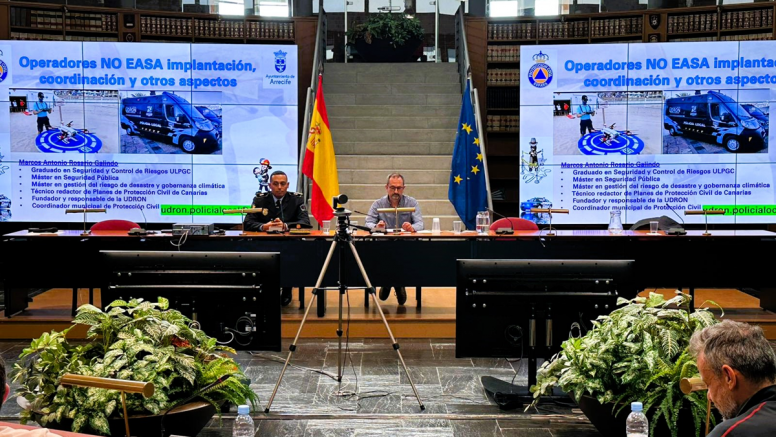
The National School of Civil Protection, in Madrid, recently hosted the third conference on Drones in Emergencies: Regulatory Framework, Uses and Trends. A professional meeting that brought together, in Spain, the most prominent professionals working in the use of drones and emergency and security assistance to the population.
This conference, organized by the General Directorate of Civil Protection, was inaugurated by its director, Antonia Garcés de Marcilla Val, who emphasized "the importance of these initiatives at a key moment of regulatory updating in the sector".
The event included the participation of high-level speakers who shared their experience in the use and regulation of Unmanned Aircraft Systems (UAS). The first presentation was given by Francisco Javier Muñoz Sánchez and Francisco Javier de la Morena Vicente, members of the UAS Division of the State Aviation Safety Agency (AESA). In their presentations, they addressed the national and European regulations applicable to operators not regulated by the European Union Aviation Safety Agency (EASA). During the intervention, the latest updates to the legal framework were highlighted, providing the key changes introduced by Royal Decree 517-2024.
This decree regulates not only UAS operations under EASA jurisdiction, but also those that fall outside, such as security, search and rescue, and firefighting activities.
Featured Presentations
Next, Rafael Peco Macías, head of the Operational Coordination of Airspace (COOP) Department of ENAIRE, offered a technical presentation focused on aeronautical coordinations in controlled airspace. Peco Macías explained the new zonings of the airspace and how they affect drone operations, especially in emergency situations. His intervention highlighted the importance of coordination between air traffic service providers and security forces to ensure safe and efficient operation of drones in high-risk areas.
Finally, the last intervention was given by Marcos Antonio Rosario Galindo, officer of the Local Police of Arrecife, responsible for the Drones and Operational Robotics in Navigation Unit (UDRON), and Municipal Coordinator of Civil Protection of Arrecife.
Galindo, trainer of UAS pilots for security and emergency organizations of the Government of the Canary Islands and as Municipal Coordinator of Civil Protection of Arrecife, is a reference in the sector. In his presentation, he addressed non-EASA operators, focusing on the implementation and coordination of UAS in security forces.
Galindo explained how the Local Police of Arrecife, a body under the direct direction of Mayor Yonathan de León, has been a pioneer in establishing coordination mechanisms with the ATSP (Air Traffic Service Provider), allowing the execution of drone operations in controlled airspace, which is crucial in emergency scenarios. The city of Arrecife, as the capital of Lanzarote, is in an aeronautical easement zone due to its proximity to the César Manrique Lanzarote Airport.
As Municipal Coordinator of Civil Protection of Arrecife, Galindo emphasized the implementation of UAS in other forces and security bodies at the national level. During his intervention, Galindo shared his experience in drafting the Municipal Action Plan for Flood Risk in Arrecife (PAMRIA), highlighting the fundamental role that UAS play in the anticipation, response and recovery phases in the face of climate emergencies.
Likewise, he made a deep reflection on articles 15, 39 and 44 of RD 517/2024 of UAS, warning that these harm the interests of the groups of Local Police of Spain and, therefore, affect the general interest. This reflection opened a relevant debate around these regulations.
Mayor Yonathan de León, and the Councilor for Security and Emergencies, and head of Civil Protection, Kevin Cortés have valued that the municipal experience is presented from the city of Arrecife in these conferences developed at the National School of Civil Protection, which have been a success.
In addition, attendees have been able to learn firsthand about the latest developments in the regulation and use of drones in emergencies. The presentations of professionals such as Francisco Javier Muñoz Sánchez, Francisco Javier de la Morena Vicente, Rafael Peco Macías and Marco Rosario Galindo highlighted the potential of this technology to transform the management of critical situations. In addition, the importance of operational safety and inter-institutional coordination was consolidated as fundamental pillars for the future of UAS in emergency services.
Add La Voz de Lanzarote as a preferred Google source.
Stay informed with the latest current news.