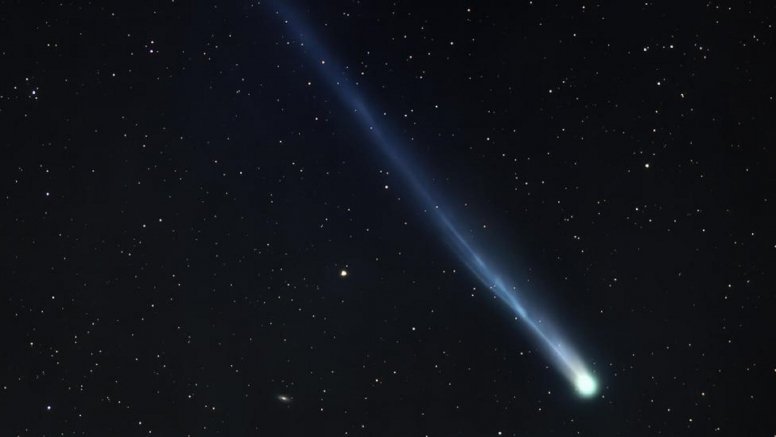
The Astrophysics Institute of the Canary Islands (IAC), along with other Spanish observatories, is participating in the monitoring of the interstellar comet 3I/Atlas, defined by the Ministry of Science as "an exceptional scientific event." This comet has been flying through our solar system for the past week.
This comet, coming from outside the solar system, can reach up to 245,000 kilometers per hour and has a diameter of between ten and thirty kilometers.
This past Thursday it reached its closest point to Earth, although it has not posed any risk to its inhabitants. Forecasts indicated that the closest point to the blue planet would be 270 million kilometers. In addition, its perihelion, or closest point to the Sun, will be 210 kilometers, when it orbits near Mars. At that time, it is expected to show greater activity and brightness and may be perceived by professional telescopes.
After that, it is expected to continue its journey through interstellar space.
The third interstellar comet
Comet 3I/Atlas is the third confirmed object of its kind to come from outside the solar system. It was detected at the beginning of summer, on July 1, 2025, by the ATLAS (Asteroid Terrestrial-impact Last Alert System) network in Chile. Studying it could allow us to analyze material formed in another star system.
Before this comet, two similar visitors were detected, Oumuamua in 2017, and 2I/Borisov in 2019.
International monitoring
Comet 3I/ATLAS is being tracked by a broad international scientific collaboration. The European Space Agency (ESA), NASA, and the International Asteroid Warning Network (IAWN), coordinated by the United Nations, are participating in its monitoring. In addition to the IAC, the Montsec Astronomical Park, the La Cañada Observatory, the Paus Observatory, and Light Bridges SL are also part of the latter.
Add La Voz de Lanzarote as a preferred Google source.
Stay informed with the latest current news.