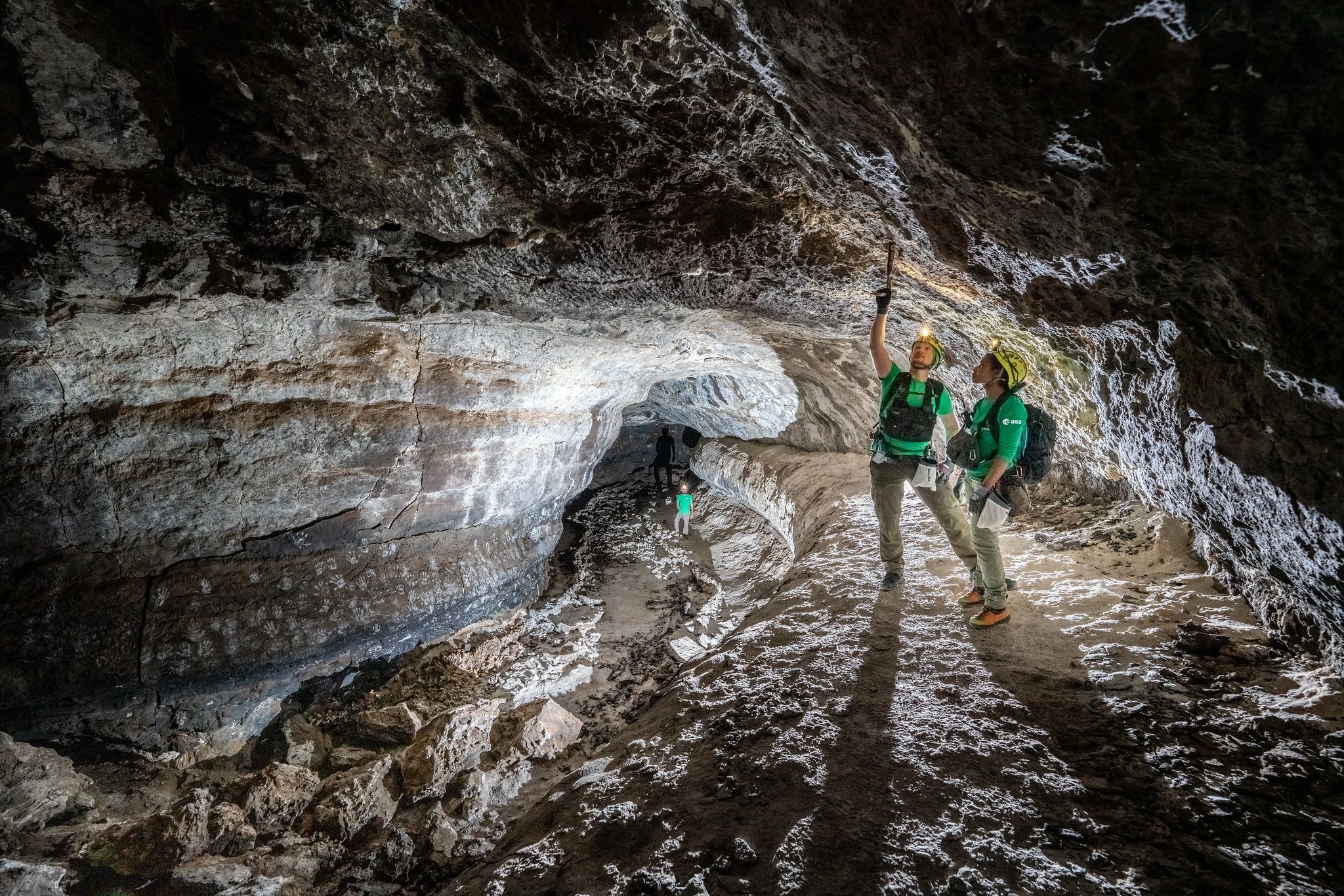
The surroundings of the Volcán del Cuervo hosted this Thursday the presentation of a training for astronauts. This is the fifth edition of the geological and astrobiological training program in planetary analogues for astronauts PANGAEA, which the European Space Agency has been carrying out for a few days in Lanzarote.
The Cabildo affirms that "all editions of the PANGAEA program have passed through the island" and that the European Space Agency is "very interested" in renewing the collaboration agreement signed in its day with the department of Geopark Lanzarote and Chinijo Archipelago for these trainings, which ends in 2022. In this way, they emphasize that Lanzarote "will continue to be in the focus of the space race for the next few years".
"We are very honored by the return of the European Space Agency on the occasion of a new training program," said the president of the Cabildo de Lanzarote, María Dolores Corujo, also expressing her satisfaction that "the uniqueness of our volcanic landscapes and their great resemblance to the lunar territory have made Lanzarote one of the best training grounds in the world for astronauts, geologists and scientists."
"It would be a great source of pride if our Geopark could continue to be useful for the exploration of the universe, since we have one of the best areas on the planet to study the links between volcanic activity and water, two key factors for the search for life," added Corujo.
"Lanzarote has a lot to offer, since its volcanic origin and its unique lunar and Martian landscape make it a unique geological museum," said the Councilor for Geopark Lanzarote and Chinijo Archipelago, Jorge Peñas, who also expressed his joy "because the European Space Agency will continue to practice on the island, preparing its astronauts and scientists for their future space missions and manned trips to the Moon and Mars."
"The space race is a field of scientific research and international cooperation that will take us to another level and from our small and beautiful volcanic island we will not be able to avoid a look of pride when we raise our eyes to the stars, with the satisfaction of feeling that we too have collaborated in these achievements," said Jorge Peñas.
Learning the best way to explore the Moon and Mars
For a few days, the astronaut of the European Space Agency, Alexander Gerst, and the veteran NASA astronaut and member of the select Artemis Team, Stephanie Wilson, accompanied by planetary scientists and engineers, have been preparing in Lanzarote to learn the best way to explore the Moon and Mars.
The training has consisted of a combination of theoretical classes and expeditions simulating missions in space, in which they have learned to function in geological environments, acquiring field geologist skills to obtain scientific data, recognize interesting rocks and assess the most likely places to find traces of life both on Earth and on other planets. In addition, they have learned how to communicate with the scientific team on Earth and tested technology for the future.
"We have been scientifically studying the island and taking samples to learn more about the Moon and Mars, which is fantastic," said the director of the PANGAEA program, Loredana Bessone, who has expressed her gratitude to the Cabildo de Lanzarote and the Geopark department for making this training possible.
In addition, Bessone has valued the landscape of Lanzarote not only for its similarities with the Moon or Mars, but for its level of preservation. "One of the most important things for space is planetary protection and here we can teach our astronauts how to do it," said the director of the PANGAEA program.
Geophysicist, volcanologist and, more recently, commander of the International Space Station in 2018, ESA astronaut Alexander Gerst has spent more than 5,700 sunrises and sunsets in space. In addition, he also carried out underground explorations as part of ESA's CAVES training in 2019.
"For me it is very special to be here, because when I was a child I had two dreams: to become a scientist and see what is inside this planet, and to be an astronaut and see what is beyond," said Alexander Gerst, expressing his excitement at being in a territory like Lanzarote. "It's crazy, my heart is racing to see so many volcanoes that I would like to explore," he said.
"We are also at a very important moment, because while we are talking the Artemis mission is already ready to go and in the future they will be able to go to places like the one behind me but in another place on the planet," added the ESA astronaut.
Precisely, the veteran NASA astronaut Stephanie Wilson, who also participates in the fifth edition of PANGAEA, is part of the Artemis Team, a select group that is preparing for future manned missions to the Moon. Thus, she could become the first woman to set foot on the lunar surface. In addition, she has participated in three space shuttle missions to the International Space Station and has recorded more than 42 days in space.
Add La Voz de Lanzarote as a preferred Google source.
Stay informed with the latest current news.