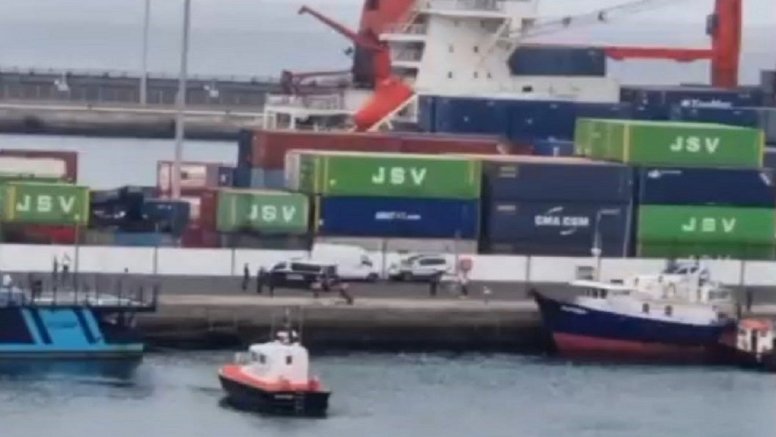
The fishing vessel 'Mathieu' seized by the Customs Surveillance Officials of the Tax Agency, in a joint operation with the National Police and the Judiciary Police of Portugal, in waters near Cape Verde has been towed to Puerto Naos in Lanzarote. The vessel was loaded with 1,000 kilos of cocaine that have been seized, an operation that has resulted in the arrest of its six crew members.
A boarding that was carried out by the patrol boat 'Fulmar' of the Tax Agency in the Atlantic Ocean, 600 miles from Cape Verde. An operation coordinated by the National Police and Customs Surveillance of the Tax Agency, through an investigation to find the exact point where the vessel was located.
The agents observed that the vessel, named 'Mathieu' and registered in the port of Georgetown, was sailing without a flag. From here, they requested confirmation from the authorities of Guyana of the registration of this vessel in their country and authorization for its transfer to the nearest Spanish port.
Forty bundles of cocaine on the stern deck
During the course of the intervention, the agents found forty bundles of cocaine on the stern deck, which are normally used for the transfer of cocaine hydrochloride. Given the facts, the agents arrested the six crew members of the fishing vessel, two of them of Albanian nationality and the rest of Guyanese nationality, and the securing of the vessel.
Once the detainees were transferred aboard the 'Fulmar', the towing of the fishing vessel began and its transfer in the Spanish vessel to Puerto Naos in Arrecife.
An investigation is the result of existing international channels for the fight against drug trafficking, through which information was received from the US agency, which warned of the existence of an international criminal organization that would try to carry out the transfer of a large amount of cocaine from one ship to another on the high seas.
The information available to the investigators coincided with that held by the Anti-Narcotics Investigation Units of the Judiciary Police of Portugal, so a joint operation was established to locate the exact transport of cocaine. With the alert received, the rapid interception of the vessel was designed as the most effective scenario to prevent the drug from being diverted in a diversified manner to Spain.
Add La Voz de Lanzarote as a preferred Google source.
Stay informed with the latest current news.