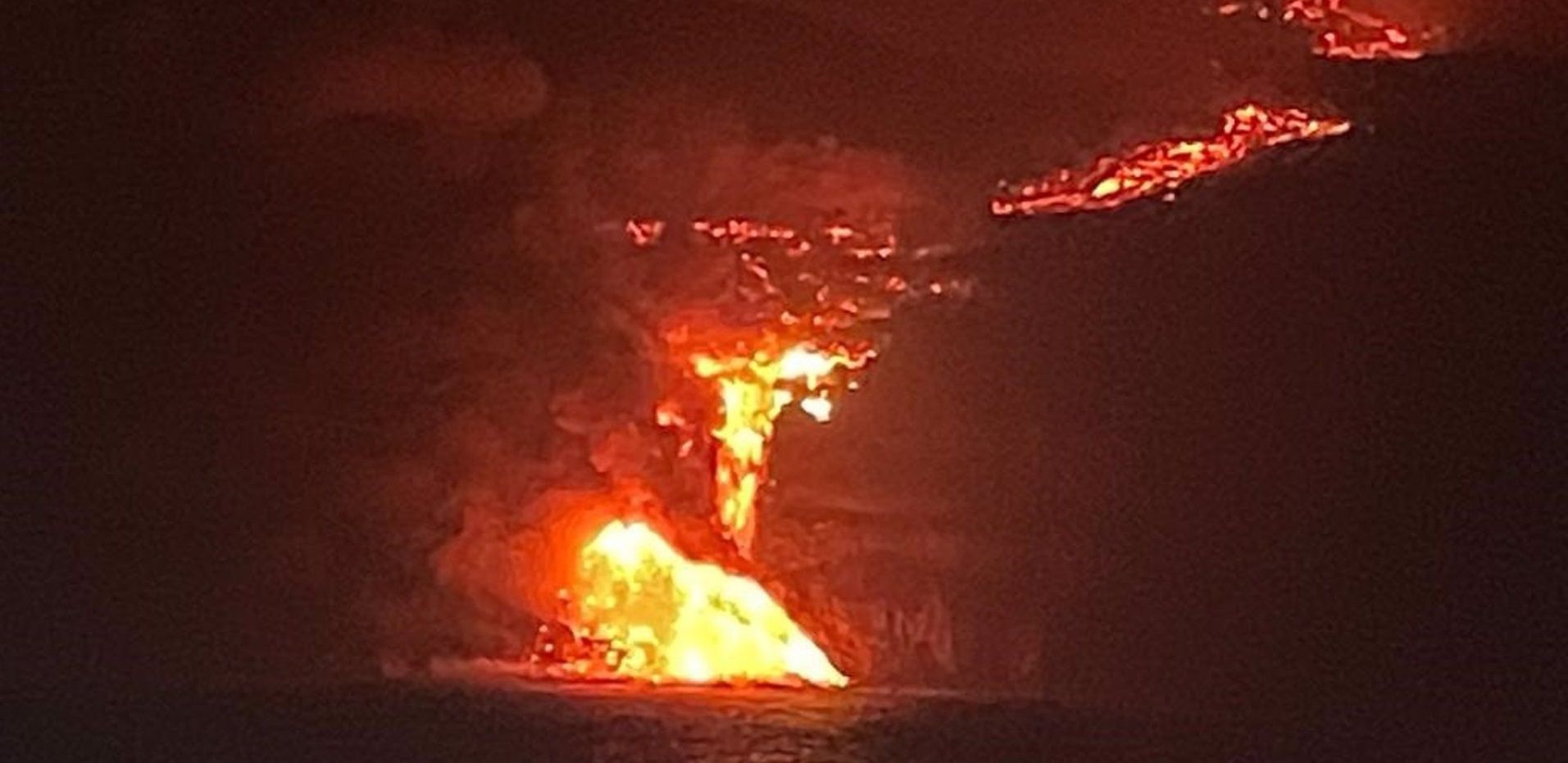
The north face of the Cumbre Vieja volcano cone suffered a partial collapse last night, which has resulted in the emission of lava flows in several directions.
According to the Volcanological Institute of the Canary Islands (Involcan), these lava flows are causing new damage as they pass and make it difficult for scientific teams to move around in the area.
As for the eruption, it continues to behave in the same way as in previous days, with a volcanic explosiveness that remains at level 2 on a scale with a maximum of 8.
Likewise, the emission of lava is concentrated in the centers of the main crater and it is not expected that another emission center will open outside this area, according to Involcan.
The ash cloud is heading south
Meanwhile, the latest report from the Volcanic Ash Advisory Centers (VAAC) in Toulouse indicates that the ash cloud caused by the volcano, which will be active for three weeks this Sunday, has been oriented towards the south.
In this regard, air traffic controllers have explained that the change of orientation that has taken place during the last hour has left the Tenerife area free, whose two airports -Tenerife North and Tenerife South- are operating normally, and since noon this Saturday also the one in La Palma.
Finally, the National Geographic Institute (IGN) has located during the night about forty earthquakes in La Palma, the most prominent one at 25.55 hours southwest of Villa de Mazo, of magnitude 4.1 and at a depth of 39 kilometers.
The 'seismic swarm' remains active to the south of the island, in the municipalities of Mazo and Fuencaliente, and average depths ranging approximately between 11 and 15 kilometers, although some have also been recorded at more than 30 kilometers.
Add La Voz de Lanzarote as a preferred Google source.
Stay informed with the latest current news.