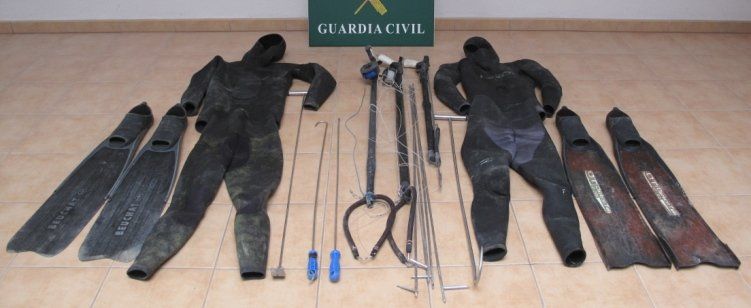
The Nature Protection Service (Seprona) of the Civil Guard in Lanzarote, reported on the 18th two people aged 35 and 36, of Spanish and foreign nationalities, both residents of Arrecife, for "practicing underwater fishing within the Marine Reserve", near La Graciosa, Montaña Clara and Alegranza. According to the Civil Guard, these two defendants would have been engaged in illegal fishing professionally since 2007, even publishing images of their catches on social networks. Therefore, the defendants would have incurred several serious and very serious infractions, which may involve fines of up to 60,000 euros.
The investigation began during the routine activities carried out by Seprona in its demarcation against illegal fishing and sale of fish from poaching. After conducting an "exhaustive monitoring of two offenders, they were able to verify that they routinely engaged in underwater fishing in the vicinity of La Graciosa, Montaña Clara and Alegranza, without respecting the protection assigned to the Marine Reserve of fishing interest", explains the Civil Guard.
Modus operandi
According to the Benemérita in its statement, the defendants were engaged in illegal underwater fishing since 2007 and "professionally". "They traveled to the reserve from Lanzarote in a zodiac of their property, equipped with rifles and other fishing equipment, in broad daylight, carrying out this activity since 2007, as they had administrative complaints since that year for carrying out illegal fishing detected by the Maritime Service of the Civil Guard," they relate.
Interception and complaint
Thus, on the 18th, Seprona intercepted that zodiac in which they were traveling. The two men were spotted by the agents from the moment they accessed the protected area and monitored for the 6 hours that the fishing lasted, "observing every detail of the transfer of the fish in the boat with the rifles used, unaware that they were being monitored from the Marine Reserve".
After observing these events, agents of the Civil Guard of Costa Teguise intercepted them in the Varadero de Caleta de Caballo, with the captured genre and the rifles on board. According to the Benemérita, they disobeyed the indications of the agents to proceed with their identification and refused to take the catches out of the boat, heading to Famara "to be able to fulfill the objective of throwing all the illegally captured fish into the sea to eliminate evidence". The Civil Guard finally intercepted the boat on Famara beach and there they were identified and "the arts used for fishing" were seized.
Serious and very serious infractions
The Benemérita states in its statement that these facts "are typified in several infractions" to the Canary Islands Fisheries Law. Specifically, the two defendants would have incurred several serious infractions, such as the "elimination or alteration of evidence that prevents knowledge of the commission of an infraction" or "the professional exercise of fishing activity without having the corresponding authorization". But, in addition, they would have committed very serious infractions for the "realization of activities not allowed in protected areas of fishing interest".
The sanctions for this type of infractions, indicates the Civil Guard, involve fines ranging between 301 and 60,000 euros for serious infractions and between 30,000 and 60,000 euros for very serious ones, in addition to the intervention of the ship and the seizure "of the arts and gear" used.
"It should be noted that the Marine Reserve of La Graciosa and Islets is the first marine reserve of the Canary Islands, created in 1995 and the largest in Europe, with 70,700 hectares. The purpose of the marine reserve is the protection, regeneration and development of resources of fishing interest for the maintenance of sustainable fisheries that allow artisanal fishermen in the area to preserve their traditional way of life", concludes the Civil Guard.
Add La Voz de Lanzarote as a preferred Google source.
Stay informed with the latest current news.