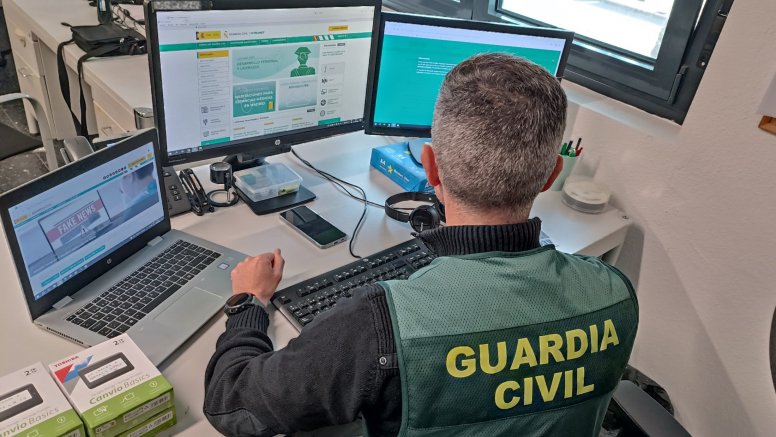
The Guardia Civil has investigated nine people of various nationalities as alleged perpetrators of several crimes related to cybercrime and money laundering within operation 'Guimaraes'. This is an increasingly frequent scam in the digital world.
Precisely this modality, known as Romance Scam or "love scam", consists of gaining the victim's trust by faking a stable romantic relationship. Once that trust is consolidated, the perpetrators begin to request amounts of money with different excuses and with the promise of returning them, something that never happens.
The investigation originated after the complaint of a person residing in Gáldar, who had been deceived by this method. From that first complaint, investigators began to detect indications that pointed to the existence of an organized group with a high degree of specialization.
Thus, with the progress of the investigations, a structured criminal group was identified, with knowledge in economic engineering and the use of banking networks. To do this, they created numerous accounts in different entities, both national and international, many of them opened with usurped identities or with falsified documentation. The objective was to move the defrauded money, make its trail difficult, and hide its final destination.
Furthermore, to avoid detection, several members of the group used multiple identities in both the banking sphere and in the use of telephone lines and other communication channels. This diversity of profiles helped to fragment the money trail and complicate the work of investigators.
Specifically, during the investigation it was found that they opened bank accounts in two ways: on the one hand, using false documents associated with non-existent identities; on the other, using falsified documentation corresponding to real people, whose identities had been previously usurped. By impersonating them, they managed to overcome the security controls of financial entities. This part of the investigation made it possible to identify three additional victims of identity theft linked to the operation.
Within the criminal engineering designed for money laundering, the group also used the payment of invoices for legitimate products. Specifically, they paid for orders of wine and construction materials to Spanish companies with international distribution, destined for West African countries, especially Nigeria. In this way, the money from the scams was integrated into apparently legal economic circuits.
As a result of the thorough police work, it was possible to identify both those responsible for managing the bank accounts used and the companies that finally received the illicitly paid merchandise. In fact, during the course of the investigation, carried out by the Judicial Police Team belonging to the Santa María de Guía Company, 22 bank accounts were initially analyzed. However, tracking the defrauded capital forced the analysis to be extended to a total of 57 accounts, managed through 30 different telephone lines.
Thanks to this work, and with judicial authorization, several of the accounts related to the criminal group that still had a balance were blocked, which will allow the main victim to recover part of the lost money.
On the other hand, it has been found that this group is linked to other cyber-scam cases nationwide, not only in the area of romance scams, but also through the method known as "Man in the Middle," in which criminals interpose themselves in communications between companies or individuals to divert payments.
Therefore, the Guardia Civil insists on the importance of not sending money to people with whom contact is only maintained via the internet if there is no absolute certainty about their identity and reliability. If you suspect you have been the victim of this type of scam, it is recommended to go to the police as soon as possible and file a report, setting aside the shame or guilt that sometimes prevents reporting what happened.
Finally, if you believe you may have been a victim of this network or a similar scam, remember that the Guardia Civil allows you to file complaints remotely through its official portal in cases of computer scams, theft, or loss of documentation, which facilitates the process and avoids unnecessary waiting at police stations.
Add La Voz de Lanzarote as a preferred Google source.
Stay informed with the latest current news.