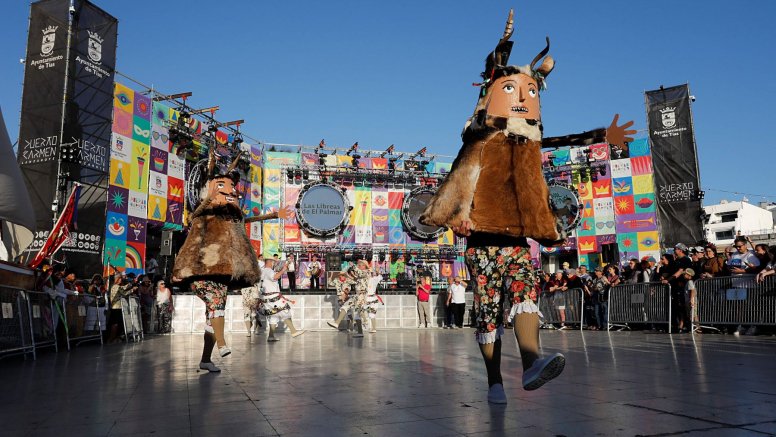
Thousands of people, including residents and visitors, enjoyed this Saturday the II edition of the Traditional Carnival of Puerto del Carmen. For the second consecutive year, the Tías City Council has trusted the solvency of the Parranda Marinera de Buches Association to jointly organize this event, one of the pioneering initiatives in highlighting respect for the ancient traditions of the Canary Islands associated with the entrudo, the ancient carnival, and other unique festivities of the archipelago, also counting on the essential collaboration of the Los Diabletes de Teguise Cultural Association.
The project, planned more than half a year in advance thanks to exhaustive work by the Department of Celebrations, allowed both the participating groups and the development of the carnival to proceed without incident, guaranteeing the quality and authenticity of each of the cultural manifestations present. As a result of this planning, there was also a notable group belonging to the realm of festive-ritual traditions of Tenerife, known as "las libreas," from the municipality of Buenavista del Norte: the Libreas de El Palmar.
The mayor of Tías, José Juan Cruz Saavedra, highlighted that the Traditional Carnival of Puerto del Carmen “is consolidating itself as a benchmark for respect for traditions in Lanzarote”, and thanked the Parranda Marinera de Buches for their willingness to collaborate with the Department of Festivals in carrying out this format. Likewise, he welcomed the cultural manifestation of the twin municipality of Buenavista del Norte, the Libreas de El Palmar, and the Cultural Association Los Diabletes de Teguise, whose participation was fundamental to the success of the day.
The event began with a parade that departed from the Playa Chica pier, where the president of the Parranda Marinera de Buches, Juan Antonio Machado Santana, arrived aboard a boat to meet with the president of Los Diabletes de Teguise, Víctor Padrón; the president of the Libreas de El Palmar; the mayor of Tías; the mayor of Buenavista del Norte, Eva García Herrera, and the councilor for Celebrations of Tías, Miriam Hernández. From there, the procession toured the Maritime Avenue, passed through El Porís, and ended in the Varadero square, where the event's host, Paola Delgado, welcomed each of the cultural manifestations, which offered demonstrations to the public.
Throughout the day, attendees enjoyed performances as emblematic as that of Los Buches, with their beloved Lola; Las Sábanas y Mascaritas, dancing to the rhythm of Chiquilla mía; the intervention of Los Diabletes de Teguise; the presence of the Toro de Tigua, accompanied by its last executor, Juan Parrilla Cabrera, and charanga music; as well as the participation of the visiting group, Las Libreas de El Palmar, who surprised with their tajaraste dances and the burning of the Devil and the She-Devil. Also present were the Dance of the Giants, possible thanks to the collaboration of the city councils of Arrecife and Teguise, and the traditional piñata game, a custom still safeguarded by the Asociación Parranda Marinera de Buches, in which dozens of children could actively participate.
The mayor of Buenavista del Norte, Eva García Herrera, expressed her gratitude for the treatment given by the Tías City Council to the group of Libreas, as well as to the Parranda Marinera de Buches for the care and coordination shown during their participation. For his part, the artistic director of the event, the artist and cultural manager David Machado, emphasized that "the interesting thing about these formats is that they are not an external recreation or an external product, but rather an encounter built with the bearer communities, with their associations and with the people who make up the traditions, to respect them and make visible the richness of the original culture of Lanzarote and the Canary Islands." In this regard, he also highlighted the voluntary work of dozens of people, essential for the event to achieve "the affection and dimension" with which it is developed.
In this way, Puerto del Carmen reaffirms its commitment to the safeguarding and dissemination of intangible cultural heritage, demonstrating once again that tradition and celebration can go hand in hand to offer a unique experience to both those who reside on the island and those who visit it.
Add La Voz de Lanzarote as a preferred Google source.
Stay informed with the latest current news.