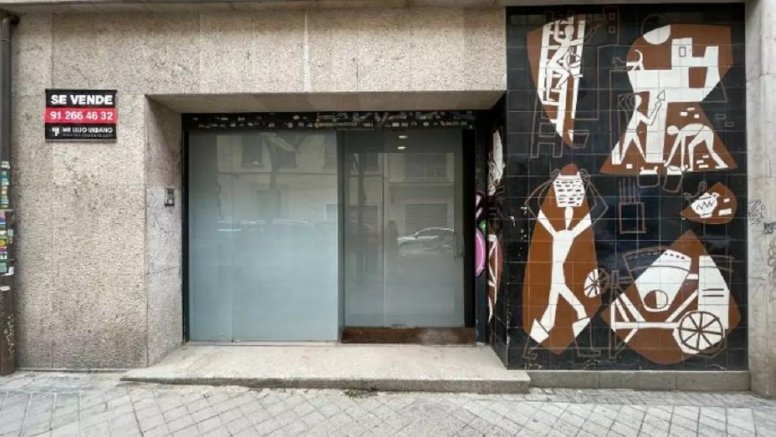
On Madrid's Calle de Santa Cruz de Marcenado, between the iconic Edificio Princesa and, ironically, the Casa de Canarias, stands for more than 70 years a mural by the Lanzarote native César Manrique (1919-1992), eaten away by dirt and the passage of time, and inspired by the world of construction.
Among stains, glued papers and peeling paint, Manrique represents a botijo and a cement mixer, and bricklayers climbing ladders, dragging sacks or carrying buckets on their heads, all captured with an austere palette of colors in a ceramic tile mural that is urgent to protect for several reasons.
Because it is the only work at street level that is preserved in Madrid of all those commissioned to Manrique by companies such as hotels and banks; because it dates from 1954 and accounts for a phase of the Lanzarote artist in which he connects with the avant-garde and with the new artistic trends of Madrid in the 50s, and because the premises in which it is embedded, at number 9 of Santa Cruz de Marcenado, is for sale and its future may be in danger.
This is explained to Efe by Violeta Izquierdo Expósito, professor at the Complutense University of Madrid and expert in Manrique's work, who emphasizes that it is a piece that "needs to be preserved as part of his legacy".
She asserts this after emphasizing that many of the creations that were commissioned to Manrique during his time in Madrid, where he came to study at the San Fernando Academy of Fine Arts, ended up being destroyed, among other things, due to lack of knowledge once the property or the company that made the commission changed hands.
"The person who arrives often doesn't know what's there," Izquierdo highlights.
She fears that this will happen with the mural on Calle Santa Cruz de Marcenado, which is larger than it seems at first glance: it not only covers a large part of the exterior facade of the premises for sale, but also enters the establishment, although that part is hidden behind a metal shutter full of graffiti.
According to the expert, it was commissioned to Manrique by a construction company, hence its iconography: bricklayers and typical elements of this sector are represented with a "quite figurative" aesthetic, although "a certain tendency towards abstraction" can also be seen.
The City Council is studying including it in the catalog of protected elements
Izquierdo explains that in 2022 Patricia Esquivias, a painter, contacted her and asked her to make a report on the mural on Calle Santa Cruz de Marcenado in order to, later, request the Madrid City Council to include it in the catalog of protected elements of the consistory.
Esquivias submitted the request in July 2022 to the Urban Planning area, and assures that, since then, she has not received a response and municipal sources tell EFE that the request is being studied.
The César Manrique Foundation also supports any measure that contributes to the protection and conservation of the mural piece, whether by declaring it an Asset of Cultural Interest (BIC) and restoring it in its original location or, if this is not possible, "acquiring it by some Canarian administration", as happened a few years ago with another mural piece, located inside a premises on Madrid's Calle Covarrubias.
In that case, the Foundation intervened with the owner of the premises and the Cabildo to facilitate the acquisition and subsequent removal of the piece, as finally happened, they tell Efe from the cultural institution.
Institution that, almost 30 years ago, in 1996, commissioned a report to know the very poor state of conservation of the mural of Santa Cruz de Marcenado, and that in 2018 formally addressed the community of owners of the building to know who the owners of the premises were and express concern about the state in which the piece was. The Foundation, however, never received a response to that letter.
Another milestone in the attempt to protect the mural by César Manrique occurred in 2022, when the General Directorate of Cultural Heritage of the Government of the Canary Islands showed its interest in processing, together with the Ministry, the protection, safeguarding or reproduction of the mural.
The Foundation collaborated with the parties by sending information about the piece, but "finally the efforts of the administrations did not consolidate in a practical sense."
Add La Voz de Lanzarote as a preferred Google source.
Stay informed with the latest current news.