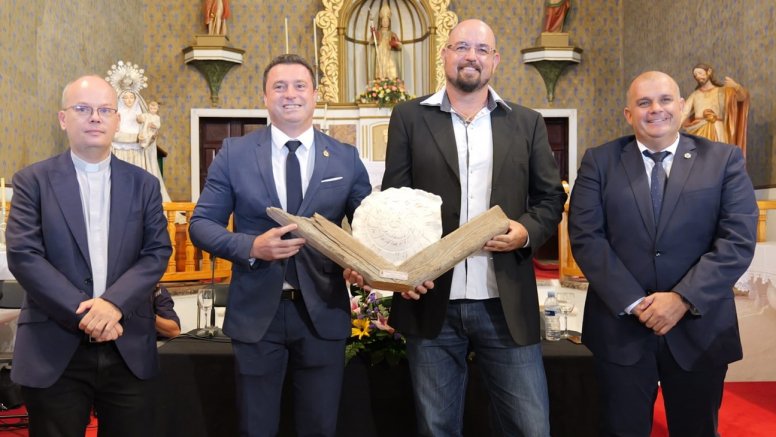
Biologist, writer and poet Ignacio Romero Perera (Nacho), one of the great environmental and cultural disseminators of the Canary Islands, was the town crier of the festivities in honor of San Marcial del Rubicón in Yaiza.
The reading took place on Sunday afternoon in the church of San Marcial del Rubicón. The parish priest of Yaiza, Jonathan Almeida, the mayor of the Yaiza town hall, Óscar Noda, and the Councilor for Festivities, Javier Camacho, shared attendance at the presidential table. Nacho began his proclamation accompanied by the chords of a song with the timple by Alexis Lemes entitled Viejo Ajache.
"Elongated hills with the taste of old earth, of low stature and cracked shield, a path between faded stones, masses of caliche, jable, dust and slabs. Everything is not broken basalt, I distinguish raised, broken and perforated beaches that distill their name, drawn in old corrals, the old and ancient gambuesa, I close my eyes and listen to the murmur of goats and sheep in social events, imaginary remnants of these communal pastures. I go up the gentle slopes of the hillsides, I dream of the mythical Maja lineage, the one that imprinted its soul on the stone, guarding its multicolored livestock hut. I glimpse old lime kilns, I implore in the cisterns of life, I savor in the salt ponds, shore on the shared border. I trot to the east and arrive at Puntagorda, I see Papagayo to the south, a large plain opens to the west, a place for gatherings, ball games and conjectures. Your summit reaches the sea, your summit reaches the land. Your summit is almost not a summit, peaks of colors abandoned like rust. Dry dusty roads, mirages of water and sea, weary rhythm of the thirsty. Quick escape of the mortal."
Nacho also recalled the course of an Employment Workshop, which he taught in Las Casitas de Femés during the course of 2005, recently arrived on the island after nine years absent due to his studies. For him it was an authentic exciting revulsive to caress the old skin of his Lanzarote again and walk through mountains, paths, ravines, plains, peaks, taros, caves in the municipality of Yaiza, which he shares with dedication and professionalism as a hiking guide.
The town crier also had Agustín Pallares Padilla very present, the great researcher of our island of Lanzarote. He spoke about its prehistory and toponymy, the meetings with him that transported him to other times and he was captivated listening to his stories, debating, consulting and contrasting toponyms. Nacho felt very grateful for Femés and its people, for how much they contributed to him: information, a lot of inspiration and above all a lot of affection, information that is reflected in all his publications where there are descriptions, mentions or poems linked to this beloved land of the south. It is a tremendously inspiring environment, from the top of La Atalaya where he fell in love with Femés and its vega, Janubio, the Isla de Lobos. Here, among others, the writer Rafael Arozarena was inspired, after his work stay in Femés where he wrote Mararía in 1973, a literary icon of the island and a classic of literature from all the Canary Islands.
At another moment of the proclamation, Nacho added the following anecdote: "I would like to close my eyes and have our hearts jump listening to the whistles of the shepherds of Femés in this church of San Marcial. An extinct tradition that is recounted in the book Canarian Customs, published in 1916, by the writer and journalist born in Yaiza, Isaac Viera. In the text Las Pascuas, he narrates how a priest bequeathed from Gran Canaria tried to end the tradition of whistling inside the church, which was carried out during the celebration of the Rooster Mass, every December 24. He describes how some of the shepherds of the town whistled during the kissing of the feet of the Child Jesus and the priest stamped the image on the bald head of the parishioner, leaving him dripping blood and destroying the image of the Child Jesus. In that same book this popular couplet is collected that remained after this event.
To the newborn child
the priest killed him
out of love for the fever
that he caught with the whistle.
All this and much more is collected in the proclamation of Nacho Romero Perera, which ended by raising a humble proposal to the Yaiza City Council, with a voice but without a vote, that in some way dignifies the importance of the town of Femés in history. The creation from the Consistory of a deputy mayor's office or councilorship with the name of Femés was proposed, without secessionist pretensions, only with an honorary purpose and perhaps greater sectoral management. In this way, the history of the disappeared municipality of Femés and its people would be enhanced.
With a long live Femés and San Marcial! the reading of the proclamation ended, after which the mayor Óscar Noda presented him with a sculpture as a souvenir.
Add La Voz de Lanzarote as a preferred Google source.
Stay informed with the latest current news.