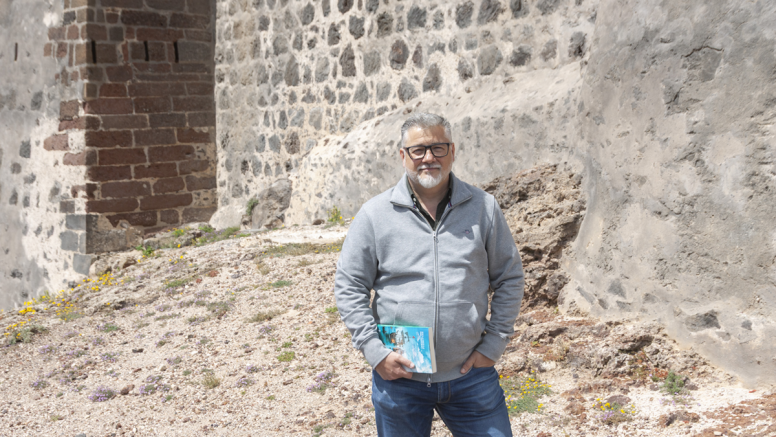
Lanzarote was one of the islands that suffered the most from corsair attacks between the 15th and 18th centuries. Unlike pirates who carried out attacks independently, corsairs did so under the flag of a nation. These lootings on the island terrified its inhabitants, as the corsairs devastated and stole whatever they found in their path. This part of the story is told in the book On the edge of the empire. Corsair attacks on Lanzarote (1586-1618), by Víctor M. Bello and Enrique Pérez, which has recently been published.
This book is the fourth edition by both authors on the history of Lanzarote because, as the writer Víctor M. Bello explains, "for some years we have been dedicated to locating documents about Lanzarote from the 15th, 16th and 17th centuries in peninsular archives because when the corsairs arrived, they burned the archives and all the documentation prior to 1618 disappeared on the island."
"At the same time that we were locating this documentation, we dedicated ourselves to doing a historiographical review because new updates had not been carried out for some time and this book is dedicated to the corsair attacks on the island because the last thing that had been done on the subject dates back to the 70s and had been done with documents kept in the archives of the Canary Islands," he says.
However, what both authors wanted to achieve with this book is to know why the attacks occurred because there were two that were very violent, those of 1586 and 1618. "We wanted to investigate the reasons why Lanzarote was not sufficiently protected against these attacks," Bello declares. To do this, they divided the work when preparing it. On the one hand, Bello went in search of the documents and Pérez transcribed them.
The documents have been compiled from archives in Simancas (Valladolid), where all the documentation of the Hispanic monarchy from the Middle Ages to the 18th century is kept, but they have also analyzed documents from Seville, Sanlúcar de Barrameda and some from the Canary Islands.
Attacks by Algerian corsairs
Among the landings, there were English corsairs but the most serious attacks of 1586 and 1618 were carried out by Algerian corsairs. When they arrived in Lanzarote, the inhabitants burned the archives, which is why the authors have to resort to documents from the peninsula. "They did it to hinder the administration because the archives kept all the documentation referring to, for example, municipal ordinances on what price bread or meat should be sold at, or also the property rights of each person," he explains.
This is something that, according to Víctor M. Bello, "we see today with the conflict between Israel and Palestine because many property records are burned and it is something very common throughout history."
In the case of the Algerian corsairs, they acted in the same way as, for example, the English, when capturing a mutiny, but having different religions, between the Christian corsairs and the Muslim corsairs they could capture slaves because a Christian could not enslave another Christian. The same thing happened with Muslims. Among themselves they could, so this was the main difference.
The attacks were usually very violent although they tried to avoid deaths. "In their landings, their objective was to capture people and take them to the port of Algiers, which was a huge point of sale for slaves, and when they captured them, they either gave the opportunity to pay a ransom to the relatives to return them or they definitely sold them," the writer points out.
Lanzarote was one of the islands most damaged by these attacks and the book details the authors' conclusions as to why. "We came to the deduction that it was in their interest that Lanzarote was not very protected because it was the first island that corsair ships passed through, although the main destination was always Tenerife and Gran Canaria because they were the richest islands, but they took advantage of landing in Lanzarote because they saw it unprotected and it was easy to capture people to then have an economic return," he asserts. This conclusion comes after analyzing more than 150 documents.
How the attacks were
When attacking Lanzarote, the corsairs knew the island very well and knew where they should land and attack. "The corsairs had spies just as the Hispanic monarchy had in North Africa to know their intentions, and they frequented the coast of Lanzarote and even often settled on the island of Lobos and La Graciosa, which allowed them to observe how the island was," he details.
In addition, among their ranks they also had Moriscos after being expelled from the Iberian Peninsula and they aligned themselves with the Algerian corsairs. "They had a lot of information about all the Spanish coasts," the author points out.
Likewise, as many slaves were brought to the Canary Islands from people who were captured in North Africa and taken to Lanzarote to work, "these served the corsairs as informants to tell them where the Lanzarote residents were hiding," he explains.
All of this gave the corsairs a very concrete idea of where, when and how to land on the island, which, normally, was on alert. "In fact, the ships always left Algiers around April 23, Saint George's Day, as they considered him a Muslim saint and, apart from that, it was the time when spring began and the maritime conditions were optimal to go sailing," Bello details. Despite everything, what was never known was the specific point where the attack would occur.
Book signing
The authors Víctor M. Bello and Enrique Pérez will be present at the Lanzarote Book Fair next Thursday, May 8, which will open at 5:00 p.m. The presentation of On the edge of the empire. Corsair attacks on Lanzarote (1586-1618) will be one hour later, at 6:00 p.m.
In the presentation, the authors will talk about the research process of the book and the objectives of the work that aims to answer why two such violent and close attacks occurred in Lanzarote.
Add La Voz de Lanzarote as a preferred Google source.
Stay informed with the latest current news.