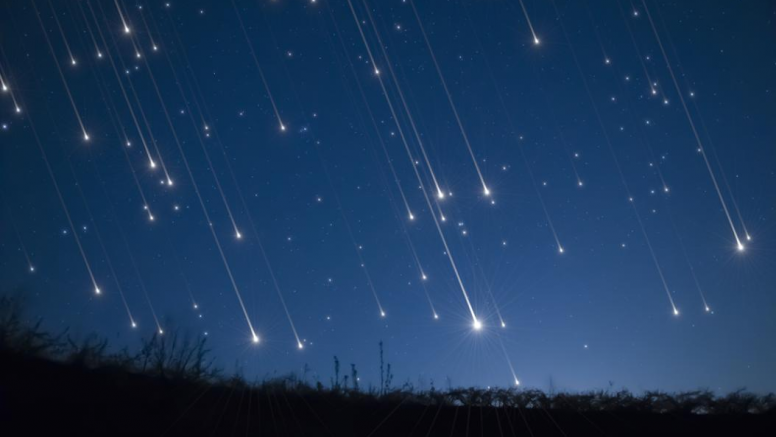
The Perseids is the astronomical name for the most intense meteor shower of the year and takes place every August, when the Earth crosses the orbit of comet 109/P (Swift-Tuttle), which in its last approach to the sun (in 1992) left a dense trail of suspended dust particles that formed part of its tail.
This "meteor shower", which is also popularly known as "Tears of Saint Lawrence" (because they occur close to the day of Saint Lawrence), occur when dust particles from the tail of that comet enter the Earth's atmosphere until they disintegrate at high altitude, producing multiple luminous flashes, each of which can last a few seconds, which is what we know as "shooting stars".
This year, the meteor shower will have its "maximum" of activity on the night of Wednesday, August 12, and will be visible from 10:00 p.m. to 3:00 a.m., although the night before and after you can also enjoy this celestial spectacle with somewhat less intensity.
At the beginning of the night they will be seen in the sky of the North and will be moving towards the west as the night progresses, below the constellation of Cassiopeia, very easy to locate due to its characteristic "w" shape.
"200 stars per hour"
On the night of August 12, it is expected to reach an activity of more than 200 meteors ("shooting stars") per hour, which will be seen crossing the sky at a speed of 50 kilometers per second and will be seen in all its splendor because it coincides with the New Moon phase and there will be a darker sky that facilitates the observation of the weakest meteors, and the weather forecasts are also good.
To be able to enjoy this meteor shower you only have to find a dark place, with the least possible light pollution, and away from buildings, trees and other obstacles that may hinder visibility, lie down looking at the sky and wait for the spectacle to occur. The beach seems like an ideal place to enjoy the shooting star shower. Also the mountain, but in the case of being in a city it will be best to access the highest possible site to get away from the lights.
It is not advisable to use telescopes or other magnifying optical objects, since with the naked eye you can observe the open sky with a more general view of the spectacle. And lights or lanterns should not be turned on, because the eye loses sensitivity. If you carry a flashlight, it is advisable to put a red plastic in front of it and not look directly at the light. And don't forget some water and a coat. It is possible that for several minutes nothing will be seen, but suddenly a great meteor shower can be unleashed.
Add La Voz de Lanzarote as a preferred Google source.
Stay informed with the latest current news.