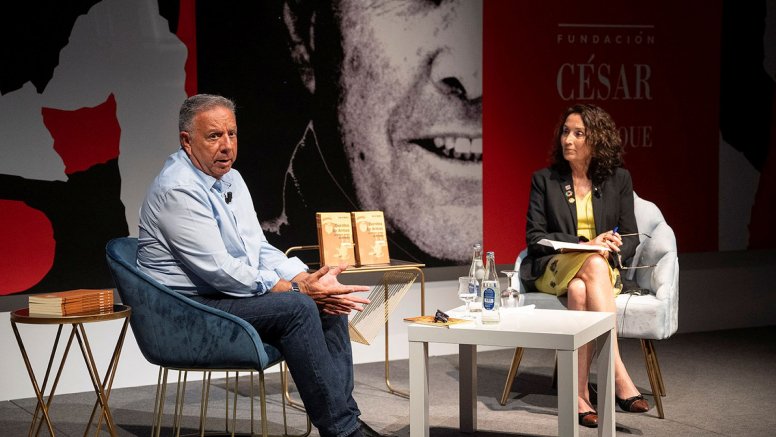
The César Manrique Foundation presented the book Dorotea de Armas. The Last Potter of El Mojón, written by Jaime Puig, on September 25 in the José Saramago room. With this publication—number 9 in the Islas de Memoria collection—the institution continues its work of recovering figures who have left their mark on the contemporary history of Lanzarote. It is also the first volume in the series dedicated to a woman.
During the event, Antonio Corujo, the protagonist of the collection's previous title, who had passed away the day before the event, was fondly remembered. On stage, a lit candle also served as a symbolic gesture of hope for Gaza.
The ceramist Toño Armas, a researcher of the painted pottery of El Mojón, opened the presentation with an exhibition on this artisanal tradition that is "manual, popular, and in the open air," typical of women. He explained that it is the only example of painted pottery in the Canary Islands, with two main production centers: El Mojón, the origin of the technique, and later Muñique, where Dorotea's ancestors moved.
Armas detailed the manufacturing process of these pieces intended for domestic use, which for decades met the basic needs of rural households. Over time, the arrival of cheaper and more accessible materials relegated the practice, which disappeared around the 1930s. It was not until the late sixties, with the rise of tourism, that Dorotea de Armas rescued the trade, adapting it to the new times without losing its essence.
After her speech, journalist Myriam Ybot, author of the prologue, spoke with Jaime Puig about the book's creation process. Puig recounted that he knew Dorotea from interviews he conducted with her for Radio Lanzarote, although much of that material was lost when the old recording tapes were reused. During his research, he rediscovered the figure of that woman whom everyone remembered "dressed in black, with a hat and dark glasses," and whose previous history was practically unknown.
Born in 1899, Dorotea lived in Las Montañetas, in Muñique, although popular memory always associates her with El Mojón, especially because of the famous pair of clay figures known as Los Novios de El Mojón (The Sweethearts of El Mojón). Puig visited the artisan's old house, now empty, where he says that "her presence still seems to float, now transformed into a memory."
The author proposed that, since the homes of the former potters are no longer preserved in El Mojón, that enclave could be turned into a space to pay tribute to the traditional ceramics of Lanzarote. He also recalled that Dorotea received all kinds of visitors in her house, from César Manrique to Alfredo Kraus, always with the same simplicity and hospitality.
For Puig, Dorotea's life was that of so many rural women of her time: marked by austerity, constant work, and the sacrifice of raising seven children with limited resources. In that sense, Ybot emphasized that the book also functions as a tribute to all the women of the Lanzarote countryside.
With the encouragement of a young Juan Brito, interested in learning traditional techniques, Dorotea returned to modeling clay to adapt to the taste of the visitors who came to the island. "The ceramics changed," Puig said, "but she remained the same."
The event concluded with an invitation from Myriam Ybot to read this work "full of poetry, tenderness, and respect for a woman who embodies the living memory of Lanzarote."
Add La Voz de Lanzarote as a preferred Google source.
Stay informed with the latest current news.