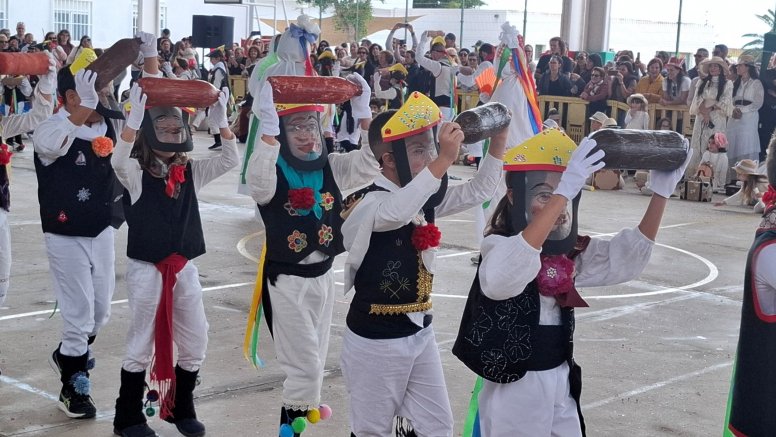
The student body of CEIP César Manrique Cabrera lived this Friday, February 13, an unforgettable day by becoming the absolute protagonist of a great carnival show lasting an hour and a half. More than 400 schoolchildren participated as actors, actresses, musicians, and dancers in a production that once again filled the Primary schoolyard with families and friends dedicated to the celebration.
The parade started after a few minutes of anticipation with a colorful procession that showcased the main traditions of the Carnival of the Canary Islands, represented by educational levels. The school's Batucada led the march, made up of sixth-grade students, who sported the Gran Canarian tradition of the Baile de Mascaritas, and fifth-grade students, who recreated the Majorero manifestation of Los Achipencos.
Fourth grade staged Los Carneros de Tigaday, an emblematic tradition of El Hierro, while third grade transformed into the Parranda Marinera de Los Buches de Arrecife. Second grade dressed in immaculate white to represent Los Indianos de La Palma, and first grade embodied Los Diabletes de Teguise. The students from Infantil, for their part, paid homage to the comparsas, one of the most deeply rooted expressions of the Carnival of Tenerife.
The show also featured the participation of the Batucada Menuda Caña, made up of grandparents and parents from the center, which provided the musical finale to the day. The dining hall staff also joined in, representing the traditional Burial of the Sardine, adding a festive and symbolic touch to the closing of the event.
The direction and coordination of this outstanding event for the educational community were carried out by the music teacher Antonio Monzón, in collaboration with the management team headed by Borja Eiroa Hernández. Both promoted the involvement of families in the creation of costumes, as well as in the rehearsals of the batucada and the choreographies.
The initiative more than met its objective: to transform the public school of Tahíche for a day into an authentic capital of the Archipelago's traditional Carnival, celebrating the cultural richness and identity of each island through participation and collective work.
Add La Voz de Lanzarote as a preferred Google source.
Stay informed with the latest current news.