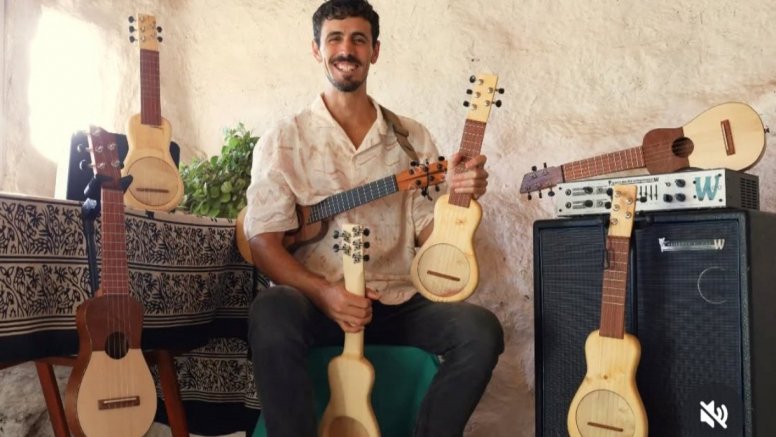
The fascination that timple player Pedro Umpiérrez from Fuerteventura feels for improvisation has given him new tools to adapt the most popular and representative instrument of the Canary Islands to other musical horizons, thus consolidating new forms of expression. Umpiérrez, who will be in charge of opening the XII edition of the Timple Encounter of La Graciosa on May 9, at 8:30 p.m., which is held in the Plaza de Caleta del Sebo, will offer the public in his performance a synthesis of the ductile experimentation that he has been developing and that we have been able to enjoy in some of the projects he has produced in which he has fused folklore and rap or explored the connections between the popular music of the Canary Islands and the Amazigh culture.
“More than a contemporary or modern repertoire, I consider it rather a very personal and original proposal”, explains the timple player about the set of pieces that he will undertake in his live performance. When composing, he confesses that he feels “like a child trying to mix and play with different elements and effects to see how they work. The question of instrumentation is important, with what elements you want to wrap yourself and feel accompanied. And how they are used,” he clarifies.
For the timple player who started with his father, Domingo Umpiérrez Chacón 'El Cuco', immersing himself from a young age in the musical tradition of Fuerteventura and later with Domingo Rodríguez 'El colorao', “if folklore is conceived in an honest way, it will always be evolving. It is part of its essence. It is as respectable that there are musicians who work with the legacy that already exists as the proposal of others who prefer to delve into popular sources and then travel the path of evolution or fusion. Everything is respectable if it is done with honesty. What we cannot do is stagnate and not be open to new possibilities. The musician by nature is an awake and restless person who feeds on experimentation to grow as a creator and be able to offer society an innovative discourse.” His studies at the Insular School of Puerto Cabras in Fuerteventura, where he began his music studies in the piano modality, were later completed at the age of 22 at the Professional Conservatory of Santa Cruz de Tenerife, where he graduated in the specialty of electric bass, under the guidance of José Carlos Machado.
Human value of music
“The timple has given me the opportunity to meet good people through music. It is a tool that helps you connect with many musicians with whom you decide to continue growing and enriching yourself. That is the human value of music,” he says. “I like to listen to all kinds of musical styles, from World Music to the imprint of improvisation, passing through the small, more acoustic formats,” warns the musician from Fuerteventura who will be accompanied in his recital by Fernando Angulo on drums, Gabriel Rodríguez on flute and Adán Moreno on guitar.
Pedro Umpiérrez believes that in the Canary Islands “despite having a powerful cultural program, clearly more important in the capital islands, there are many rural environments where people would be very grateful if more musical events were programmed. It is necessary for the town halls to show a certain predisposition to facilitate what is necessary without so much bureaucracy or limitations to organize outdoor concerts. The bonds of cohesion that are generated around these little moments create good experiences among the citizens,” says the timple player who every Monday, at the Pepe Fuentes club in La Laguna, dynamizes string classes “with the desire to create community and parties of people of all ages, to enjoy and live music and folklore sharing verses. To this dedication he also adds his classes at the Piccolo school in Santa Cruz de Tenerife and at the Tagoror Cultural de Agache in El Escobonal.
“I have always been involved in musical projects in which there was compositional creativity,” he adds. He has been part of bands such as BenDjembé, Sal Om Free, Pedro Umpiérrez Quartet and Rupatrupa, where he has ventured with the ancestral culture of West African drums, avant-garde jazz or singer-songwriter music. He has also collaborated in projects such as Calle Viana and Madai, in which the essence of flamenco roots marks the sound line.
He owns four timples for which he has affection, one of them given by 'El colorao', another by the teacher Andrés and two others from the workshops of the luthiers David Sánchez and Adán Moreno.
Add La Voz de Lanzarote as a preferred Google source.
Stay informed with the latest current news.