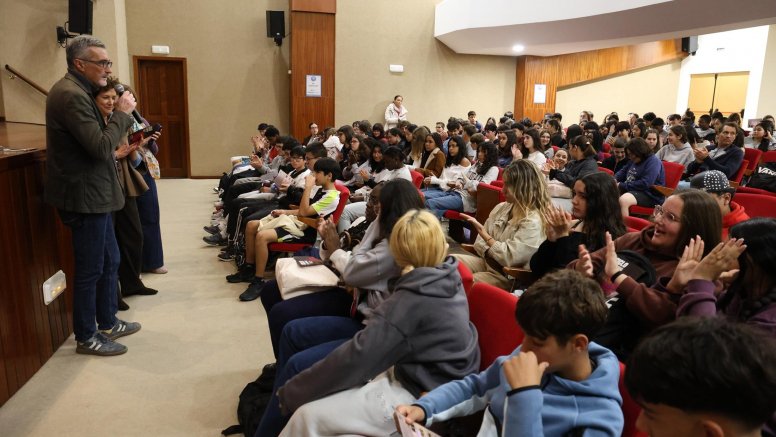
The Cabildo of Lanzarote, through the Comprehensive Women's Care Service of the Social Welfare and Inclusion Area, has organized a cycle of short films directed by women on the occasion of March 8, International Women's Day. The activity has been developed in collaboration with the CortoEspaña platform and is aimed at students of Compulsory Secondary Education and Baccalaureate from the island's educational centers.
The Assembly Hall of the island Institution hosted, in two sessions aimed at students, the initiative that allowed the screening of six short films with extensive experience in national and international festivals, some of them nominated for the Goya Awards, and which had the participation of 275 students in the first showing and 235 in the second, from different educational centers on the island.
The Councilor for Social Welfare and Inclusion of the Cabildo de Lanzarote, Marci Acuña, highlighted that “this cycle is part of the March 8 program and seeks to bring students audiovisual content that invites reflection on relationships, social roles, and the different realities many women experience.”
Acuña added that “cinema is a very effective pedagogical tool for working on values in classrooms. In this case, furthermore, visibility is given to the work of female directors who are developing a relevant career within the audiovisual landscape.”
Six short films directed by women
The programming has included six works directed by filmmakers who have obtained recognition at different festivals. Among them are two short films nominated for the Goya Awards: Sex at 70, by Vanesa Romero, and The Throne, directed by Lucía Jiménez.
The cycle was completed with Healthy Cure, by Lucía G. Romero; You Lied Amanda, by Eva Libertad and Nuria Muñoz; and the animated short films Lola, Lolita, Lolaza, by Mabel Lozano, and Interns, directed by Marina Donderis, Núria Poveda and Marina Cortón.
The short films address different social and personal themes from diverse perspectives, which allows for opening spaces for debate among students on equality, personal relationships, autonomy, or violence.
Add La Voz de Lanzarote as a preferred Google source.
Stay informed with the latest current news.