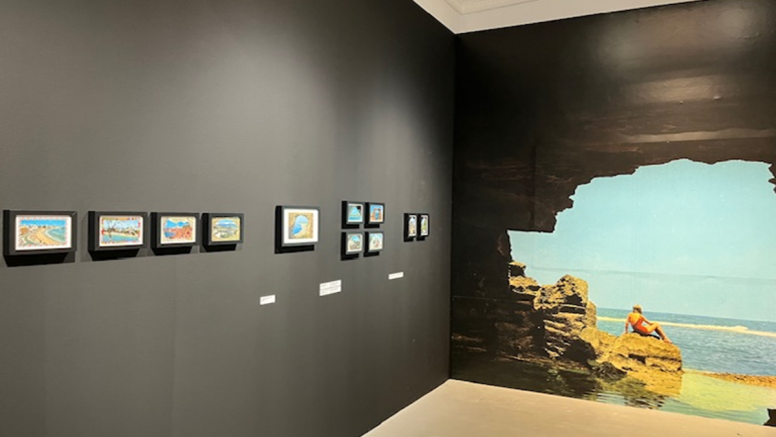
The exhibition Dialogue of Postcards, which has been on display at La Casa Amarilla, in Arrecife, since May 23. The exhibition, curated by collectors and university professors Cristina Arribas and Carmelo Vega, will close its doors this Saturday, July 20, after receiving a total of 1,383 visitors until yesterday.
Dialogue of Postcards aims to analyze the collecting of postcards, highlight the postcard with a diverse approach, and analyze the role of the postcard in the sublimation of places and tourist destinations that are visited, among other topics.
Those interested in enjoying the exhibition can do so throughout this week, and those who want to do so with a guided tour will have one last opportunity this Saturday, July 20 at 11:00 a.m., as that day the last one scheduled will take place. Guided tours are free but places are limited, so it is necessary to book in advance by calling 928 810 100 (ext: 3003). The person in charge of leading the visits is the cultural mediator David Machado Gutiérrez.
Admission is free and opening hours are Monday to Friday from 10:00 a.m. to 2:00 p.m., and from 2:30 p.m. to 6:00 p.m. Saturdays from 10:00 a.m. to 2:00 p.m. and Sundays and holidays closed.
A two-sided conversation
“Dialogue of Postcards” is designed in part as a “conversation” between two collections of historical postcards, those of the curators themselves: CA by Cristina Arribas (Barcelona) and CV by Carmelo Vega (Tenerife). Both collections, which total more than 40,000 copies, are especially focused on the period of development and the tourist boom in Spain, which took place from the late 1950s, with the oldest postcard in the exhibition being from 1957 and the newest from the early 1980s.
Faced with more classic options when classifying this type of exhibition, such as ordering by publishers, photographers or places portrayed, Cristina Arribas and Carmelo Vega have chosen to classify them based on the forms of visual representation, in such a way that it is ordered into five thematic blocks: Viewpoint, Framed Landscape, Pointing Out Postcards, Maps and Souvenirs.
The curators highlight that the two collections show numerous similarities, despite the fact that the postcards were conceived by different photographers, designers and publishers. In their opinion, the exhibition shows the similarities and parallels of the creators when reflecting that 'parallel world', idealized to please and attract tourists and visitors.
One of the common elements that Arribas and Vega highlight is that, due to the dates to which most of the images on display belong, that of the developmental era in Spain, the images on display are characterized by an abundant, overloaded use of color and pop imagery. The Councilor of the Data Center of the Cabildo de Lanzarote, Ascensión Toledo, has encouraged the people of Lanzarote to come and see the exhibition if they have not already done so. “In addition to being able to see some little-known postcards of Lanzarote and the Canary Islands, this exhibition allows us to effectively analyze how the publishers and authors of postcards sought to idealize tourist destinations, with the aim of attracting more visitors, but also of giving the postcard itself an aesthetic and cultural interest of its own,” Toledo declared.
Organized by the Data Center of the Cabildo de Lanzarote, this exhibition proposal is associated with the project “The paradoxical modernity: Artistic and tourist experience in developmental Spain (1959-1975)”, of the interuniversity research group, based at the University of La Laguna and with members from the Universities Jaume I, Castilla-La Mancha, Miguel Hernández, Goldsmiths (UK) and Marquette (USA): “The tourist experience: Image, Body and Death in the culture of leisure” (TURICOM).
Add La Voz de Lanzarote as a preferred Google source.
Stay informed with the latest current news.