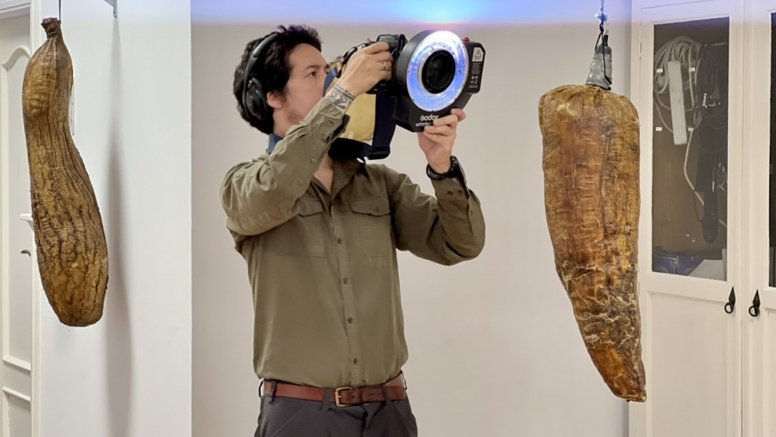
Lanzarote will take a decisive step in the protection of its intangible heritage thanks to the manufacture of 35 synthetic buches, exact replicas of the ritual artifact that defines the Entrudo arrecifeño, the oldest urban carnival in the Canary Islands.
The project, the result of the altruistic collaboration of the Lanzarote artist and researcher David Machado; of the Factum Foundation for Digital Technology in Conservation, of international prestige; of the Cultural Association Parranda Marinera de Buches and the Cabildo of Lanzarote, has the support in equal parts of the Centers of Art, Culture and Tourism (CACT) and SPEL-Turismo Lanzarote, and combines technological innovation and popular memory to ensure the continuity of a tradition documented since 1711.
The situation was critical: the restrictions on the Atlantic shortfin mako and natural wear and tear have reduced the original buches still in use to twelve. Without an urgent intervention, the emblem object, which runs through the streets of Arrecife hitting and marking the compass of the island, ran a serious risk of disappearing from the cultural landscape of Lanzarote.
During four intense days of work at the social headquarters of Los Buches, a team from the Factum Foundation composed of the curator and philosopher Sol Costales Doulton, the specialist in three-dimensional scanning Otto Lowe and the sound artist Nathaniel Mann digitized the historical buches through high-precision photogrammetry and recorded their acoustic particularities. With the data obtained, resistant prototypes will be produced that respect the shape, color and sound of the originals, ensuring that the street continues to rumble "as it did before".
The public filled the main hall of the Casa de la Cultura Agustín de La Hoz, a nineteenth-century building closely linked to the history of the carnival and ceded for the occasion by the Department of Culture, to learn about the launch of the project.
The president of Los Buches, Juan Antonio Machado, and the young student and vice president Mencey Rodríguez explained the urgency of the initiative and the first actions undertaken. Then, four members, dressed in the traditional sailor suit, performed the batea, recalling the vitality of this collective memory. The day closed with a conference by Sol Costales Doulton, Otto Lowe and David Machado, who detailed the scanning methodology, the acoustic recording, the future rematerialization of the buches and the planned international projection for
2026.
The calendar foresees that the first facsimiles will be delivered to the Parranda in 2026 to be tested and premiered in the Old Carnivals of Arrecife and Lanzarote, together with its official presentation on the island. In addition, the Factum Foundation has sent a formal invitation to present the project in Oulu 2026, European Capital of Culture, a perfect context to exhibit a Canarian example of heritage innovation.
"Culture is our first line of heritage defense: by preserving the buches we affirm the island identity and demonstrate that collective memory can resist global homogenization by adapting to the contemporary world," emphasizes David Machado, promoter of the initiative.
The proposal not only guarantees the continuity of a festive symbol: it will launch educational workshops, strengthen cultural tourism and offer other communities a replicable model for safeguarding intangible heritage.
Add La Voz de Lanzarote as a preferred Google source.
Stay informed with the latest current news.